
Macropis nuda
(Provancher, 1882)
Dark-footed Yellow Loosestrife Bee
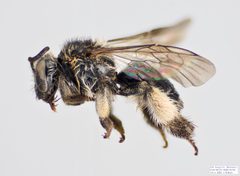
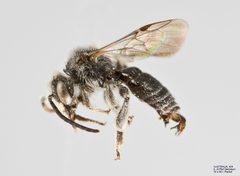
Macropis nuda is a small, ground-nesting solitary in the Melittidae, native to northern North America. It is a highly specialized oligolectic that forages exclusively for floral oils and pollen from Lysimachia ciliata (Primulaceae). The bee exhibits unique adaptations for oil collection, including dense white scopae on the tibiae that use capillary action to hold oils. It is , with offspring hibernating as pupae in cocoons until the following spring.
Pronunciation
How to pronounce Macropis nuda: /məˈkroʊpɪs ˈnjuːdə/
These audio files are automatically generated. While they are not always 100% accurate, they are a good starting point.
Identification
Distinguished from other bees by the specialized capillary-action scopae on female hind tibiae for oil collection, unlike the branched hairs used by most bees for pollen. Males identified by the completely yellow . Within the Macropis, all share oligolectic oil-foraging , but M. nuda is specifically associated with Lysimachia ciliata in its northern range. Distinguished from the cuckoo bee Epeoloides pilosulus (Macropis Cuckoo Bee), which parasitizes its nests, by the latter's different body proportions and lack of oil-collecting structures.
Images
Habitat
Ground-nesting found in association with its plant Lysimachia ciliata. Nests are constructed in shady areas of drier, sandy-loam textured soil, typically near loosestrife flowers. Females are particular about nest site selection, leading to aggregated nest distributions where suitable conditions exist.
Distribution
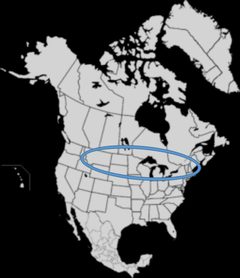
Native to northern North America. Historically recorded from British Columbia, Idaho, and Utah east to Newfoundland and New Jersey. Range appears to be shrinking due to climate change, with northern range limits contracting.
Seasonality
Active during the growing season when Lysimachia ciliata flowers. Males emerge from cocoons 1-2 weeks before females in spring. with single per year; active for approximately 2-4 weeks.
Diet
feed on nectar from various flowers for their own nutrition. Females collect floral oils and pollen exclusively from Lysimachia ciliata for larval provisioning. The oil is mixed with pollen to create a specialized larval food provision.
Host Associations
- Lysimachia ciliata - exclusive oil and pollen sourceOligolectic association; females forage exclusively for floral oils and pollen from this
Life Cycle
with complete . Females construct shallow ground nests ( up to 6.5 mm deep), line cells with floral oils, and provision with oil-pollen mixture before laying single white . Larvae develop rapidly, feeding for 10-14 days before pupating. Pupae spin cocoons and hibernate through winter. emerge in spring when temperatures increase. Males emerge 1-2 weeks before females (protandry).
Behavior
Females exhibit specialized foraging , collecting oil and pollen simultaneously from Lysimachia flowers during full sun conditions. They locate plants using volatile chemical cues, including diacetin, an acetylated glycerol that represents a private communication channel between plant and . Males patrol near nest aggregates and Lysimachia plants, attempting to mate by pouncing on females; mating is brief (1-2 seconds) and occurs only near host plants, never at nest sites. Females reject unwanted males by kicking with hind legs. Males rest on flowers while females sleep in nests. Females may reuse old nests or commandeer abandoned ones.
Ecological Role
Primary of oil-producing Lysimachia , representing one of the most specialized plant-pollinator mutualisms. The interaction involves exclusive dependency: the requires the plant's oils for , and the plant depends on the bee for pollination. This specialization makes the species vulnerable to plant decline.
Human Relevance
Subject of conservation concern due to specialized ecological requirements and apparent range contraction from climate change. Serves as a model organism for studying specialized plant- and chemical communication in pollination systems. The 's nest , Epeoloides pilosulus (Macropis Cuckoo Bee), is one of North America's rarest bees and was thought extinct until rediscovered in 2002, highlighting the conservation significance of the Macropis-Lysimachia system.
Similar Taxa
- Epeoloides pilosulusMacropis Cuckoo Bee; nest of Macropis nuda. Distinguished by lack of oil-collecting scopae and cleptoparasitic lifestyle. Females locate nests by smell of floral oils.
- Other Macropis speciesAll Macropis are oil-collecting oligoleges, but differ in geographic distribution and specific Lysimachia associations. M. nuda is specifically associated with L. ciliata in northern North America.
More Details
Nest construction
Nests are compact and shallow, with burrows 3.0-3.5 mm in diameter. Entrances concealed by dried leaves, twigs, rocks, or low-growing plants. and burrows coated with waterproof floral oil lining that maintains humidity for developing offspring.
Cocoon structure
Cocoons completely occupy and adhere strongly to cell walls. A small hole near the apex allows , as the waxy oil coating and silk cocoon are otherwise impermeable.
Conservation status
Evidence suggests range contraction due to climate change. Specialized co-dependence with Lysimachia ciliata and its cuckoo bee Epeoloides pilosulus creates a tenuous three- interaction vulnerable to disruption.
Sources and further reading
- BugGuide
- Wikipedia
- GBIF taxonomy match
- iNaturalist taxon
- NCBI Taxonomy
- Catalogue of Life
- conservation | Blog - Part 13
- pollinators | Blog - Part 2
- entomology | Blog - Part 10
- Climate-driven range shifts of a rare specialist bee, Macropis nuda (Melittidae), and its host plant, Lysimachia ciliata (Primulaceae)
- Foraging, Grooming and Mate-seeking Behaviors of Macropis nuda (Hymenoptera, Melittidae) and Use of Lysimachia ciliata (Primulaceae) Oils in Larval Provisions and Cell Linings