
Epeolus americanus
(Cresson, 1878)
American Cellophane-cuckoo Bee
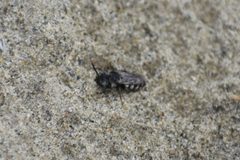
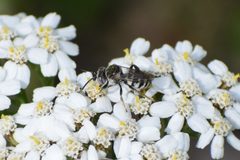
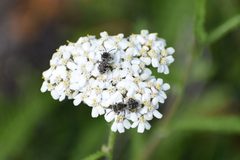
Epeolus americanus is a cleptoparasitic (cuckoo bee) in the Apidae. It was newly confirmed in 2020 to parasitize the solitary bee Colletes consors mesocopus, with the first instar larva described for the first time. The belongs to a of bees that invade nests of polyester bees (genus Colletes) and lacks the branched body hairs typical of pollen-collecting bees.
Pronunciation
How to pronounce Epeolus americanus: /ɛˈpiːoʊləs əˌmɛrɪˈkeɪnəs/
These audio files are automatically generated. While they are not always 100% accurate, they are a good starting point.
Images
Habitat
Clay pit in Meadow Creek, British Columbia, where nests were located in 2020. The specific requirements reflect those of its host , which nests in clay soil substrates.
Distribution
North America; confirmed present in British Columbia, Canada. Distribution records indicate presence across North America, though specific locality data is sparse.
Seasonality
Females observed entering nests in June 2020. Activity timing corresponds with host nesting period.
Host Associations
- Colletes consors mesocopus - Confirmed association documented June 2020 at Meadow Creek, British Columbia. Females observed entering host nests; first instar larvae found in host , with one specimen barcoded to confirm identity.
Life Cycle
First instar larvae develop within . The first instar has been described and imaged based on four specimens unearthed from host cells. Cleptoparasitic development involves the larval stage consuming provisions stored by the host female.
Behavior
Females exhibit nest-seeking , entering nests to lay . This behavior was directly observed in June 2020.
Ecological Role
of solitary bees. As a cuckoo bee, it functions as a natural control on its , though at lower population densities than hosts due to -prey dynamics.
Similar Taxa
- Other Epeolus speciesShares cleptoparasitic lifestyle and general with ; distinguished by specific associations and subtle morphological features not detailed in available sources.
- Epeolus attenboroughiRecently described congeneric cuckoo bee from Colorado and New Mexico; both parasitize Colletes but occupy different geographic ranges.
More Details
First instar description
The first instar of E. americanus was described for the first time in 2020 based on four specimens recovered from . This represents a significant contribution as larval stages of cleptoparasitic bees are often poorly known.
Sources and further reading
- BugGuide
- GBIF taxonomy match
- iNaturalist taxon
- NCBI Taxonomy
- Catalogue of Life
- entomology | Blog - Part 10
- Discovery and description of the hospicidal first instar of <i>Epeolus americanus</i> (Cresson) (Hymenoptera: Apidae), a cleptoparasite of <i>Colletes consors mesocopus</i> Swenk (Hymenoptera: Colletidae)