
Labeninae
Genus Guides
2Labeninae is a of within Ichneumonidae, comprising 12 extant organized into four tribes: Labenini, Groteini, Poecilocryptini, and Xenothyrini. The group has a predominantly Southern Hemisphere distribution, with phylogenomic and biogeographic analyses supporting a Gondwanan origin approximately 146 million years ago. Members exhibit diverse associations: Labenini parasitize wood-boring beetles (Buprestidae, Cerambycidae, Curculionidae), Groteini specialize on solitary bees, and Poecilocryptini may include phytophagous based on larval . The subfamily represents an ancient lineage with complex biogeographic history involving vicariance and range expansion events.
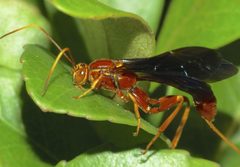
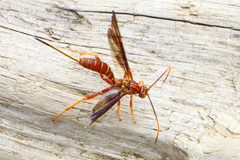
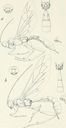
Pronunciation
How to pronounce Labeninae: //læbɛˈnɪni.aɪ//
These audio files are automatically generated. While they are not always 100% accurate, they are a good starting point.
Identification
Labeninae can be distinguished from other ichneumonid by the combination of a distinct genal projection, specific carinal arrangements on the mesosoma, and in some , elongated body proportions. The mesosoma is often notably elongated relative to height in certain genera (e.g., 2.9× as long as high in Grotea ambarosa). Tribal-level identification requires examination of associations and detailed morphological characters: Groteini possess adaptations for accessing nests, while Poecilocryptini show larval capsule modifications suggestive of . -level identification relies on coloration patterns, leg markings, and precise carinal configurations.
Images
Habitat
correspond to availability: parasitizing wood-boring beetles occur in forested and woodland areas with dead or dying wood; species attacking ground-nesting solitary bees inhabit open, well-drained soils; and those targeting cavity-nesting bees are found in areas with hollow stems, borings, or other pre-existing cavities. High-Andean in Colombia support at least one Grotea species (G. colletiphaga). Habitat quality influences reproductive success in host bees and associated rates.
Distribution
Predominantly distributed in Australia and South America, with phylogenomic evidence supporting a Gondwanan origin. A few of Labena and Grotea extend into North America, representing pre-Isthmus of Panama range expansions. The Eocene fossil Trigonator macrocheirus from Europe indicates the once exceeded Gondwanan boundaries. First record from the Greater Antilles (Grotea ambarosa) and documented from Rica, Colombia, Ecuador, and Mexico. Biogeographic inference suggests biotic exchange between South America and Australia potentially occurred through Antarctica until at least 49 million years ago.
Seasonality
Nesting activity of bees—and by extension, activity—occurs year-round in tropical regions with seasonal peaks. In the Colombian Andes, Colletes paulae shows peak nesting in October–November, with Grotea colletiphaga tracking this . Specific seasonality patterns for most Labeninae remain undocumented.
Host Associations
- Buprestidae - wood-boring beetles; tribe Labenini
- Cerambycidae - wood-boring beetles; tribe Labenini
- Curculionidae - wood-boring beetles; tribe Labenini
- Colletidae - ground-nesting and cavity-nesting solitary bees; tribe Groteini
- Hylaeinae - cavity-nesting bees; Grotea hylaeivora described from Hylaeus platensis
Life Cycle
Behavior
Females of Groteini locate and access nests of solitary bees to oviposit in . rates vary with quality, with higher rates observed in conserved versus restored habitats in at least one documented system (Colletes paulae–Grotea colletiphaga). Poecilocryptini larvae exhibit capsule adaptations suggestive of phytophagous feeding, though this remains unconfirmed by direct observation.
Ecological Role
Human Relevance
Potential agents for wood-boring pest beetles in forestry and agriculture. Research interest in , , and evolution of Southern Hemisphere faunas. No documented direct negative impacts on humans.
Similar Taxa
- XoridinaeAlso of wood-boring beetles; distinguished by different carinal arrangements and genal structure
- BrachycyrtinaeHistorically associated with Labeninae; transferred to separate based on phylogenetic analysis; parasitize cocoons rather than active wood-borers or bees
- PhygadeuontinaeClasini were transferred from Labeninae to this ; distinguished by different associations and morphological characters
More Details
Tribal classification
Four tribes recognized: Labenini (wood-borer ), Groteini ( parasitoids), Poecilocryptini (putatively phytophagous), and Xenothyrini (, unknown). Brachycyrtini were removed from Labeninae based on cladistic analysis.
Phylogenomic dating
Total-evidence divergence dating places Labeninae origin at ~146 mya, predating complete separation of Africa and South America. The Eocene European fossil Trigonator macrocheirus is firmly placed within crown-group Labeninae, complicating simple Gondwanan vicariance hypotheses.
Sources and further reading
- BugGuide
- Wikipedia
- iNaturalist taxon
- NCBI Taxonomy
- Three new species of Labeninae (Hymenoptera: Ichneumonidae) from Costa Rica
- The Labeninae (Hymenoptera: Ichneumonidae): a study in phylogenetic reconstruction and evolutionary biology
- The Labeninae (Hymenoptera: Ichneumonidae): a study in phylogenetic reconstruction and evolutionary biology
- The classification, evolution and distribution of the Labeninae, an ancient southern group of Ichneumonidae (Hymenoptera)
- A new species of Grotea Cresson, the first record of Labeninae (Hymenoptera, Ichneumonidae) in the Greater Antilles
- Description of the female of Labium walkeri Turner & Waterson, 1920 from Australia with new distribution data of L. montivagum (Hymenoptera, Ichneumonidae, Labeninae)
- Description of the female of Labena madoricola González-Moreno & Bordera, 2015 (Hymenoptera, Ichneumonidae, Labeninae), with new records of Labena species from Mexico
- Nesting ecology of the bee Hylaeus (Hylaeopsis) platensis n. sp. (Colletidae, Hylaeinae) with description of its parasite, Grotea hylaeivora n. sp. (Ichneumonidae, Labeninae)
- A Parasitoid Puzzle: Phylogenomics, Total-evidence Dating, and the Role of Gondwanan Vicariance in the Diversification of Labeninae (Hymenoptera, Ichneumonidae)
- Nesting biology and phenology of a new Andean Colletes (Colletidae: Colletinae) from Colombia, with the description of a new parasitoid species of Grotea (Ichneumonidae: Labeninae)
- New Species of Grotea (Hymenoptera, Ichneumonidae, Labeninae) from Ecuador, with New Records and a Key to the Neotropical Species.