
Brachycyrtinae
Genus Guides
1Brachycyrtinae is a small, morphologically distinctive of ichneumonid wasps (Darwin wasps) containing the single Brachycyrtus with approximately 27 described . The subfamily has a distribution with highest diversity in tropical regions, though Brachycyrtus ornatus is widespread across the Holarctic. The subfamily was recently recorded for the first time in Finland, representing the northernmost known occurrence. Members are solitary of green lacewings (Neuroptera: Chrysopidae).
Pronunciation
How to pronounce Brachycyrtinae: /ˌbrækɪˈsaɪrtɪniː/
These audio files are automatically generated. While they are not always 100% accurate, they are a good starting point.
Identification
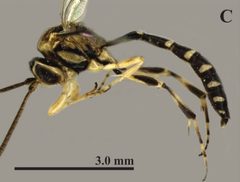
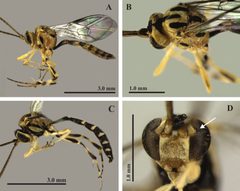
Distinguished from other ichneumonid by a hunched mesosoma, distinctive wing venation, and characteristic yellow-black or yellow-black-orange colouration. The Brachycyrtus can be separated from other ichneumonid genera by these combined morphological features.
Images
Habitat
Edge between open areas and forest, such as powerline clearings adjacent to broadleaf forest. In Finland, collected at the edge of a powerline clearing with plant dominated by red raspberry (Rubus idaeus), false spiraea (Sorbaria sorbifolia), alder buckthorn (Frangula alnus), and red elderberry (Sambucus racemosa), with ground layer of lily of the valley (Convallaria majalis). Also occurs in urban and semi-urban park settings.
Distribution
with records from all continents except Antarctica, though most are tropical. Holarctic distribution for B. ornatus with records from France, Italy, North Macedonia, Turkey, Iran, southern Sweden, Norway, and Finland (northernmost record). Brazilian Amazon region for B. amazonensis. Likely occurs in Baltic countries and other regions currently without records.
Seasonality
activity from August to September recorded in Finland.
Host Associations
- Chrysopidae - solitary of green lacewing cocooned and pupae
Life Cycle
Solitary ; idiobiont ectoparasitoid inferred from phylogenetic position and .
Ecological Role
of green lacewings (Chrysopidae), contributing to regulation of . Potential indicator of range expansion, with recent higher latitude records suggesting possible northward range expansion.