
Chrysopa oculata
Say, 1839
golden-eyed lacewing, green lacewing
Chrysopa oculata is a widely distributed across North and Central America. Commonly known as the golden-eyed , it has been studied for its thermal developmental and diet-dependent reproductive . The species was introduced to New Zealand in 1926 as a agent for aphids but failed to establish.
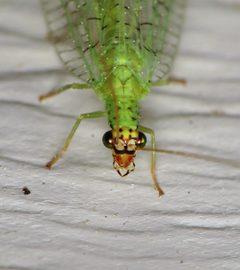
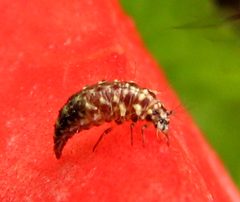

Pronunciation
How to pronounce Chrysopa oculata: //ˈkrɪsəˌpɑ ˌɒkjʊˈleɪtə//
These audio files are automatically generated. While they are not always 100% accurate, they are a good starting point.
Images
Distribution
Transcontinental across North America from Canada south to Mexico; present in Central America. Introduced to New Zealand in 1926 but did not become established.
Diet
Pea aphids (Acyrthosiphon pisum) are suitable prey for continuous rearing. Females require prey to mate and produce fertile , while males can reproduce with sugar and water alone.
Life Cycle
Thermal requirements for nondiapause development are geographically stable across from southern Canada to montane Mexico. Lower thermal thresholds vary by only 1.2°C among populations. required for total preimaginal development differ by approximately 85 degree-days among populations. Northern populations show higher rates of induction under low temperatures due to differential effects of temperature on critical . Males emerge slightly but consistently earlier than females.
Behavior
Female reproductive is highly dependent on diet; females remain unmated when maintained on sugar and water alone but mate and produce fertile when given pea aphids prior to pairing. Males do not require prey beyond sugar and water to produce fertile matings.
Human Relevance
Imported to New Zealand in 1926 as a agent for , though it failed to become established. Studied as a potential biological control agent for aphids.
More Details
Thermal Development Biology
from five widespread localities showed remarkable similarities in thermal requirements for nondiapause development, suggesting functional constraints on evolution of these traits. Temperature did not affect sex ratio or survival except at 15.6°C where mortality increased significantly.
Failed Introduction to New Zealand
The 1926 introduction to New Zealand represents an early attempt at . The failure to establish suggests potential limitations in the ' ability to adapt to novel environments or compete with existing fauna.
Sources and further reading
- BugGuide
- Wikipedia
- GBIF taxonomy match
- iNaturalist taxon
- NCBI Taxonomy
- Catalogue of Life
- Mylabris oculatus in South Africa | Beetles In The Bush
- Buppies in the bush(veld) | Beetles In The Bush
- Thermal Requirements for Development in Chrysopa Oculata: A Geographically Stable Trait
- DIETARY REQUIREMENTS FOR MATING INCHRYSOPA OCULATA(NEUROPTERA: CHRYSOPIDAE)