
Acyrthosiphon
Mordvilko, 1914
pea aphids
Species Guides
3- Acyrthosiphon lactucae(Prickly Lettuce Aphid)
- Acyrthosiphon macrosiphum(Long-legged Serviceberry Aphid)
- Acyrthosiphon pisum(Pea aphid)
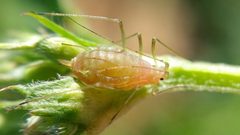
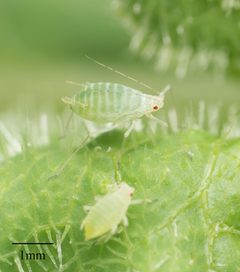
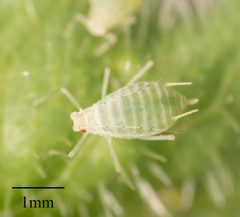
Acyrthosiphon is a of aphids in the Aphididae, established by Alexander Mordvilko in 1914. The genus has a distribution and includes several economically important agricultural pests. The best-known , Acyrthosiphon pisum (pea aphid), is a major pest of legume crops and serves as a model organism for studies of insect-bacteria , particularly its relationship with the obligate endosymbiont Buchnera aphidicola.
Pronunciation
How to pronounce Acyrthosiphon: /ˌæˌsɜrθoʊˈsaɪfən/
These audio files are automatically generated. While they are not always 100% accurate, they are a good starting point.
Images
Habitat
in this are associated with leguminous plants. Acyrthosiphon pisum has been documented on alfalfa, peas, clover, lentils, chickpeas, fava beans, and lupin. Acyrthosiphon kondoi attacks lucerne and other Leguminosae, particularly Melilotus and Trifolium.
Distribution
. Documented from Europe, Asia, Africa, Australasia, North America, Central America, and South America. Specific distribution records include: Europe (widespread including Britain, France, Germany, Italy, Scandinavia), Asia (China, India, Japan, Iran, Turkey), Africa (South Africa, Egypt, Kenya, Morocco), Australasia (Australia, New Zealand), and the Americas (USA, Canada, Mexico, Argentina, Brazil, Chile).
Diet
Phloem-feeding on leguminous plants. Acyrthosiphon pisum feeds on sap from leaves, stems, and pods of plants.
Host Associations
- Pisum sativum - pea
- Medicago sativa - alfalfa/lucerne
- Trifolium - clover
- Lens culinaris - lentil
- Cicer arietinum - chickpea
- Vicia faba - fava bean
- Lupinus - lupin
- Melilotus -
- Glycine max - soybean
Life Cycle
Complex with both and . In temperate regions, hatch in spring to produce stem mothers (fundatrices) that reproduce parthenogenetically through summer, producing multiple of females that may be winged or unwinged. In autumn, sexual morphs ( females and males) are produced. The Arctic Acyrthosiphon svalbardicum has a shortened life cycle with only two generations: stem mother and sexuales, an to the brief breeding period from late July to late August.
Behavior
Exhibits escape in response to and vibration stimuli. Tends to cluster on plants and does not move far when food is available. Reproduces primarily by during spring and summer, enabling rapid increase.
Ecological Role
Herbivore and agricultural pest. Acyrthosiphon pisum transmits over 30 plant viruses including pea enation mosaic virus. Excreted honeydew supports growth affecting . Serves as for including Aphidius ervi, A. smithi, and Praon pequodorum, as well as predatory lady beetles. Endosymbiotic bacteria including Hamiltonella defensa and Serratia symbiotica provide defense against natural enemies.
Human Relevance
Major agricultural pest of pulse crops causing yield losses of 30-40% in years. Subject of extensive research including programs using and lady beetles. Acyrthosiphon pisum is an important model organism for studies of insect-microbe , particularly the obligate nutritional symbiosis with Buchnera aphidicola. Research on this system has advanced understanding of defensive symbiosis, , and evolutionary .
More Details
Endosymbiotic bacteria
in this harbor obligate and facultative endosymbiotic bacteria. Buchnera aphidicola is an obligate intracellular transmitted vertically that provides lacking in plant sap. Facultative symbionts including Hamiltonella defensa and Serratia symbiotica confer resistance to and predatory lady beetles. Hamiltonella defensa's protective effect against wasps depends on with a virus that produces a toxin.
Research significance
Acyrthosiphon pisum was the first basal hemimetabolous insect with a fully sequenced . The serves as a model for studying evolutionary developmental , , and insect-plant interactions.
Sources and further reading
- BugGuide
- Wikipedia
- GBIF taxonomy match
- iNaturalist taxon
- NCBI Taxonomy
- Catalogue of Life
- Oh, Those Pestiferous Aphids! | Bug Squad
- Pea Aphid in Pulse Crops: New Guide Outlines IPM Options
- American Underdog Wasp Fights for Foothold on Exotic Hosts
- ID Challenge #16 | Beetles In The Bush
- Bacteria Can Aid Aphids Against Predation and Parasitism
- Complexity Untangled: For Plant Defenses, Pest Attack Order Matters
- Acyrthosiphon kondoi . [Distribution map].
- Acyrthosiphon pisum . [Distribution map].
- Escape behaviour of the pea aphid Acyrthosiphon pisum (Harris) in response to alarm pheromone and vibration.
- Seasonal Abundance of Primary Parasitoids and Hyperparasitoids Associated with Acyrthosiphon pisum (Harris) and Acyrthosiphon kondoi Shinji (Homoptera: Aphididae) on Alfalfa.
- Structure of the reproductive system of the sexual generation of the endemic Arctic species Acyrthosiphon svalbardicum and its temperate counterpart Acyrthosiphon pisum (Hemiptera, Aphididae)
- Adaptive variation of Buchnera endosymbiont density in aphid host Acyrthosiphon pisum controlled by environmental conditions
- Pathogenicity of Erynia neoaphidis for Acyrthosiphon pisum.
- Adaptive variation of Buchnera endosymbiont density in aphid host Acyrthosiphon pisum controlled by environmental conditions
- Adaptive variation of Buchnera endosymbiont density in aphid host Acyrthosiphon pisum controlled by environmental conditions
- Adaptive variation of Buchnera endosymbiont density in aphid host Acyrthosiphon pisum controlled by environmental conditions
- Lethal and sublethal effects of lambda-cyhalothrin on Aphis fabae (Scopoli, 1763), Myzus persicae (Sulzer, 1776) and Acyrthosiphon pisum (Harris, 1776) (Hemiptera: Aphididae) Lambda-cyhalothrin’nin Aphis fabae (Scopli, 1763), Myzus persicae (Sulzer, 1776) ve Acyrthosiphon pisum (Harris, 1776) (Hemiptera: Aphididae) üzerindeki letal ve subletal etkileri
- Développement embryonnaire du puceron Acyrthosiphon pisum : caractérisation de voies métaboliques et gènes clé dans les interactions trophiques avec Buchnera aphidicola