
Macrosiphini
Wilson, 1910
Genus Guides
57- Abstrusomyzus
- Acuticauda
- Acyrthosiphon(pea aphids)
- Amphorophora(Berry Aphids)
- Aphthargelia(Snowberry Aphids)
- Aulacorthum
- Brachycaudus(Short-tailed Aphids)
- Brevicoryne
- Capitophorus
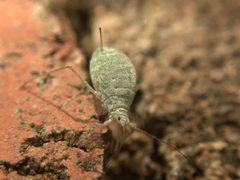
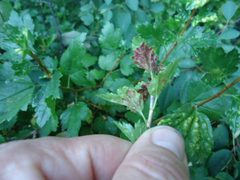
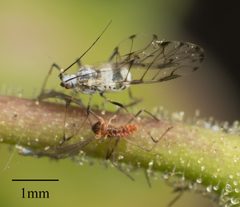
Macrosiphini is a large tribe of aphids within the Aphidinae, comprising over 200 and numerous distributed worldwide. Members exhibit diverse , including both species that remain on herbaceous plants year-round and heteroecious species that alternate between woody primary and herbaceous secondary hosts. The tribe includes many economically significant agricultural pests, such as Myzus persicae (green peach aphid) and Macrosiphum species. Host plant specificity varies considerably, with some species restricted to single host species and others feeding across multiple plant .
Pronunciation
How to pronounce Macrosiphini: /ˌmækrəˈsaɪfɪnaɪ/
These audio files are automatically generated. While they are not always 100% accurate, they are a good starting point.
Identification
Identification to requires examination of antennal segment proportions, siphunculus shape and length relative to body, cauda , and presence or absence of spinal . -level identification often necessitates plant association data and examination of slide-mounted specimens for subtle characters such as setal lengths, distribution, and body ornamentation. The tribe is distinguished from other Aphidinae tribes (Aphidini, Rhopalosiphini) primarily by the combination of well-developed siphunculi and antennal tubercles that are usually well-developed and divergent.
Images
Habitat
Primarily associated with vascular plants across terrestrial . inhabit herbaceous vegetation including forbs, grasses, and agricultural crops. Heteroecious species utilize woody shrubs and trees as primary () , migrating to herbaceous plants for summer . Some species colonize specialized such as subterranean plant parts or aquatic emergent vegetation.
Distribution
distribution with representatives on all continents except Antarctica. Particularly diverse in temperate regions of the Northern Hemisphere. The Belarus fauna alone includes 52 and 156 , with diversity increasing toward Western Europe and decreasing eastward in some regions. Individual species ranges vary from widespread (e.g., Myzus persicae, nearly global) to highly restricted endemics.
Seasonality
activity varies by and climate; in temperate regions, spring from primary to secondary occurs March–May, with peak production in summer months. Autumn return migration to primary hosts typically September–November. Some species maintain continuous parthenogenetic on herbaceous hosts year-round in mild climates or greenhouses. occurs as on primary hosts (heteroecious species) or as active nymphs/ ( species in favorable conditions).
Diet
Phloem sap feeders; all possess (stylets) adapted for accessing plant vascular tissue. Specific associations vary from extreme (single host species) to broad . The Belarus fauna includes 27 species on single host species, 85 on single , 37 on single , and 7 on multiple families. Some species are significant agricultural pests on crops including potato, peach, sugar beet, and cereals.
Host Associations
- Herbaceous plants - primary_habitatMajority of ; species permanent residents, dioecious species summer
- Woody plants - overwintering_hostPrimary for heteroecious ; laid on bark or buds
- Photinia villosa - probable_primary_hostFor Miyazakia ranunculi
- Ranunculus - secondary_hostFor Miyazakia ranunculi
- Hippophae rhamnoides - Capitophorus wojciechowskii
- Malva neglecta - favorable_hostMyzus persicae in Canterbury, New Zealand
- Solanum nigrum - favorable_hostMyzus persicae in Canterbury, New Zealand
- Trifolium repens - Aulacorthum solani predominant; Myzus persicae less favorable
- Achillea millefolium - Aulacorthum solani and Myzus ascalonicus
Life Cycle
Complex involving multiple morphs: fundatrix (foundress, stem mother), females (parthenogenetic, live-bearing), viviparous females (winged, dispersing), females (sexual, -laying), and males. Heteroecious alternate between and egg-laying on primary (woody) and parthenogenetic on secondary (herbaceous) hosts. species may remain parthenogenetic year-round or undergo abbreviated sexual phases on herbaceous hosts. Developmental rate and number of vary with temperature and host quality.
Behavior
morphs engage in directed for location, using visual and olfactory cues. Colony formation involves on young plant growth. Some exhibit defensive including kicking, dropping from plants, and release from siphunculi. mutualism occurs in some species, with aphids providing honeydew in exchange for protection. patterns are well-documented for some species, with predictable seasonal movements between host types.
Ecological Role
Major herbivores in terrestrial , transferring significant plant to higher . Serve as prey for diverse natural enemies including lady beetles (Coccinellidae), lacewings (Chrysopidae), syrphid flies, , and insectivorous birds. Honeydew production supports growth and . Several are economically important of plant viruses including potyviruses, luteoviruses, and nanoviruses.
Human Relevance
Contains numerous agricultural and horticultural pests causing direct damage through feeding and indirect damage as virus . Myzus persicae (green peach aphid) is among the world's most important agricultural pests, transmitting over 100 plant viruses. Macrosiphum euphorbiae (potato aphid) and other damage potato, tomato, and ornamental crops. Some species are ; at least 16 species (10%) in the Belarus fauna are . Conversely, some species are used as biocontrol agents or studied for silk production. Management relies on chemical control, , and crop varieties.
Similar Taxa
More Details
Taxonomic scope
With over 200 , Macrosiphini represents one of the largest tribes. The genus list includes significant agricultural genera: Myzus, Macrosiphum, Aulacorthum, Acyrthosiphon, Brevicoryne, and Nasonovia. Ongoing taxonomic revision continues to clarify generic boundaries, with recent synonymizations (e.g., Spinaphis and Longisiphoniella into Allocotaphis) and new genus descriptions (e.g., Miyazakia from Japan).
Virus vector capacity
In Canterbury, New Zealand, Myzus persicae, Aulacorthum solani, and Myzus ascalonicus were documented as of beet western yellows virus (BWYV), with weed including Malva neglecta and Solanum nigrum serving as virus . This illustrates the ecological complexity of virus--plant interactions within the tribe.
Sources and further reading
- BugGuide
- Wikipedia
- iNaturalist taxon
- NCBI Taxonomy
- Catalogue of Life
- Aphids of the tribe Macrosiphini (Insecta: Homoptera: Aphididae) in Belarus
- Revision of the genus Allocotaphis Börner, 1950 (Hemiptera, Homoptera, Aphididae, Macrosiphini)
- Miyazakia, a new aphid genus from Japan (Hemiptera: Aphididae: Macrosiphini)
- Capitophorus wojciechowskii – a new aphid species from Iran (Hemiptera: Aphididae: Aphidinae: Macrosiphini)
- Flight activity and weed hosts of Macrosiphini (Homoptera: Aphididae) in Canterbury
- Amphicercidus (Hemiptera, Aphidinae, Macrosiphini) species in China: two synonyms and two new records
- Revision of the aphid subgenus Ramitrichophorus Hille Ris Lambers of genus Macrosiphoniella (Hemiptera, Homoptera: Aphididae, Macrosiphini), with redescriptions of all known species and identification keys
- Another two new aphid species of the genus Cryptomyzus Oestlund, 1922 (Hemiptera, Aphididae, Macrosiphini) from Kazakhstan.