
Macrosiphum euphorbiae
(Thomas, 1878)
potato aphid
, commonly known as the , is a sap-sucking insect in the Aphididae. It is a globally significant agricultural pest, particularly of potato (Solanum tuberosum), tomato, lettuce, and numerous other crops across more than 20 plant families. The exhibits complex strategies including alternation between primary (Rosa spp.) and secondary hosts, cyclical in North America, and obligate in UK . It multiple plant viruses including potato leaf roll virus, potato virus Y, and tomato yellow top virus. The demonstrates notable phenotypic plasticity with green and pink color morphs, and possesses distinctive antipredator including dropping from host plants followed by tonic immobility.
Pronunciation
How to pronounce Macrosiphum euphorbiae: /ˌmækroʊˈsaɪfəm juːˈfɔːrbi.i/
These audio files are automatically generated. While they are not always 100% accurate, they are a good starting point.
Identification
Distinguished from other Macrosiphum by the combination of: longer than body with dark joints; siphunculi pale with dark tips and operculi, approximately one-third body length; cauda sword-shaped and distinctly shorter than siphunculi; longer legs relative to body compared to . The green and pink color morphs occur sympatrically; green morphs prefer lower, older leaves on potato while pink morphs show no such preference. Winged forms have uniformly darker coloration. May be confused with other potato-feeding aphids but combination of antennal length, siphuncular proportions, and leg length is diagnostic.
Images
Appearance
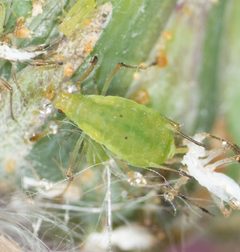
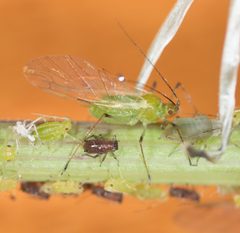
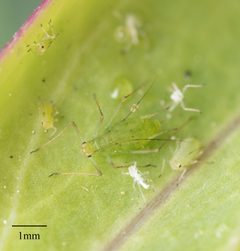
Wingless females (apterae) are green or occasionally pink, often with a darker stripe, with a pear-shaped body reaching approximately 4 mm in length. are dark at segment joints and longer than the body, set on outward-facing . Legs are longer than in other aphids, pale green with darker apices. Siphunculi are pale, cylindrical with dark tips and operculi, about one-third body length. Cauda is sword-shaped with 6-12 hairs, much shorter than siphunculi. Winged females (alatae) have uniformly darker body and appendages with green . Nymphs resemble miniature .
Habitat
Agricultural and horticultural systems, particularly potato fields, tomato crops, lettuce , and greenhouse environments. Primary plants are Rosa (); secondary hosts include diverse cultivated and wild plants in Solanaceae, Chenopodiaceae, and over 20 other plant . Non-host-alternating persist year-round on secondary hosts, especially in protected indoor environments. Host-alternating populations require seasonal between primary and secondary hosts.
Distribution
Native to North America; introduced and established throughout temperate regions of Europe and Asia. Present in all areas where potatoes are commercially grown. UK demonstrate clonal structure with geographically distinct . No evidence of current range expansion.
Seasonality
In temperate regions with alternation: hatch April, with spring to secondary hosts in May-June; up to 10 parthenogenetic occur through summer; autumn migration to primary hosts in August, followed by and egg-laying for . In greenhouse and mild climate , continuous parthenogenetic occurs year-round. Optimal temperature for population increase is 20°C (68°F).
Diet
Phloem sap feeder using to access vascular tissue. Highly , feeding on over 200 in more than 20 plant . Strong preference for Solanaceae (potato, tomato, pepper, eggplant), with secondary preferences for Chenopodiaceae, Asteraceae, and Brassicaceae. Feeding occurs on shoots, leaf undersides, buds, and flowers, typically on lower plant parts.
Host Associations
- Solanum tuberosum - primary potato, major economic
- Solanum lycopersicum - secondary tomato
- Lactuca sativa - secondary lettuce
- Rosa spp. - primary () and -laying
- Solanum nigrum - wild weed for viruses
- Capsicum spp. - secondary pepper
- Brassica oleracea - secondary cabbage and cole crops
Life Cycle
Complex with two distinct strategies. -alternating (heteroecious) : overwinter as on primary host (Rosa spp.); fundatrices hatch in spring and reproduce parthenogenetically; migrants disperse to secondary hosts in late spring; multiple parthenogenetic on secondary hosts through summer; autumn migrants return to primary hosts where sexual morphs (gynoparae, males, oviparae) are produced; mating and egg-laying completes cycle. Non-host-alternating populations: continuous on secondary hosts, especially in greenhouses and mild climates. UK populations are obligately with clonal structure; North American populations undergo cyclical parthenogenesis.
Behavior
Exhibits dropping as primary antipredator defense: falls from plant when disturbed by or tactile stimuli, followed by tonic immobility on substrate. Post-dropping tonic immobility duration negatively correlated with temperature; recovery rates increase at higher temperatures. Recovery slower after real predator exposure than after standardized tactile stimulus.
Ecological Role
Significant agricultural pest causing direct damage through phloem feeding and indirect damage as of plant viruses. Major vector of potato leaf roll virus, potato virus Y, tomato yellow top virus, lettuce mosaic virus, beet mild yellowing virus, beet yellows virus, and others. Serves as for including Aphidius nigripes (braconid) and Aphidius ervi, with some showing innate resistance to . Prey for diverse predatory insects including lady beetles (Coccinellidae), larvae (Chrysopidae), and syrphid fly larvae. Contributes to nutrient cycling through honeydew production supporting growth and associations.
Human Relevance
Major economic pest of potato, tomato, lettuce, and other crops causing yield losses through direct feeding damage and virus transmission. Subject to programs incorporating ( , ), , cultural practices, and selective application. Some have developed insecticide resistance. Used as model organism for studies of genetics, , inheritance, and plant-insect interactions. Subject of metabolic engineering research to develop aphid- crop varieties through terpene biosynthesis modification.
Similar Taxa
- Myzus persicae (green peach aphid)Also green, pest of solanaceous crops; distinguished by shorter , siphunculi without distinct dark operculi, and preference for newer growth rather than lower leaves
- Aphis gossypii (cotton aphid)Similar size and coloration; distinguished by much shorter , shorter siphunculi, and presence of abdominal
- Schizaphis graminum (greenbug)Green with dark stripe on cereals; distinguished by short , very short siphunculi, and restriction to Poaceae
- Diuraphis noxia (Russian wheat aphid)Spindle-shaped lime green on small grains; distinguished by short , reduced cornicles, and characteristic 'double-tailed' appearance from caudal projection
More Details
Genomic and cytogenetic features
assembly comprises five chromosomal blocks totaling 560 Mbp with high completeness (BUSCO C: 95.6-98.0%). Possesses holocentric . Sex determination is XX (female) / XO (male). X chromosome inheritance is non-random: the X chromosome with fewer ribosomal (rDNA) genes is preferentially eliminated during male determination due to differential 'stickiness' mediated by rDNA-mediated chromosome attachment during prophase.
Clonal diversity and genotype-specific traits
UK exhibit clonal structure dominated by two , one absent from commercial farms possibly due to intolerance or broader range. Some genotypes demonstrate innate resistance to Aphidius ervi. Whole- sequencing indicates UK populations originated from hybridization event and persist asexually, contrasting with North American cyclical .
Climate change responses
Performance affected by combined drought and heat stress. Moderate water-deficit stress (25-30% pot capacity) reduces stomatal conductance and leaf area. High day-night temperatures (30/20°C) interact with water stress to reduce nymphal and survival. Water stress and high temperatures independently reduce . Recovery from direct heat stress aided by cooler night temperatures, but combined stressors produce net negative effects.
Plant defense interactions
Feeding affected by sesquiterpene defenses in wild tomato Solanum habrochaites. Metabolic engineering of tomato to produce β-caryophyllene/α-humulene or (−)-endo-α-bergamotene/(+)-α-santalene/(+)-endo-β-bergamotene significantly reduces longevity and , demonstrating potential for through terpene manipulation.
Sources and further reading
- BugGuide
- Wikipedia
- iNaturalist taxon
- NCBI Taxonomy
- Catalogue of Life
- Seeing Spots at the Bohart | Bug Squad
- Bembicid Holdings | Entomology Research Museum
- Aboveground Pests - AgriLife Extension Entomology
- Sustainable Entomology: How Insect Scientists Can Protect Our Planet
- Uncategorized | Blog - Part 54
- Chromosome inheritance? Not the same for all the chromosomes | Blog
- Macrosiphum euphorbiae (potato aphid).
- Pest Identification Guides: Potato Aphid, Macrosiphum euphorbiae
- Post-Dropping Behavior of Potato Aphids (Macrosiphum euphorbiae)
- Genomic insights into clonal diversity in UK populations of the Potato aphid, Macrosiphum euphorbiae
- Genomic insights into clonal diversity in UK populations of the potato aphid, Macrosiphum euphorbiae
- Seasonal Ecology of Aphidius nigripes (Hymenoptera: Aphidiidae), a Parasitoid of Macrosiphum euphorbiae (Homoptera: Aphididae)
- Host Plant Volatiles and the Sexual Reproduction of the Potato Aphid, Macrosiphum euphorbiae
- Diurnal Patterns in Host Finding by Potato Aphids, Macrosiphum euphorbiae (Homoptera: Aphididae)
- Tomato yellow top virus: Its distribution, characteristics and transmission by the aphid Macrosiphum euphorbiae (Thom.)
- Epidermis-Specific Metabolic Engineering of Sesquiterpene Formation in Tomato Affects the Performance of Potato Aphid Macrosiphum euphorbiae
- Drought and heat waves associated with climate change affect performance of the potato aphid Macrosiphum euphorbiae