
Schizaphis graminum
(Rondani, 1852)
greenbug, wheat aphid, common wheat-louse
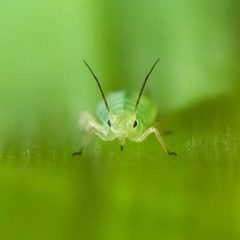
, commonly known as the or wheat , is a small aphid in the Aphididae. Native to the Palaearctic region, it has been introduced worldwide and is a significant pest of cereal crops, particularly wheat and sorghum. The species exhibits wing dimorphism, with wingless forms predominating early in the season and winged forms developing under crowded conditions to disperse to new . It causes direct damage through feeding and toxin injection, and indirect damage as a of multiple plant viruses.

Pronunciation
How to pronounce Schizaphis graminum: /ˈskɪzəfɪs ˈɡræmɪnəm/
These audio files are automatically generated. While they are not always 100% accurate, they are a good starting point.
Identification
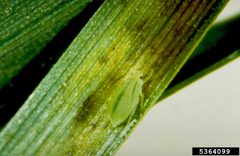
Distinguished from other cereal aphids by the prominent dark green stripe running lengthwise down the back. (Rhopalosiphum maidis) are dark bluish-green without this stripe and typically feed in the . Yellow sugarcane aphids (Sipha flava) are bright yellow with rows of dark spots and short cornicles. Sugarcane aphids (Melanaphis sacchari) are pale yellow, gray, or tan with black feet, , and cornicles. produce honeydew and inject a toxin causing yellow or red leaf spots, unlike bird cherry-oat aphids which do not inject toxin.
Images
Appearance
are 1.3–2.1 mm long. The and are straw-colored to pale green, and the is mid-green with a characteristic dark green stripe visible in late-stage nymphs and adults. are dark, and cornicles are pale with dark tips. Winged and wingless morphs occur; winged forms develop under crowded conditions.
Habitat
Found in agricultural fields and grasslands dominated by Poaceae (grass ) . In cooler climates, overwinters as on grasses such as Poa pratensis. Favors warm, dry conditions that promote rapid growth.
Distribution
Originally Palaearctic; now introduced and established worldwide. Present across Europe, Asia, Africa, North America, Central America, South America, and Oceania. In North America, widespread from Canada through the United States (particularly the Great Plains and southern states) to Mexico. Notable in the southern Great Plains of the United States where it is a major pest.
Seasonality
Active year-round in warm climates. In temperate regions, hatch in spring; multiple occur through summer. Winged forms appear in response to crowding and environmental cues. In the Post-Soviet states, up to fifteen generations per year at optimal temperatures (~20°C for wingless forms, 27°C for winged forms). Activity suppressed by temperatures below 20°F (-7°C) for extended periods without snow cover.
Diet
Phloem-feeding on Poaceae (grass ). Feeds on leaves, sucking sap and injecting toxin during feeding. include Agropyron, Avena, Bromus, Dactylis, Eleusine, Festuca, Hordeum, Lolium, Oryza, Panicum, Poa, Sorghum, Triticum, and Zea.
Host Associations
- Triticum aestivum - primary Wheat; major economic
- Sorghum bicolor - primary Sorghum; major economic , particularly preferred by North American
- Hordeum vulgare - Barley
- Avena sativa - Oat
- Secale cereale - Rye
- Zea mays - Corn
- Poa pratensis - Kentucky bluegrass; site in cooler climates
Life Cycle
Reproduces parthenogenetically in warm or moderate climates, with females producing up to five nymphs per day. Three instar stages with length of 7–9 days at 16–27°C (60–80°F). In cooler climates, occurs in autumn: females mate with winged males and produce . Each female produces approximately 80 offspring during a 25-day lifespan under optimal conditions. completes in about 7 days under ideal conditions.
Behavior
Forms colonies on undersides of leaves. Early-season are wingless; winged forms develop under crowded conditions and migrate to neighboring plants. After , exhibits a period of wandering and evaluation before settling. Produces honeydew. Feeding causes characteristic yellow or red leaf spots that enlarge as progresses. Colonies begin on lower leaves and move upward as plant tissue dies.
Ecological Role
Major pest of cereal agriculture causing direct feeding damage and vectoring plant viruses. Attracts natural enemies including lady beetles, parasitic (particularly Lysiphlebus testaceipes), lacewings, damsel bugs, spiders, and syrphid flies. Can serve as prey for in agricultural . influenced by agents, with rates affecting treatment decisions.
Human Relevance
Significant economic pest of wheat, sorghum, and other small grains for over 50 years, especially in the Great Plains. Direct damage from feeding and toxin injection reduces yield and quality; heavy cause plant death. Indirect damage through transmission of barley yellow dwarf virus, sugarcane mosaic virus, maize dwarf mosaic virus, and millet red leaf virus. Subject to programs incorporating varieties, , cultural practices, and selective application. Has developed resistance to organophosphorus insecticides in some regions. The "Glance 'n Go" sampling system was developed specifically for management in wheat.
Similar Taxa
- Rhopalosiphum maidisCorn leaf aphid; dark bluish-green without stripe, feeds in , does not inject toxin
- Sipha flavaYellow sugarcane aphid; bright yellow with rows of dark spots, short cornicles, does not produce honeydew
- Melanaphis sacchariSugarcane aphid; pale yellow/gray/tan with black feet, , and cornicles, produces abundant honeydew
- Rhopalosiphum padiBird cherry-oat aphid; yellowish green to black with reddish area around cornicle bases, does not inject toxin
More Details
Biotypes and Host Adaptation
Multiple exist with varying preferences; one North American biotype specifically prefers sorghum. exhibit pre-adapted genetic diversity allowing opportunistic success on different hosts rather than evolving resistance de novo.
Insecticide Resistance
Resistance to organophosphorus ( Group 1B) has been documented in several Texas Panhandle counties since 1990, with additional detections in 2014. Resistance management requires of insecticide modes of action.
Economic Thresholds
Treatment thresholds vary by crop growth stage: 20% of plants visibly damaged with present from to 6 inches; before any entire leaves killed on 20% of plants for larger plants to boot; 1 functional leaf dead on 20% of plants from boot to heading; 2 normal-size leaves dead on 20% of plants from heading to hard dough.
Sources and further reading
- BugGuide
- Wikipedia
- iNaturalist taxon
- NCBI Taxonomy
- Catalogue of Life
- Aboveground Pests - AgriLife Extension Entomology
- Stem- and Leaf- Feeding Insects - AgriLife Extension Entomology
- Managing Insect and Mite Pests of Texas Small Grains - AgriLife Extension Entomology
- Seeing Spots at the Bohart | Bug Squad
- Schizaphis graminum Archives - Entomology Today
- Open-Access Article Takes a Closer Look at Crop-Damaging Greenbugs
- Greenbug (Schizaphis graminum): an overview
- Schizaphis graminum . [Distribution map].
- Postflight Behavior of the Greenbug, Schizaphis graminum (Homoptera: Aphididae), in the Laboratory1
- Identification of a protein associated with circulative transmission of Barley yellow dwarf virus from cereal aphids, Schizaphis graminum and Sitobion avenae
- Chromosome-level genome assemblies of two cereal aphids, Metopolophium dirhodum and Schizaphis graminum, provides insights into wing dimorphism
- Resistance of Selected Cool and Warm Season Turfgrasses to the Greenbug (Schizaphis graminum)1