
Sipha flava
(Forbes, 1884)
yellow sugarcane aphid
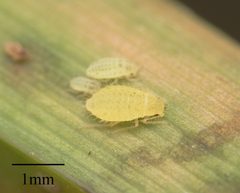
Sipha flava, commonly known as the yellow sugarcane aphid, is a significant agricultural pest native to North America that has spread to multiple continents. This feeds on warm- and cool-season grasses including sugarcane, sorghum, corn, rice, and numerous pasture grasses. It is distinguished by its bright lemon-yellow to pale green coloration, body covered with small spines, and two double rows of dark spots on the dorsum. The is notable for injecting a toxin while feeding that causes plant leaves to turn purple in seedlings and yellow to reddish in older plants, leading to stunted growth, delayed maturity, and potential lodging. Unlike many aphids, it produces little to no honeydew. can increase rapidly through parthenogenetic , with females giving birth to live young for approximately 28 days.
Pronunciation
How to pronounce Sipha flava: /ˈsiːfə ˈfleɪvə/
These audio files are automatically generated. While they are not always 100% accurate, they are a good starting point.
Identification
are typically lemon yellow, occasionally pale green, and measure approximately 1.5-2.0 mm in length. The body is covered with numerous small spines and distinctive long hairs. Two parallel double rows of dark spots run longitudinally along the surface. Both winged () and wingless () forms occur. The cornicles are short relative to body size. Key distinguishing features from similar aphids include: bright yellow coloration with dark spot rows (vs. pale yellow-gray with black cornicles and legs in Melanaphis sacchari); absence of honeydew production (vs. abundant honeydew in sugarcane aphid); and purple seedling damage (vs. yellow-brown damage patterns of greenbug Schizaphis graminum).
Images
Habitat
Found in agricultural fields, pastures, and areas with grasses. Thrives in warm conditions and is particularly abundant during hot, dry weather. In sugarcane plantations, are influenced by soil salinity, irrigation practices, and water management. The colonizes the underside of leaves in both seedling and mature crop stages.
Distribution
Native to North America with established across the United States (California, Florida, Georgia, Hawaii, Illinois, Indiana, Kansas, Kentucky, Louisiana, Minnesota, Nebraska, New York, Oklahoma, Texas, Virginia, Washington, West Virginia) and Mexico. Introduced and established in Central America and Caribbean (Bahamas, Barbados, Rica, Cuba, Dominican Republic, El Salvador, Honduras), South America (Brazil), Europe (Portugal including Azores and Madeira, Spain), and Africa (Morocco, South Africa, Swaziland, Tanzania, Zimbabwe). Records also from Albania.
Seasonality
Activity peaks during warm growing seasons. In temperate regions, build during spring and summer. In tropical and subtropical areas such as Tanzania, major have been recorded with high peaks causing significant crop losses. Continuous occurs year-round in suitable climates.
Diet
Phloem-feeding on warm- and cool-season grasses (Poaceae). Documented include sugarcane (Saccharum officinarum), sorghum (Sorghum bicolor), corn (Zea mays), rice (Oryza sativa), johnsongrass (Sorghum halepense), dallisgrass, crabgrasses (Digitaria spp.), barleys, panic grasses, paspalums, pennisetums, wheats, and various lawn and pasture grasses. Also recorded on sedges (Cyperaceae).
Host Associations
- Saccharum officinarum - primary major agricultural pest of sugarcane
- Sorghum bicolor - primary significant pest of grain and forage sorghum
- Sorghum halepense - wild johnsongrass; important
- Zea mays - corn
- Oryza sativa - rice
- Digitaria spp. - crabgrasses; variable resistance documented among and
- Miscanthus spp. - ornamental and grasses
Life Cycle
is parthenogenetic; all individuals are female and give birth to live young (nymphs). Females reproduce for approximately 28 days, producing an average of two nymphs per day. Nymphs mature in 13-19 days under favorable conditions. live 25-30 days. Development rate and longevity are temperature-dependent; studies have examined effects of both fluctuating and constant temperatures on parameters. Multiple overlapping occur annually in suitable climates.
Behavior
Feeds on the underside of leaves, preferentially colonizing lower leaves before moving upward. Injects a toxin during feeding that induces localized or plant responses including anthocyanin accumulation (reddish-purple discoloration). Feeding and growth are enhanced on previously infested leaves, suggesting the induces plant susceptibility that benefits subsequent feeding. Winged forms develop for to new plants. Does not produce honeydew, differing markedly from other aphid pests of grasses.
Ecological Role
Agricultural pest causing direct damage through feeding and toxin injection. Induces physiological changes in plants including chloroplast swelling, starch accumulation, and reduction in epicuticular waxes. Serves as prey for natural enemies including the lady beetle Diomus terminatus and other ; is reportedly rare. are influenced by temperature and rainfall, with negative correlations between resistance ratings and both rainy days and average temperature.
Human Relevance
Major economic pest of sugarcane, sorghum, corn, and rice with documented yield losses. Damage include purple discoloration of seedling leaves and yellow-to-reddish coloration of older leaves; severe cause stunting, delayed maturity, lodging, and plant death. have been established for grain sorghum at different growth stages and control costs. Management relies on chemical control (chlorpyrifos, dimethoate, flupyradifurone, with clothianidin, imidacloprid, thiamethoxam), though using Tithonia diversifolia and conservation of natural enemies are alternatives. In Tanzania, approaches using decision support tools are being developed to reduce use.
Similar Taxa
- Melanaphis sacchariAlso called sugarcane aphid; differs in pale yellow-gray-tan color, black /feet/cornicles, abundant honeydew production, and more recent pest status in North America
- Schizaphis graminumGreenbug; differs in light green color with dark green stripe, produces honeydew, causes reddish spots rather than purple seedling damage
- Rhopalosiphum maidisCorn leaf aphid; differs in dark bluish-green color, feeds primarily in , does not inject toxin
- Sipha maydisCongeneric ; requires microscopic examination for definitive separation
Sources and further reading
- BugGuide
- Wikipedia
- GBIF taxonomy match
- iNaturalist taxon
- NCBI Taxonomy
- Stem- and Leaf- Feeding Insects - AgriLife Extension Entomology
- Forage Sorghum Insects - AgriLife Extension Entomology
- Diet Detoxification in Insects | Bug Squad
- Lewis Ocean Bay Heritage Preserve & Wildlife Management Area | Beetles In The Bush
- Revision of the Formicidae of North America | Beetles In The Bush
- Sipha flava . [Distribution map].
- Effect of Climate Change on Longevity and Reproduction ofSipha flava(Hemiptera: Aphididae)
- Host plant changes produced by the aphid Sipha flava: consequences for aphid feeding behaviour and growth
- Progress towards an IPM support tool for the yellow sugarcane aphid, Sipha flava, in Tanzanian sugarcane
- MORPHOLOGY AND BIOLOGY OF DIOMUS TERMINATUS (COLEOPTERA: COCCINELLIDAE), A PREDATOR OF SIPHA FLAVA (HOMOPTERA: APHIDAE)
- Resistance in Digitaria to Yellow Sugarcane Aphid, Sipha flava (Forbes) as Related to Temperature and Rainfall
- Impact of Fluctuating and Constant Temperatures on Key Life History Parameters ofSipha flava(Hemiptera: Aphididae)