
Sipha maydis
Passerini, 1860
Hedgehog Grain Aphid
Sipha maydis, commonly known as the hedgehog grain , is a globally distributed pest of cereal crops and wild grasses. Native to Europe, Asia, Africa, and the Middle East, it was first detected in the United States in 2007 and has since expanded across the Southwest and Rocky Mountain states. The aphid feeds on phloem of Poaceae, with documented including wheat, barley, sorghum, millet, and over 50 plant worldwide. It reproduces parthenogenetically, with optimal development at 20–25°C. S. maydis is a of barley yellow dwarf virus and can cause leaf yellowing, rolling, and desiccation leading to yield reduction.
Pronunciation
How to pronounce Sipha maydis: //ˈsiːfə ˈmeɪdɪs//
These audio files are automatically generated. While they are not always 100% accurate, they are a good starting point.
Identification
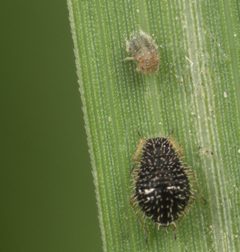
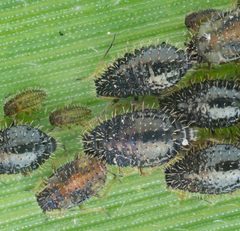
Distinguished from other cereal aphids by its dark brown to black coloration and covering of white spine-like hairs. Yellow sugarcane aphid (Sipha flava) is bright yellow with rows of dark spots. Greenbug (Schizaphis graminum) is light green with a dark green stripe down the back. Corn leaf aphid (Rhopalosiphum maidis) is dark bluish-green with black , cornicles, and legs. In the field, look for yellow patches around colonies on affected leaves and attendant ants attracted to honeydew.
Images
Appearance
Relatively small, pear-shaped , dark brown to nearly black in color. Body covered with distinctive white, spine-like hairs visible under magnification—giving rise to the 'hedgehog grain aphid.'
Habitat
Cereal crop fields, particularly wheat, barley, and sorghum. Also found on wild grasses including johnsongrass, dallisgrass, and giant wild rice. Optimal temperatures 20–25°C; development hindered below 10°C and above 35°C. Survives winter temperatures down to approximately −16°C based on supercooling point measurements.
Distribution
Native to Europe, Middle East, Asia, and Africa. First detected in North America in California in 2007, with subsequent detections in Georgia (2012, glasshouse), Florida (2011–2012, on produce), and New Mexico (2015, established ). Expanded to Colorado, Utah, and Wyoming by 2015–2017. In South America, detected in Argentina in 2002 and spread rapidly.
Seasonality
Activity temperature-dependent; increase in warm, dry conditions. In temperate regions, active during growing season when temperatures exceed 10°C. In the U.S. Southern Plains and Rocky Mountain states, detected during spring and summer cereal growing seasons; winter survival limited by extreme cold events below −9°C.
Diet
Strictly phloemophagous; feeds on vascular sap of Poaceae. Documented include wheat (Triticum aestivum), barley (Hordeum vulgare), sorghum (Sorghum bicolor), millet, corn, and at least 52 plant worldwide including wild grasses such as Leymus condensatus and Agropyron cristatum.
Host Associations
- Triticum aestivum - primary preferred
- Hordeum vulgare - primary preferred
- Sorghum bicolor - multiple cultivars including varieties
- Millet - including Millex 32 cultivar
- Zea mays - corn
- Leymus condensatus - wild giant wild rice; site of first U.S. detection
- Agropyron cristatum - wild crested wheatgrass
- Lolium multiflorum - Italian ryegrass; shows to endophyte defenses
Life Cycle
Parthenogenetic with both (wingless) and (winged) morphs. Pre-reproductive period approximately 10.5 days at 25–30°C, 11–13 days at 23°C. Developmental time from birth to adult ranges 9.55 days at 30°C to 17.28 days at 15°C; no development at 32.5°C. Adult longevity 18–45 days depending on temperature and . Lower developmental threshold 4.2°C to −5.52°C depending on study; thermal constant approximately 244–332 . No sexual morphs observed in U.S. .
Behavior
Forms colonies on leaves, producing honeydew that attracts ants. Capable of rapid increase under favorable warm, dry conditions. Winged disperse to establish new colonies. In Argentina, spread across an area in 4 years that took 10 years to achieve. Can be transported long distances on commercial crops, including non- plants such as lettuce.
Ecological Role
Pest of cereal crops causing direct feeding damage and transmitting barley yellow dwarf virus, one of the most destructive of small grain crops globally. Feeding causes leaf yellowing, rolling, and desiccation; heavy reduce yields and can delay maturity. In U.S. studies, no significant natural enemy or observed at field sites.
Human Relevance
Economic pest of wheat, barley, and sorghum production. of barley yellow dwarf virus. Management includes monitoring for yellow patches around colonies and attendant ants. (clothianidin, imidacloprid, thiamethoxam) and foliar applications may be used. No significant plant damage observed in early U.S. surveys, but potential for increase if expand. sorghum cultivars effective against sorghum (Melanaphis sorghi) do not resist S. maydis.
Similar Taxa
- Sipha flavaYellow sugarcane aphid; bright yellow with rows of dark spots and short cornicles, does not produce honeydew
- Melanaphis sacchariSugarcane aphid; pale yellow, gray, or tan with black feet, , and cornicles; produces abundant honeydew
- Schizaphis graminumGreenbug; light green with dark green stripe down back, injects toxin causing reddish leaf spots
- Rhopalosiphum maidisCorn leaf aphid; dark bluish-green with black , cornicles, and legs; typically feeds in
Sources and further reading
- BugGuide
- Wikipedia
- GBIF taxonomy match
- iNaturalist taxon
- NCBI Taxonomy
- Catalogue of Life
- Stem- and Leaf- Feeding Insects - AgriLife Extension Entomology
- New Invasive Aphid Pest Found in Albuquerque Area
- barley yellow dwarf virus Archives - Entomology Today
- Sipha-maydis - Entomology Today
- Collaboration Leads to Documentation: Tracking the Spread of Tar Spot on Corn in the U.S.
- Temperature-dependent life history of Sipha maydis (Hemiptera: Aphididae) on wheat
- Effects of Temperature and Host Plant on Hedgehog Grain Aphid, Sipha maydis Demographics
- Sipha maydis (Hemiptera: Aphididae) in the Humid Subtropical Region of Brazil: Distribution, Seasonality and Biology
- Sipha maydis: Distribution and Host Range of a New Aphid Pest of Winter Cereals in Argentina
- PacBio Hi-Fi genome assembly of Sipha maydis, a model for the study of multipartite mutualism in insects
- Sipha maydissensitivity to defences ofLolium multiflorumand its endophytic fungusEpichloëoccultans
- ArtSymbioCyc, a metabolic network database collection dedicated to arthropod symbioses: a case study, the tripartite cooperation in Sipha maydis
- ArtSymbioCyc, a metabolic network database collection dedicated to arthropod symbioses: a case study, the tripartite cooperation in Sipha maydis
- The di-symbiotic systems in the aphids Sipha maydis and Peryphillus lyropictus provide a contrasting picture of recent co-obligate nutritional endosymbiosis in aphids
- <I>Sipha maydis</I>: Distribution and Host Range of a New Aphid Pest of Winter Cereals in Argentina
- Distribution of a New Invasive Species, Sipha maydis (Heteroptera: Aphididae), on Cereals and Wild Grasses in the Southern Plains and Rocky Mountain States
- The Di-Symbiotic Systems in the Aphids Sipha maydis and Periphyllus lyropictus Provide a Contrasting Picture of Recent Co-Obligate Nutritional Endosymbiosis in Aphids