
Sipha
Passerini, 1860
yellow sugarcane aphid (for S. flava), hedgehog grain aphid (for S. maydis)
Species Guides
2- Sipha flava(yellow sugarcane aphid)
- Sipha maydis(Hedgehog Grain Aphid)
Sipha is a of aphids (Aphididae) in the tribe Siphini, with nearly distribution. The genus includes notable agricultural pests, particularly Sipha flava (yellow sugarcane aphid) and Sipha maydis (hedgehog grain ). in this genus feed on grasses and cereal crops, with some capable of transmitting plant viruses such as barley yellow dwarf virus. Several species have expanded their ranges rapidly in recent decades, becoming significant pests of sorghum, sugarcane, wheat, and barley.
Pronunciation
How to pronounce Sipha: //ˈsi.fa//
These audio files are automatically generated. While they are not always 100% accurate, they are a good starting point.
Identification
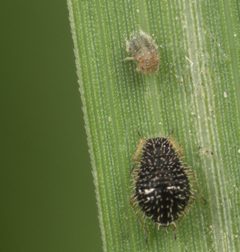
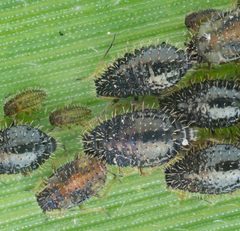
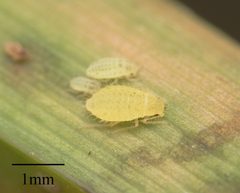
Sipha are small, pear-shaped aphids. Sipha flava is typically lemon yellow to pale green, covered with small spines, with two double rows of dark spots on the dorsum and short cornicles. Sipha maydis is relatively small, pear-shaped, and dark brown to nearly black, with white spine-like hairs visible under magnification. Winged and wingless () morphs occur in both species. Differentiation from other cereal aphids: (Schizaphis graminum) have a dark green stripe down the back; (Rhopalosiphum maidis) are dark bluish-green with black , cornicles, and legs; sugarcane aphid (Melanaphis sacchari) has black feet, antennae, and cornicles on a pale yellow, gray, or tan body.
Images
Habitat
Agricultural fields and natural grasslands; associated with Poaceae including cereal crops and wild grasses. Found in warm- and cool-season grass systems.
Distribution
Nearly . Documented in Europe (Portugal, Spain, Azores, Madeira), Africa (Morocco, South Africa, Swaziland, Zimbabwe), Asia, Middle East, North America (USA, Mexico), Central America and Caribbean. Sipha flava established in southeastern and central United States. Sipha maydis first detected in United States in 2007 (New Mexico), subsequently recorded in Colorado, Utah, and Wyoming; in Argentina since 2002.
Diet
Phloem-feeding on Poaceae. Documented include sugarcane (Saccharum officinarum), sorghum (Sorghum bicolor), wheat (Triticum aestivum), barley (Hordeum vulgare), millet, corn (Zea mays), johnsongrass (Sorghum halepense), dallisgrass, Miscanthus spp., and numerous wild grasses. Sipha maydis has been recorded on over 52 plant host worldwide.
Host Associations
- sugarcane - primary Saccharum officinarum; major pest of sugarcane in Tanzania and other regions
- sorghum - primary Sorghum bicolor; significant pest causing direct damage and virus transmission
- wheat - primary Triticum aestivum; preferred of S. maydis, virus
- barley - primary Hordeum vulgare; preferred of S. maydis
- corn - Zea mays; S. maydis documented
- millet - Multiple ; suitable for development and
- johnsongrass - Sorghum halepense; wild
- dallisgrass - Paspalum dilatatum; for S. flava
- Miscanthus - Miscanthus spp.; for S. flava
- Leymus condensatus - giant wild rice; first US detection site of S. maydis
Life Cycle
Development from first instar to ranges from 9.5 days at 30°C to 17.3 days at 15°C. Lower developmental threshold approximately -5.5°C to 4.2°C depending on study; thermal constant approximately 244-332 . is parthenogenetic with cyclic ; sexual morphs ( females and males) have been described in at least S. littoralis. Females give birth to live nymphs. Lifetime varies with temperature: approximately 45 nymphs per female at 20°C, declining at higher and lower temperatures. Nymphs mature in 13-19 days at favorable temperatures. Adults live 25-30 days under optimal conditions.
Behavior
Feeds on leaf surfaces, with S. kurdjumovi observed to prefer concave upper leaf surfaces and insert stylets primarily through stomata. Produces honeydew that attracts ants. Capable of rapid increase; populations can double every 4-8 days under favorable conditions. Disperses via winged morphs for of new . S. flava induces reddish anthocyanin spots on infested leaves of Sorghum halepense, which paradoxically enhances subsequent feeding and growth.
Ecological Role
Agricultural pest causing direct feeding damage and transmitting plant viruses, particularly barley yellow dwarf virus. Feeding causes leaf discoloration (yellowing, purple, or red spots), stunting, delayed maturity, and plant lodging. Serves as prey for natural enemies including lady beetles, syrphid flies, and parasitic , though parasitization rates are reportedly low for S. flava.
Human Relevance
Significant economic pest of grain and forage crops. S. flava is a major pest of sugarcane and sorghum, causing yield losses and harvest complications from honeydew . S. maydis is an emerging pest of winter cereals in North and South America. Management involves scouting, , varieties, (clothianidin, imidacloprid, thiamethoxam), and foliar insecticides. Overuse of broad-spectrum insecticides can disrupt and exacerbate .
Similar Taxa
- Melanaphis sacchari (sugarcane aphid)Similar range on sorghum and sugarcane; distinguished by black feet, , and cornicles on pale body, and production of abundant honeydew
- Schizaphis graminum (greenbug)Similar cereal pest; distinguished by light green body with dark green stripe, and injection of toxin causing reddish leaf spots
- Rhopalosiphum maidis (corn leaf aphid)Overlapping in sorghum ; distinguished by dark bluish-green color, preference for whorl feeding, and lack of toxin injection
- Sipha flava vs. S. maydisBoth yellowish aphids on grasses; S. flava is lemon yellow with dark spot rows and short cornicles, S. maydis is darker with white spine-like hairs
Sources and further reading
- BugGuide
- Wikipedia
- GBIF taxonomy match
- iNaturalist taxon
- NCBI Taxonomy
- Catalogue of Life
- Stem- and Leaf- Feeding Insects - AgriLife Extension Entomology
- Sipha-maydis - Entomology Today
- New Invasive Aphid Pest Found in Albuquerque Area
- barley yellow dwarf virus Archives - Entomology Today
- Sipha flava . [Distribution map].
- Description of sexuales of <i>Sipha (Sipha) littoralis</i> (Walker, 1848) (Aphididae: Chaitophorinae) with remarks on its distribution and host plants
- Effects of Temperature and Host Plant on Hedgehog Grain Aphid, Sipha maydis Demographics
- Temperature-dependent life history of Sipha maydis (Hemiptera: Aphididae) on wheat
- Progress towards an IPM support tool for the yellow sugarcane aphid, Sipha flava, in Tanzanian sugarcane
- Distribution, Host Range and Seasonal Abundance of Sipha Sp. (Homoptera: Aphididae) and Their Natural Enemies in Pakistan
- Effect of Climate Change on Longevity and Reproduction ofSipha flava(Hemiptera: Aphididae)
- Resistance in Digitaria to Yellow Sugarcane Aphid, Sipha flava (Forbes) as Related to Temperature and Rainfall
- ArtSymbioCyc, a metabolic network database collection dedicated to arthropod symbioses: a case study, the tripartite cooperation in Sipha maydis
- Host plant changes produced by the aphid Sipha flava: consequences for aphid feeding behaviour and growth
- FACTORS DETERMINING THE DISTRIBUTION OF THE APHID SIPHA KURDJUMOVI ON GRASSES
- Sipha maydis (Hemiptera: Aphididae) in the Humid Subtropical Region of Brazil: Distribution, Seasonality and Biology
- Sipha maydis: Distribution and Host Range of a New Aphid Pest of Winter Cereals in Argentina
- Impact of Fluctuating and Constant Temperatures on Key Life History Parameters ofSipha flava(Hemiptera: Aphididae)