
Rhopalosiphum maidis
(Fitch, 1856)
Corn Leaf Aphid, Corn Aphid
is a globally distributed and the most economically damaging aphid pest of maize (Zea mays), particularly in tropical and warmer temperate regions. It feeds on phloem sap and causes direct damage through photoassimilate removal. Dense can deposit large amounts of honeydew on maize tassels, preventing pollen shed and reducing yield by up to 90%. The species transmits several destructive plant viruses including Maize yellow dwarf virus, Barley yellow dwarf virus, Sugarcane mosaic virus, and Cucumber mosaic virus. Most populations reproduce parthenogenetically (anholocyclic), though has been reported in Pakistan and Korea with Prunus species as primary .
Pronunciation
How to pronounce Rhopalosiphum maidis: /rɔˌpæloʊˈsɪfəm ˈmeɪdɪs/
These audio files are automatically generated. While they are not always 100% accurate, they are a good starting point.
Identification
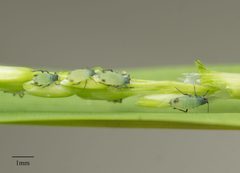
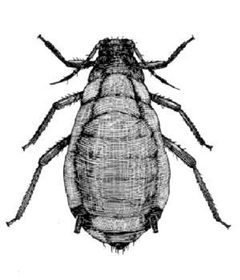
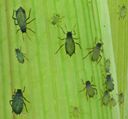
Wingless parthenogenetic females have green to whitish-green bodies with black-brown , , legs, cornicles, tail, and transverse abdominal bands. The body has sparse short hairs. Antennae are less than half the body length. Cornicles are not longer than the finger-like cauda. Winged females have black-brown head and , with cornicles shorter than in wingless forms. These features distinguish it from Rhopalosiphum padi (bird cherry-oat ), which has a reddish-orange area around cornicle bases, and from (Schizaphis graminum), which have a dark green stripe down the back.
Images
Habitat
Found in agricultural fields, grasslands, and forest-grassland zones. In winter, winged parthenogenetic females and larvae survive on wild-growing monocots, moving to agricultural fields in spring. Fields populate gradually from edges to center.
Distribution
Nearly worldwide distribution. Documented in North America (Canada, Mexico, USA), Central America and West Indies, South America (Argentina, Brazil, Chile, Colombia, Ecuador, Guyana, Paraguay, Peru, Surinam, Uruguay, Venezuela), Europe (Austria, Azores, Belgium, Britain, Bulgaria, Czechoslovakia, Denmark, France, Germany, Greece, Hungary, Italy, Netherlands, Norway, Poland, Portugal, Romania, Sicily, Spain, Sweden, Switzerland, Yugoslavia), Asia (Burma, Cambodia, Ceylon, China, Cyprus, Hong Kong, India, Indonesia, Iran, Iraq, Israel, Japan, Jordan, Korea, Lebanon, Malaysia, Nepal, Pakistan, Philippines, Ryukyu Islands, Saudi Arabia, Sikkim, South Yemen, Syria, Taiwan, Thailand, Turkey, Vietnam, Yemen Arab Republic, USSR), Africa (Algeria, Angola, Botswana, Burundi, Cameroon, Canary Islands, Chad, Congo, Dahomey, Egypt, Ethiopia, Gambia, Ghana, Guinea, Ivory Coast, Kenya, Libya, Madagascar, Malawi, Mali, Mauritania, Mauritius, Morocco, Mozambique, Niger, Nigeria, Réunion, Rhodesia, Rwanda, Senegal, Sierra Leone, Somalia, South Africa, Sudan, Tanzania, Togo, Uganda, Upper Volta, Zambia), and Australasia/Pacific Islands (Australia, Caroline Islands, Cook Islands, Easter Island, Fiji, Hawaii, Marianas Islands, New Caledonia, New Hebrides, New Zealand, Papua New Guinea, Solomon Islands, Tonga Islands, Wallis Islands, Irian Jaya).
Seasonality
In southwestern Ontario, from the south begins early spring (alatae with colonies found by late April). of field corn occurs over a month after plant . reach maximum late summer. In temperate regions, cannot overwinter; re-establishes annually via migration. continues year-round in suitable climates with up to 12 per year.
Diet
Feeds on phloem sap of maize (Zea mays) and other cultivated and wild monocots. Also damages rice, sorghum, wheat, barley, oat, rye, sugarcane, and various Gramineae . Barley is a particularly suitable .
Host Associations
- Zea mays (maize/corn) - primary and major economic cropMost commonly encountered and economically damaging on maize; causes direct damage and transmits viruses
- Sorghum bicolor (sorghum) - Feeding, growth, and markedly poorer on smaller plants; associated with less time spent feeding and increased activity
- Hordeum vulgare (barley) - particularly suitable Considerable within- variation in resistance observed
- Oryza sativa (rice) - Documented damage to rice crops
- Triticum aestivum (wheat) - Included in range
- Secale cereale (rye) - Included in range
- Avena sativa (oat) - Included in range
- Saccharum officinarum (sugarcane) - Included in range
- Prunus spp. - primary ()Reported as primary for in Pakistan and Korea; males found in Japan and Kenya
- Maize yellow dwarf virus - Transmitted to maize
- Barley yellow dwarf virus - Transmitted to maize
- Sugarcane mosaic virus - Transmitted to maize
- Cucumber mosaic virus - Transmitted to maize
Life Cycle
Most are anholocyclic, with occurring entirely by . Under laboratory conditions at 25.5°C with 14:10 light:dark , prereproductive period averages 5.9 days, reproductive period 15.8 days, postreproductive period 9.6 days, with average of 68.2 nymphs per female. reported in Pakistan and Korea with Prunus as primary ; males but not sexually reproducing females found in Japan and Kenya populations. (winged) forms produced under crowded conditions; oviparae and males produced in response to short photoperiod. Up to 12 per year reported.
Behavior
Winged parthenogenetic females and larvae overwinter on wild-growing monocots, migrating to agricultural fields in spring. Fields populate gradually from edges to center. activity requires minimum temperature of 13°C. Under enhanced CO2 conditions, growth rate and on barley significantly decreased; volatiles from barley grown under enhanced CO2 less attractive than atmospheric CO2 conditions. Temperature and crowding have differential effects on wing formation in parthenogenetically reproducing individuals. Exhibits greater of benzoxazinoids (maize defensive metabolites) relative to other maize-feeding aphids. Repelled by volatiles from damaged maize plants, including (E)-β-farnesene ().
Ecological Role
Major agricultural pest causing economic damage to grain crops through direct feeding and as a of destructive plant viruses. Attracts beneficial insects such as lady beetles, which may subsequently attack other pests.
Human Relevance
Significant economic pest of maize and other cereal crops. Yield losses occur through direct photoassimilate removal, honeydew deposition interfering with pollen shed, and virus transmission. Management includes (maize inbred lines vary in resistance), chemical control, and through natural enemies. sequenced (321-326 Mb, 17,629-17,647 protein-coding genes) to enable research on virus transmission, resistance, and ecological interactions. numbers vary within : 2n = 8 (typical on maize), 9, and 10 (typical on barley).
Similar Taxa
- Rhopalosiphum padi (bird cherry-oat aphid)Both feed on cereals; R. padi has reddish-orange area around cornicle bases, while R. maidis has entirely black-brown cornicles and lacks this coloration. R. padi also differs in preferences and is less associated with maize .
- Schizaphis graminum (greenbug)Both are cereal aphids; have characteristic dark green stripe down the back and inject toxin causing leaf reddening, while R. maidis lacks this stripe and does not inject toxin causing purple discoloration.
- Sipha flava (yellow sugarcane aphid)Both yellowish aphids on grasses; S. flava has rows of dark spots and short cornicles, produces no honeydew, and injects toxin causing purple seedling discoloration. R. maidis has longer cornicles, produces abundant honeydew, and lacks spotted pattern.
- Melanaphis sacchari (sugarcane aphid)Both pale aphids on sorghum; M. sacchari has black feet, , and cornicles like R. maidis but is typically found on leaf undersides rather than in , and produces more extensive honeydew coverage.
Sources and further reading
- BugGuide
- Wikipedia
- GBIF taxonomy match
- iNaturalist taxon
- NCBI Taxonomy
- Catalogue of Life
- Stem- and Leaf- Feeding Insects - AgriLife Extension Entomology
- Seedling to tassel stage insect control - AgriLife Extension Entomology
- Managing Insect and Mite Pests of Texas Corn - AgriLife Extension Entomology
- Publications | Entomology Research Museum
- Aboveground Pests - AgriLife Extension Entomology
- Cutting Through the Complexity of Managing Early-Season Crop Pests
- Rhopalosiphum maidis . [Distribution map].
- Biology of Laboratory-Reared Corn Aphids, Rhopalosiphum maidis (Homoptera: Aphididae)1
- Genome sequence of the corn leaf aphid ( Rhopalosiphum maidis Fitch)
- BIOLOGY OF THE CORN LEAF APHID, RHOPALOSIPHUM MAIDIS (HOMOPTERA: APHIDIDAE), IN SOUTHWESTERN ONTARIO
- Morphological and Biochemical Responses of Three Durum Wheat Varieties to Aphid (Rhopalosiphum maidis) Infestation
- RESISTANCE OF SORGHUM BICOLOR TO RHOPALOSIPHUM MAIDIS AND PEREGRINUS MAIDIS AS AFFECTED BY DIFFERENCES IN THE GROWTH STAGE OF THE HOST
- Loss in Corn Yield Associated with the Abundance of the Corn Leaf Aphid, Rhopalosiphum maidis, in Indiana1