
Rhopalosiphum
Koch, 1854
Cherry-Grass Aphids
Species Guides
5- Rhopalosiphum enigmae(cattail aphid)
- Rhopalosiphum maidis(Corn Leaf Aphid)
- Rhopalosiphum nymphaeae(waterlily aphid)
- Rhopalosiphum padi(bird cherry-oat aphid)
- Rhopalosiphum rufiabdominale(rice root aphid)
Rhopalosiphum is a of aphids in the Aphididae comprising approximately 16-17 worldwide. Species within this genus are significant agricultural pests, feeding on phloem of plants and causing direct damage to crops. Several species, notably Rhopalosiphum padi (bird cherry-oat ) and (), are important of plant viruses including barley yellow dwarf virus and maize dwarf mosaic virus. The genus exhibits typical aphid characteristics including with both winged and wingless forms, and parthenogenetic in favorable conditions.
Pronunciation
How to pronounce Rhopalosiphum: /roʊˌpæloʊˈsaɪfəm/
These audio files are automatically generated. While they are not always 100% accurate, they are a good starting point.
Identification
Distinguished from other by combination of associations and morphological features. Rhopalosiphum padi has reddish-orange coloration around cornicle bases, distinguishing it from greenbug (Schizaphis graminum) which has a dark green stripe down the back. is dark bluish-green with entirely black appendages, contrasting with yellow sugarcane aphid (Sipha flava) which is bright yellow with rows of dark spots and short cornicles. Rhopalosiphum rufiabdominale develops on roots rather than above-ground plant parts, with reddish abdominal markings. Cornicles in Rhopalosiphum are typically medium-length, longer than those of Sipha but shorter than those of Macrosiphum.
Images
Appearance
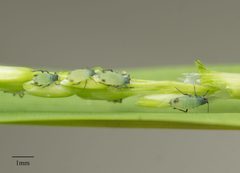
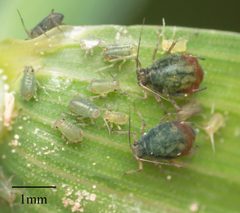
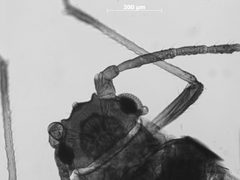
Small soft-bodied insects, typically 1-3 mm in length. Body coloration varies by : Rhopalosiphum padi is yellowish green, dark green, or black with a reddish-orange area around the base of the cornicles; is oval and dark bluish-green with black , cornicles, and legs; Rhopalosiphum rufiabdominale is olive or dark green with a reddish area at the rear between the cornicles. All species possess the characteristic features: pear-shaped body, long antennae, pair of cornicles (siphunculi) on the , and . Winged forms () have membranous wings with distinct venation; wingless forms (apterae) are more common in established colonies.
Habitat
Agricultural fields, grasslands, and areas with plants. occupy diverse : Rhopalosiphum padi on cereals and grasses including bird cherry (Prunus padus) as primary host; in of preboot sorghum and maize; Rhopalosiphum rufiabdominale on roots of grains, sedges, and other plants; Rhopalosiphum nymphaeae on aquatic plants including water lilies. Some species utilize woody primary hosts (Prunus spp.) for and herbaceous secondary hosts for parthenogenetic .
Distribution
distribution with present across North America, Europe, Asia, and other regions. Rhopalosiphum padi is widespread in temperate cereal-growing regions. occurs in maize and sorghum production areas globally. Rhopalosiphum rufiabdominale has been recorded in North America for over a century and is now established on indoor-grown cannabis throughout North America. Specific distribution varies by species; 17 species recognized worldwide with individual ranges reflecting plant distributions.
Seasonality
Activity patterns vary by and climate. In temperate regions, occurs as on primary woody or as active stages in mild conditions. Spring to secondary hosts occurs when temperatures permit. Rhopalosiphum padi build during winter and early spring on small grains, with peak activity during tillering and stem elongation stages. Multiple per year under favorable conditions; populations decline rapidly after grain from boot. Continuous possible in greenhouse and indoor environments without .
Diet
Phloem-feeding . Rhopalosiphum padi feeds on Prunus padus (bird cherry) as primary , and various cereals and grasses (oats, barley, wheat) as secondary hosts. feeds on maize, sorghum, and other grasses, primarily in leaf . Rhopalosiphum rufiabdominale feeds on roots of rice, wheat, other small grains, sedges, and has been observed on cotton, squash, peppers, dieffenbachia, and Cannabis sativa. Rhopalosiphum nymphaeae feeds on water lilies and related aquatic plants. Some exhibit strict host fidelity; others are on grasses and cereals.
Host Associations
- Prunus padus - primary bird cherry, for of R. padi
- Triticum aestivum - secondary wheat
- Hordeum vulgare - secondary barley
- Avena sativa - secondary oats
- Zea mays - maize, for R. maidis
- Sorghum bicolor - grain and forage sorghum, for R. maidis and R. padi
- Oryza sativa - rice, for R. rufiabdominale
- Chusquea tomentosa - bamboo, for R. chusqueae
- Musa spp. - banana, for R. musae
- Nymphaea spp. - water lily, for R. nymphaeae
- Cannabis sativa - hemp/cannabis, for R. rufiabdominale
- Cyperaceae - sedges, for R. rufiabdominale
Life Cycle
Complex involving alternation between primary woody (for ) and secondary herbaceous hosts (for parthenogenetic ) in most temperate . Obligate possible in some or continuous favorable conditions. Females give birth to live young (nymphs) without mating in parthenogenetic . Nymphs develop through four instars before adulthood. Development time varies with temperature: approximately 5 days from birth to under optimal conditions for some species. Adults live 25-30 days. Winged forms produced in response to crowding, host quality decline, or seasonal cues. Sexual forms (males and females) produced in autumn on primary host, producing . Some species like R. maidis may reproduce parthenogenetically year-round in suitable climates or indoor environments.
Behavior
Form colonies on plants with aggregating mediated by . Feeding occurs through inserted into phloem sieve elements. Honeydew is common, with some producing substantial quantities that promote growth. Defensive behaviors include cornicle secretion of (E-β-farnesene) and kicking with hind legs. Winged forms disperse to new hosts using wind currents and active . exhibits specific behavior of feeding deep within sorghum . Rhopalosiphum rufiabdominale has cryptic subterranean behavior, feeding on roots and emerging only when are high or for . Drop-off response to disturbance and natural enemy presence observed.
Ecological Role
Significant herbivores in agricultural and natural grassland . Role as of plant viruses amplifies their ecological and economic impact beyond direct feeding damage. Rhopalosiphum padi and R. maidis transmit barley yellow dwarf virus, maize dwarf mosaic virus, and other luteoviruses and potyviruses. Honeydew production supports secondary consumers including ants, , and fungi. Serve as prey for diverse natural enemies including lady beetles (Coccinellidae), lacewings (Chrysopidae), syrphid fly larvae, wasps (Aphidius, Lysiphlebus), and fungi. Some like R. maidis may attract beneficial insects that subsequently control more damaging pest species.
Human Relevance
Major agricultural pests causing direct yield loss through phloem feeding and indirect losses through virus transmission. Rhopalosiphum padi is a principal of barley yellow dwarf virus in small grains globally. transmits maize dwarf mosaic virus and causes occasional damage to sorghum exertion. Rhopalosiphum rufiabdominale has emerged as a significant pest of indoor-grown cannabis in North America, causing growth retardation and yield loss. Management relies on crop varieties, , foliar insecticides, and . established for several in major crops. significance for some virus . Used in banker plant systems for biological control: R. padi on cereals supports Aphidius colemani that controls other pests in greenhouses.
Similar Taxa
- Schizaphis graminumGreenbug is also a cereal-feeding but has distinctive dark green stripe down the back and injects toxin causing reddish leaf spots; Rhopalosiphum padi lacks this stripe and does not inject toxin
- Sipha flavaYellow sugarcane aphid is bright yellow with rows of dark spots and short cornicles, produces no honeydew; Rhopalosiphum typically have longer cornicles and produce honeydew
- Myzus persicaeGreen peach aphid is green or pink with prominent at base of and feeds on broadleaf plants including solanaceous crops; Rhopalosiphum lack these tubercles and primarily feed on grasses and cereals
- Macrosiphum avenaeEnglish grain aphid is larger (about 1/10 inch), with long black , cornicles, and legs; distinguished from smaller Rhopalosiphum by size and proportions
- Diuraphis noxia is spindle-shaped with short and projection above cauda giving double-tailed appearance; causes distinctive white and purple streaks and leaf rolling unlike Rhopalosiphum damage
Misconceptions
Rice root (Rhopalosiphum rufiabdominale) has been frequently misidentified in online discussions about cannabis production, with incorrect information borrowed from unrelated root-feeding such as grape phylloxera (Daktulosphaira vitifoliae) or various Pemphigus species. () is often assumed to be highly damaging to sorghum, but economic loss is rare; its presence can actually be beneficial by attracting natural enemies that control more damaging pests. Bird cherry-oat aphid (Rhopalosiphum padi) is sometimes confused with greenbug due to similar , but lacks the toxin-injecting and characteristic damage of Schizaphis graminum.
More Details
Taxonomic note
The Rhopalosiphum was described by Koch in 1854. Some taxonomic authorities have treated Rhopalosiphum as a synonym of Coloradoa, but current consensus accepts Rhopalosiphum as valid. The genus includes approximately 16-17 recognized with variable ranges and strategies.
Research significance
Rhopalosiphum padi has become a model organism for studying rhythms in agricultural pests, with research at Colorado State University investigating circadian and . The ' interactions with plants and viruses continue to be active research areas for development.
Biological control applications
Banker plant systems utilizing Rhopalosiphum padi on wheat or barley support of the Aphidius colemani, which also parasitizes economically damaging aphids including Myzus persicae and Aphis gossypii in greenhouse environments. This represents an important non-chemical management strategy.
Sources and further reading
- BugGuide
- Wikipedia
- GBIF taxonomy match
- iNaturalist taxon
- NCBI Taxonomy
- Catalogue of Life
- Aboveground Pests - AgriLife Extension Entomology
- Stem- and Leaf- Feeding Insects - AgriLife Extension Entomology
- Rice Root Aphid: An Insect Surprise on Indoor-Grown Cannabis
- Got Aphids? Call in the Reinforcements With Banker Plants
- Uncategorized | Blog - Part 50
- An Entomologist's Adventure in the Web of Plant-Virus-Insect Interactions