
Rhopalosiphum padi
(Linnaeus, 1758)
bird cherry-oat aphid, oat-bird cherry aphid, apple-grain aphid
Rhopalosiphum padi is a globally distributed and major pest of temperate cereal crops. It exhibits a complex involving alternation between a woody primary host (Prunus padus, bird cherry) and herbaceous secondary hosts including barley, oats, wheat, and other grasses. The species is the principal of barley yellow dwarf virus (BYDV) and several other economically important plant viruses. Unlike some cereal aphids, it does not inject toxins while feeding, so direct damage from feeding is generally less severe than virus transmission losses.
Pronunciation
How to pronounce Rhopalosiphum padi: //ˌroʊ.pə.loʊˈsɪ.fəm ˈpeɪ.daɪ//
These audio files are automatically generated. While they are not always 100% accurate, they are a good starting point.
Identification
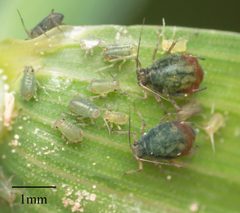
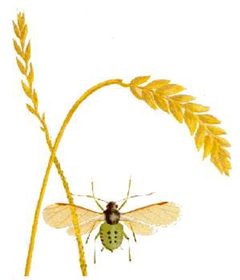
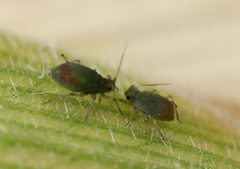
are small (approximately 1.5–2.0 mm), soft-bodied aphids with coloration ranging from yellowish-green to dark green or black. A distinctive reddish-orange patch surrounds the base of the cornicles (siphunculi), which are short and cylindrical. This reddish cornicle base distinguishes R. padi from the (Schizaphis graminum), which has a dark stripe, and from the (), which lacks prominent cornicles and has a "double-tailed" appearance from a caudal projection. Winged forms (alatae) have a dark thoracic dorsum and are produced in high proportions during spring from primary to secondary .
Images
Habitat
Found in temperate agricultural landscapes, particularly cereal-growing regions. On primary , colonies develop on young shoots and leaves of bird cherry (Prunus padus) in spring, often inducing pseudogall formation. On secondary hosts, concentrate at the base of cereal stems and tillers, favoring moist, cool conditions. In greenhouses, can be maintained on banker plants (oats, barley, wheat) for systems.
Distribution
distribution spanning Europe, Asia, Africa, Australasia, North America, and South America. In Europe, present from Scandinavia to the Mediterranean; in Asia, recorded from China, Japan, India, and the Middle East; in North America, widespread in Canada and the United States; also established in South America (Argentina, Brazil, Chile, Peru), Australia, New Zealand, and various Pacific islands.
Seasonality
Fundatrices hatch from on primary (Prunus padus) from early to mid-March in temperate regions, beginning by mid-April. First- alatae migrate to cereals in early May; mass of second-generation alatae occurs late May to early June, leaving primary hosts entirely by early June. On secondary hosts, persist through summer. Gynoparae return to primary hosts from late August through September, producing oviparae; males arrive October to mid-November. Mating occurs and eggs are laid from October through mid-November for overwintering.
Diet
Phloem-feeding sap-sucker specializing on vascular plants. Primary : Prunus padus (bird cherry), where and -laying occur. Secondary hosts include major cereals: barley (Hordeum vulgare), oats (Avena sativa), wheat (Triticum aestivum), as well as rice (Oryza sativa), maize (Zea mays), and various pasture grasses (Poaceae). Has also been recorded on apple (Malus domestica) and Manila hemp.
Host Associations
- Prunus padus - primary / winter hostSite of and ; induces pseudogall formation on shoots
- Prunus virginiana - primary in North America
- Hordeum vulgare - secondary Major cereal crop pest
- Avena sativa - secondary Major cereal crop pest
- Triticum aestivum - secondary Major cereal crop pest
- Zea mays - secondary Maize-growing regions
- Oryza sativa - secondary Rice records
- Poaceae - secondary Various pasture grasses and cereals
Life Cycle
Holocyclic with alternation in temperate regions; anholocyclic (permanent ) possible in milder climates. : on primary host wood. Spring: fundatrices hatch, reproduce parthenogenetically, produce alatae that migrate to cereals. Summer: multiple parthenogenetic on secondary hosts. Autumn: gynoparae and males return to primary host; sexual females (oviparae) produced; mating occurs; eggs laid for overwintering.
Behavior
Exhibits behavioral rhythms in selection and feeding activity. Forms dense colonies at stem bases of cereals. Produces (E-β-farnesene) that induce . Engages in mutualistic relationships with ants (Lasius niger observed) that tend colonies for honeydew and may provide protection. Winged forms respond to plant volatiles and visual cues for host location during .
Ecological Role
Major agricultural pest through direct feeding and especially as a virus . Serves as for (Aphidius colemani, Aphidius uzbekistanicus) and including Coccinellidae, Syrphidae, Chrysopidae, and Araneae, supporting natural enemy in cereal agroecosystems. Used in banker plant systems to maintain parasitoid for of other pests in greenhouses.
Human Relevance
Principal of barley yellow dwarf virus (BYDV), cereal yellow dwarf virus–RPV, filaree red leaf virus, maize leaf fleck virus, and rice giallume virus, causing substantial yield losses in global cereal production. Direct feeding damage is generally minor compared to virus transmission. Management relies on varieties, , and . Employed in banker plant systems in greenhouses to support Aphidius colemani for control of green peach aphid and melon aphid.
Similar Taxa
- Schizaphis graminum (greenbug)Also a major cereal pest, but distinguished by pale green color with dark stripe, toxin injection causing yellowing and death of leaves, and shorter cornicles without reddish base
- Diuraphis noxia (Russian wheat aphid)Lacks prominent cornicles entirely, has distinctive caudal projection giving "double-tailed" appearance, causes leaf rolling and streaking through toxin injection, does not BYDV
- Sitobion avenae (English grain aphid)Larger (up to 3.5 mm), longer black and cornicles, light green to brown coloration without reddish cornicle base, feeds preferentially on grain rather than stem bases
- Rhopalosiphum maidis (corn leaf aphid)Closely related with similar , but prefers maize and sorghum, dark blue-green color, shorter relative to body
- Rhopalosiphum rufiabdominale (rice root aphid)Closely related , olive to dark green with reddish area at rear, primarily root-feeding habit, different primary (Prunus spp. peaches/plums)
Sources and further reading
- BugGuide
- Wikipedia
- GBIF taxonomy match
- iNaturalist taxon
- NCBI Taxonomy
- Catalogue of Life
- Aboveground Pests - AgriLife Extension Entomology
- Got Aphids? Call in the Reinforcements With Banker Plants
- An Entomologist's Adventure in the Web of Plant-Virus-Insect Interactions
- Why Insects Make Great Ambassadors for Science Education
- Rice Root Aphid: An Insect Surprise on Indoor-Grown Cannabis
- Uncategorized | Blog - Part 50
- Rhopalosiphum padi . [Distribution map].
- Untersuchungen zum Auftreten der Haferblattlaus Rhopalosiphum padi (L.) (Homoptera: Aphididae) an ihrem Winterwirt Prunus padus L.
- Effect of selected flavonoids on the behavior of the bird cherry-oat aphid (Rhopalosiphum padi L.) during the colonization of winter wheat
- Exploring the role of tall fescue-endophyte association in shaping Rhopalosiphum padi host choice and reproduction and barley yellow dwarf virus transmission
- Peer Review #1 of "Asexual reproduction of a few genotypes favored the invasion of the cereal aphid Rhopalosiphum padi in Chile (v0.1)"
- Peer Review #2 of "Asexual reproduction of a few genotypes favored the invasion of the cereal aphid Rhopalosiphum padi in Chile (v0.2)"
- Peer Review #1 of "Asexual reproduction of a few genotypes favored the invasion of the cereal aphid Rhopalosiphum padi in Chile (v0.2)"
- Supplemental Information 7: Reproductive performance of five clonal lineages of the Rp1 genotype of Rhopalosiphum padi tested on four hosts.
- Peer Review #2 of "Asexual reproduction of a few genotypes favored the invasion of the cereal aphid Rhopalosiphum padi in Chile (v0.1)"
- Activity of the grain aphid (Sitobion avenae) and the bird cherry-oat aphid (Rhopalosiphum padi) during the feeding behaviour on an artificial diet containing extracts of surface waxes