
Rhopalosiphum rufiabdominale
(Sasaki, 1899)
rice root aphid, red rice root aphid
Rhopalosiphum rufiabdominale is a globally distributed root-feeding pest with a remarkably broad range spanning 22 plant . Native to East Asia, it has established across every continent except Antarctica. The exhibits a heteroecious in its native range, alternating between Prunus species (primary hosts) and herbaceous plant roots (secondary hosts), though dominates in temperate regions and protected . Its subterranean habit makes detection difficult and management challenging. The aphid several economically important plant viruses including barley yellow dwarf virus and sugarcane yellow leaf virus, and has emerged as a significant pest of indoor-grown cannabis in North America.
Pronunciation
How to pronounce Rhopalosiphum rufiabdominale: /roʊˌpæloʊˈsɪfəm ˌruːfiæbdəmɪˈnɑːli/
These audio files are automatically generated. While they are not always 100% accurate, they are a good starting point.
Identification
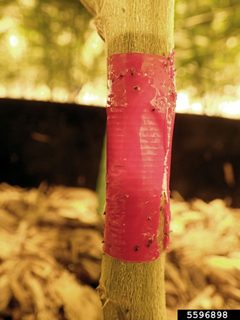
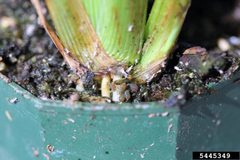
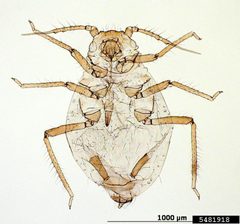
Initial detection is difficult due to subterranean habit; inspect roots carefully or monitor for winged emerging from soil fissures. Sticky traps may provide first indication of presence. activity near plants indicates honeydew production and potential . Distinguished from Rhopalosiphum padi by five antennal segments and denser setae. In hydroponic systems, irrigation events may temporarily bring aphids to surface. Plant (, stunting, wilting) are easily mistaken for nutritional deficiencies or . Winged adults can be trapped on plant surfaces or observed climbing stems from soil.
Images
Habitat
Primarily subterranean, inhabiting soil, growing media, and root zones of plants. Occurs in agricultural fields, greenhouses, hydroponic systems, aeroponic systems, and indoor facilities. Can persist in soil and media as . Favors sandy soils and mulched top dressings. In native range, alternates between aerial parts of Prunus (fall/winter) and roots of herbaceous hosts (remainder of year).
Distribution
distribution spanning every continent except Antarctica. Native to East Asia (Japan). Established in over 50 countries including United States (present for over 100 years, documented in nearly half of states), Canada, India, Australia, and multiple European, African, and South American nations. Particularly widespread and damaging in Japanese rice crops. First holocyclic colony outside East Asia reported in Italy (2005).
Seasonality
In native range: heteroecious holocycle with on Prunus primary in fall/winter, on herbaceous root hosts remainder of year. In temperate regions and protected : predominantly asexual year-round. Under ideal conditions (23°C), new every 7 days; can double in less than 2 days. Winged emerge in late spring to migrate to new hosts.
Diet
Phloem-feeding on plant roots and occasionally stems. Strongly prefers monocotyledonous plants over dicotyledonous plants; multiplies significantly faster on monocots. Documented include rice, barley, wheat, oats, millet, sorghum, sugarcane, cotton, tobacco, potato, tomato, pepper, eggplant, squash, celery, cauliflower, corn, cannabis, Prunus (peach, plum, apricot), and numerous ornamental plants.
Host Associations
- Prunus spp. - Primary (, native range)17 known stone fruit and ornamental trees/shrubs; aerial parts used in fall/winter
- Oryza sativa - Secondary Major economic ; yield losses up to 50% documented in Japan
- Cannabis sativa - Secondary Emerging significant pest in North American indoor ; thrives in all growing media
- Hordeum vulgare - Secondary Preferred monocot; used as candidate
- Triticum aestivum - Secondary One of most abundant aphids affecting wheat in United States
- Solanum lycopersicum - Secondary Significant pest in greenhouse production
- Capsicum spp. - Secondary Greenhouse pest documented in Ontario since 2005
- Secale cereale - Secondary Preferred monocot in choice experiments
Life Cycle
Heteroecious holocyclic in native range: alternates between sexual phase on Prunus primary (producing ) and phase on roots of herbaceous secondary hosts. In temperate/protected environments: typically anholocyclic with continuous . Nymphs mature in less than 10 days; live up to 30 days reproducing daily. Under optimal conditions (23°C), time 7 days. Overwintering as mitotically derived eggs in soil/media when conditions unfavorable.
Behavior
Subterranean habit with most occurring below ground. Winged emerge from soil fissures to colonize new , can persist on aerial plant parts for weeks. Strong preference for monocotyledonous hosts demonstrated in choice experiments; host selection involves cues beyond olfaction alone. Forms mutualistic associations with ants attracted to honeydew. High mobility and adaptive plasticity contribute to success. Disperses via winged adults, contaminated soil/media, plant material, and possibly irrigation water in hydroponic systems.
Ecological Role
Herbivore and agricultural pest. of multiple plant viruses including barley yellow dwarf virus, sugarcane yellow leaf virus, sugarcane mosaic virus, maize mosaic virus. Honeydew production promotes growth. Serves as for including Aphelinus varipes and Aphelinus spp. Potential prey for soil-dwelling including Stratiolaelaps scimitus.
Human Relevance
Significant agricultural pest causing yield losses up to 50% in rice and 80% in organic celery. Economic damage documented in cereals, vegetables, stone fruits, and emerging as major pest of indoor cannabis production. Management complicated by subterranean limiting and rendering foliar ineffective. economically important plant viruses. Subject to approaches including cultural controls, physical exclusion, banker plant systems, and fungi.
Similar Taxa
- Rhopalosiphum padiSimilar range and ; distinguished by six antennal segments (vs. five), less dense setae, and more prominent antennal
- Rhopalosiphum maidisRelated cereal-feeding ; similar preference for monocot but primarily leaf-feeding rather than root-feeding
- Pemphigus spp.Other root-feeding aphids; frequently confused in internet sources but morphologically and biologically distinct
- Phorodon cannabisCannabis-specific pest; feeds on aerial parts rather than roots, allowing differentiation by location on plant
Misconceptions
Frequently confused with grape phylloxera (Daktulosphaira vitifoliae) and Pemphigus in informal online sources. Often misidentified in cannabis discussions prior to formal documentation. Plant (, stunting, wilting) commonly attributed to nutritional deficiencies or rather than root , delaying detection and management.
More Details
Virus Transmission
barley yellow dwarf virus, sugarcane yellow leaf virus, sugarcane mosaic virus, and maize mosaic virus. Virus transmission occurs through stylet-borne and persistent mechanisms.
Management Challenges
Subterranean limits efficacy of foliar and many agents. Heat sterilization of media reduces microorganism diversity. insecticides historically used but many now prohibited due to resistance, environmental persistence, and non-target effects.
Biological Control Potential
fungus lecanii (formerly Verticillium lecanii) discovered to cause substantial mortality in squash crops; routine use subsequently adopted. bassiana with reduced 62% in organic systems. Stratiolaelaps scimitus offers potential below-ground suppression. Aphelinus varipes parasitizes both rice root aphids and cannabis aphids at rates up to 21%.
Trap Crop Potential
Laboratory studies demonstrate strong preference for monocots; rye identified as candidate to divert aphids from valuable dicot crops including cannabis and vegetables, though field validation in commercial settings remains needed.
Sources and further reading
- BugGuide
- Wikipedia
- GBIF taxonomy match
- Catalogue of Life
- Aboveground Pests - AgriLife Extension Entomology
- Stem- and Leaf- Feeding Insects - AgriLife Extension Entomology
- Rice Root Aphid: An Insect Surprise on Indoor-Grown Cannabis
- Got Aphids? Call in the Reinforcements With Banker Plants
- Uncategorized | Blog - Part 50
- An Entomologist's Adventure in the Web of Plant-Virus-Insect Interactions
- Rice Root Aphids, Rhopalosiphum rufiabdominale, Preferentially Choose and Multiply Faster on Monocotyledonous Plants
- Rice root aphids, Rhopalosiphum rufiabdominale, and cannabis aphids, Phorodon cannabis (Hemiptera: Aphididae), are parasitised by Aphelinus varipes (Hymenoptera: Aphelinidae)