
Stratiolaelaps
Berlese, 1916
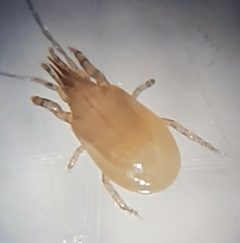
Stratiolaelaps is a of predatory mites in the Laelapidae, with at least nine described . The genus is best known from Stratiolaelaps scimitus, a soil-dwelling native to the Northern Hemisphere that has been commercialized globally as a agent. Members of this genus inhabit soil, litter, and rhizosphere environments where they prey on small including fungus gnat larvae, pupae, , and other mites. The genus exhibits haplodiploid sex determination and has been subject to extensive study regarding mass rearing, genetic management, and behavioral responses to chemical cues.
Pronunciation
How to pronounce Stratiolaelaps: //stræ.ti.əˈleɪ.læps//
These audio files are automatically generated. While they are not always 100% accurate, they are a good starting point.
Images
Habitat
Soil, humus, and litter microhabitats; rhizosphere environments of plants; greenhouse substrates and agricultural soils. occupy (ground-dwelling) where they interact with soil .
Distribution
Native to the Northern Hemisphere; commercial established in North America, Europe, Oceania, and China. Records indicate presence in Southeast Asia based on distribution data. Study populations documented from Rio Grande do Sul, Brazil.
Diet
on soil-dwelling . Documented prey includes: fungus gnat larvae (Sciaridae), pupae (Thripidae), root-knot second-stage juveniles (Meloidogyne incognita), potworms (Enchytraeidae), acaroid mites (Acaridae), Drosophila and larvae, and the poultry red mite . Stratiolaelaps scimitus shows prey stage preference, with stages preferred over when attacking D. gallinae.
Life Cycle
Developmental duration varies with diet and temperature. On optimal diets (Ephestia kuehniella , Tyrophagus curvipenis), development completes in approximately 9.7–10 days at 25°C; slower development occurs on pollen (18 days) or Artemia cysts (21 days). Total pre-ovipositional period from birth to first oviposition averages approximately 13 days. Female pre-ovipositional period (APOP) is under 3 days on high-quality diets. Oviposition period extends 30+ days under favorable conditions. Egg viability exceeds 97% on adequate diets. doubling time of 11.89 days has been recorded for S. scimitus feeding on .
Behavior
Exhibits complex behavioral responses to volatile chemical compounds. Acetic acid attracts and activates locomotion; thioacetic acid repels and inhibits activity. (tridecylic, oleic, propionic) activate movement. Valeric acid isomers, formic acid, succinic acid, and several other organic compounds inhibit locomotion and induce negative chemostasis. Mating increases oviposition period by 1–2 days and by 50–70% depending on diet. Predatory shows stage-specific , with greater success capturing smaller, prey than larger .
Ecological Role
Predatory agent targeting soil-dwelling pest stages. Effective against fungus gnats, pupae, and plant-parasitic in greenhouse and agricultural systems. Potential for combined use with foliar (e.g., Phytoseiidae) using shared non-pest prey such as Tyrophagus curvipenis for . analysis reveals expansions in gene associated with digestion, detoxification, , and venom production, supporting predatory .
Human Relevance
Commercially mass-produced and sold as biocontrol agent for greenhouse pests, mushroom , and poultry systems. Used to control fungus gnats in horticulture, in greenhouse crops, and in poultry facilities. Recommended for combined application with bassiana for thrips management; the two agents are compatible. Genetic management through periodic outcrossing is recommended to maintain colony and avoid inbreeding depression in commercial rearing programs.
Similar Taxa
- HypoaspisFormerly included some Stratiolaelaps ; S. miles was previously classified as Hypoaspis miles. Distinguished by taxonomic revision based on morphological characters.
- GaeolaelapsAnother laelapid containing soil-dwelling predatory mites with similar ecological roles. Separation based on specific morphological features of the shield and gnathosoma.
More Details
Genomic Resources
High-quality assembly available for S. scimitus (158 contigs, N50 7.66 Mb, 93.1% BUSCO completeness). Genome contains 13,305 protein-coding genes with significant expansions in P450s and carboxylesterases, suggesting genetic mechanisms underlying polyphagy and detoxification capacity.
Inbreeding Considerations
Despite haplodiploid sex determination, S. scimitus exhibits inbreeding depression after 30 of sibling mating, including extended female lifespan (possible trade-off), reduced male longevity, delayed , and reduced . Transcriptomic analysis shows dysregulation in , oxidative stress response, and metabolism .
Mass Rearing Diets
Tyrophagus curvipenis is identified as a promising mass-rearing prey due to ease of culture, non-plant-damaging properties, and lack of allergenic risk to . This mite does not damage plants and can serve as shared prey with foliar in greenhouse systems.
Sources and further reading
- BugGuide
- Wikipedia
- GBIF taxonomy match
- iNaturalist taxon
- NCBI Taxonomy
- Development, survival and reproduction of Stratiolaelaps scimitus (Acari: Laelapidae) on four diets
- Influence of organic acids on locomotor activity of Stratiolaelaps scimitus (Mesostigmata, Laelapidae)
- Ecological response of Stratiolaelaps scimitus (Laelapidae) to Dermanyssus gallinae (Dermanyssidae)
- Effects of thermal shock on the survival and reproduction of Stratiolaelaps scimitus (Mesostigmata: Laelapidae)
- Effects of temperatures on development and reproduction of predatory mite Stratiolaelaps scimitus(Acari: Laelapidae
- A Highly Contiguous Genome Assembly of a Polyphagous Predatory Mite Stratiolaelaps scimitus (Womersley) (Acari: Laelapidae)
- Evaluation of Stratiolaelaps scimitus (Acari: Laelapidae) for controlling the root-knot nematode, Meloidogyne incognita (Tylenchida: Heteroderidae)
- Effects of inbreeding on development, growth, reproduction and survival in a predatory mite Stratiolaelaps scimitus
- Inbreeding depression in the predatory mite Stratiolaelaps scimitus : demographic and transcriptomic insights
- Combined application of Stratiolaelaps scimitus and Beauveria bassiana granules for control of soil-dwelling stage of Frankliniella occidentalis
- Effects of flour mites feeding on powders of two insects and yeast on the life parameters of Stratiolaelaps scimitus
- The entomopathogenic fungus Beauveria bassiana used as granules has no impact on the soil-dwelling predatory mite Stratiolaelaps scimitus
- Development and reproduction of Stratiolaelaps scimitus (Acari: Laelapidae) with fungus gnat larvae (Diptera: Sciaridae), potworms (Oligochaeta: Enchytraeidae) or Sancassania aff. sphaerogaster (Acari: Acaridae) as the sole food source