
Laelapidae
Genus Guides
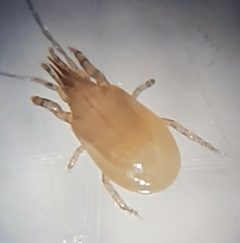
2Laelapidae is a of mites in the order Mesostigmata, comprising over 1500 across 146 . The family exhibits exceptional ecological diversity, including free-living soil , of mammals, and associates of arthropods. Members are characterized by a holodorsal shield covering most of the surface, a sternal shield with three pairs of setae, and a genital shield that is typically tongue- or flask-shaped. The family is the only one in superfamily Dermanyssoidea to include free-living predators.
Pronunciation
How to pronounce Laelapidae: /laɪˈlæpɪdiː/
These audio files are automatically generated. While they are not always 100% accurate, they are a good starting point.
Identification
Identification to and relies on shield , setal counts and arrangements, and cheliceral structure. The holodorsal shield and shield configuration (sternal, genital, anal) are primary diagnostic features. Molecular methods including and high-resolution melting analysis (HRM) of COI barcode regions can distinguish closely related species, particularly in genera such as Tropilaelaps. Some species groups require examination of male cheliceral morphology, which varies with feeding .
Images
Habitat
span soil, mammal nests and burrows, nests (including hives, colonies, and habitats), and tree hollows. Free-living predatory occupy soil and leaf litter. Parasitic species are found on mammals or within their nests. Arthropod-associated species inhabit nests of bees, ants, , and millipedes. Arboreal nest such as Ulyxes are confined to tree hollows and fallen logs.
Distribution
distribution with records from all continents. Significant diversity in the Neotropics, with extensive research in Argentina on rodent-associated . such as Tropilaelaps mercedesae have expanded from native Asian range into Eastern Europe (Georgia, Russia). Australian fauna includes 13 species of Laelaps on native rodents. Indian fauna includes 66 species in 21 , though this is considered poorly known.
Diet
Highly variable across the : free-living are predatory on soil microarthropods ( pupae, fly maggots, , fungus gnats, , astigmatid mites); parasitic species feed on blood or tissue fluids of mammals; -associated species include pollen-feeders (Raymentia, Pneumolaelaps, Melittiphis), of other mites (Neohypoaspis), and obligatory of honey bees (Tropilaelaps). Hypoaspis miles cuts prey with , extracts soft material, and crushes it into semi-liquid form before ingestion, avoiding sclerotized parts.
Life Cycle
Development includes , larva, , deutonymph, and stages. In parasitic , deutonymphs show specific adaptations; for example, the deutonymph of Laelaps mazzai is recognized by marked hypertriquy of the idiosoma. Tropilaelaps mercedesae invades , mates before capping, and females lay eggs during the pupal stage. Adults can survive 7–8 weeks without food in some predatory species.
Behavior
Predatory such as Hypoaspis miles may kill multiple prey before consuming any one. Some species exhibit on bees for when resources are limited. Tropilaelaps mercedesae disperses via swarming honey bees and drifting foragers, with higher attachment rates when brood exceed 2.5 percent per 100 . Laelaps echidnina has been observed to respond to -emitted infrared radiation.
Ecological Role
Free-living contribute to of soil pests and crop pests in agriculture. Parasitic species may play roles in transmission among rodent . -associated species range from commensal to parasitic, with some affecting health. The represents the most ecologically diverse group within Mesostigmata.
Human Relevance
Several are commercially used as agents: Gaeolaelaps aculeifer and Stratiolaelaps scimitus control pupae, fly maggots, , fungus gnats in mushrooms, and poultry red mites. Tropilaelaps species pose significant threats to apiculture; T. mercedesae and T. clareae infest western honey bee (Apis mellifera) colonies and are considered emerging pests with potential for greater damage than Varroa destructor. Monitoring and rapid identification protocols are being developed for surveillance.
Similar Taxa
- DermanyssidaeAlso in superfamily Dermanyssoidea; distinguished by lacking free-living predatory members and typically having different shield fragmentation patterns.
- VarroidaeParasitic mites of bees including Varroa destructor; Tropilaelaps were historically confused with Varroa but differ in , timing, and faster rates.
Misconceptions
The spelling 'Laelaptidae' has been proposed as potentially correct, though 'Laelapidae' remains in widespread use. Tropilaelaps mercedesae was previously assumed to survive only 3 days off , but studies have shown longer survival on bees and in new colonies without brood.
More Details
Taxonomic nomenclature issues
The -group names Geolaelaps and Gaeolaelaps have been subject to confusion regarding spelling and authorship, with both forms appearing in taxonomic and agricultural literature. The genus Laelaps is considered potentially polyphyletic based on molecular studies.
Morphological plasticity
Laelaps mazzai and Androlaelaps fahrenholzi exhibit with morphological and genetic variation across and geographic regions, yet remain single species rather than cryptic .
Sources and further reading
- BugGuide
- Wikipedia
- GBIF taxonomy match
- iNaturalist taxon
- NCBI Taxonomy
- Catalogue of Life
- Lab Test Rapidly IDs Potential Mite Pest of Honey Bees
- New Research Links Honey Bee Swarms to the Spread of an Invasive Mite
- Hitching a Ride: Why a New Mite Might Vex U.S. Beekeepers
- THE GENUS LAELAPS IN AUSTRALIA (ACARINA: LAELAPIDAE)
- Observations on the feeding behaviour of Hypoaspis miles (Mesostigmata: Laelapidae)
- Checklist of Indian mites in the family Laelapidae (Acari: Mesostigmata)
- Ulyxes, a new Australopapuan mite genus associated with arboreal nests (Acari: Laelapidae)
- Nomenclatural notes on the names Gaeolaelaps and Geolaelaps (Acari: Laelapidae)
- Los ácaros Laelapidae (Parasitiformes, Mesostigmata) parásitos de los roedores de la tribu Phyllotini (Cricetidae, Sigmodontinae): sistemática y relaciones filogenéticas
- Host Specificity of Laelaps (Acari: Laelapidae) in Central Brazil
- Status of lifespan in laelapid mites (Acari: Mesostigmata: Laelapidae)
- Three New Unusual Beetle-Associated Species of the Genus Gaeolaelaps (Acari, Mesostigmata, Laelapidae) from Ukraine
- Patrones y factores que determinan la distribución de los ácaros (Mesostigmata, Laelapidae) ectoparásitos de los roedores sigmodontinos (Cricetidae) en la Cuenca del Plata
- Attraction of Laelaps echidnina (Acari: Laelapidae) to Host-Emitted IR Radiation
- Two new species of Myrmozercon (Acari: Laelapidae) from Australian ants (Hymenoptera: Formicidae)
- Effects of temperatures on development and reproduction of predatory mite Stratiolaelaps scimitus(Acari: Laelapidae