
Varroa destructor
Anderson & Trueman, 2000
Varroa mite
Varroa destructor is an external parasitic mite and the most damaging pest of managed colonies worldwide. The originally parasitized the Asian honey bee (Apis cerana) but -shifted to the western honey bee (Apis mellifera), causing catastrophic colony losses. female mites feed on the tissue of adult bees and larvae, while reproducing exclusively within sealed . The mite at least five debilitating viruses, including deformed wing virus, and colonies without management typically collapse within 2–3 years.
Pronunciation
How to pronounce Varroa destructor: /væˈroʊə dɪˈstrʌktər/
These audio files are automatically generated. While they are not always 100% accurate, they are a good starting point.
Identification
Physical differentiation from the closely related Varroa jacobsoni is not possible without analysis, as the two share 99.7% similarity and nearly identical . The only reliable distinguishing feature is association: V. destructor successfully reproduces on Apis mellifera (western honey bee), while V. jacobsoni does not. If a Varroa species is found on A. mellifera, it is almost certainly V. destructor. Varroa underwoodi and V. rindereri can be distinguished by slight differences in body size and setae characteristics, though DNA analysis is required for definitive identification.
Images
Appearance
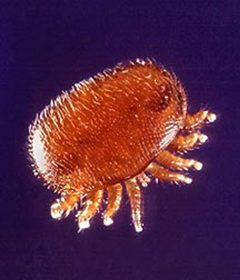
female mites are reddish-brown, flat, and button-shaped, measuring 1.0–1.8 mm long and 1.5–2.0 mm wide. Adult males are white. The body is curved to fit between abdominal segments of bees. Mites possess eight legs and lack . The shield area averages approximately 1.47 mm² in mites from non- host colonies, but is reduced by about 6.8% in mites associated with varroa-resistant colonies.
Habitat
Distribution
Originally restricted to Asia on Apis cerana. Now present throughout North America (excluding Greenland), South America, most of Europe and Asia, and portions of Africa. Confirmed present in Australia (detected 2022 in New South Wales). Not present in Oman, Congo, Democratic Republic of Congo, and Malawi; suspected absent from Sudan and Somalia. Two genetic strains occur: the Korean strain (emerged 1952, now worldwide and ) and the Japanese strain (emerged 1957, same range but at much lower frequency).
Seasonality
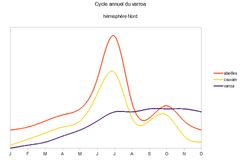
Phoretic stage on bees lasts 4.5–11 days during -rearing periods, or extends to 5–6 months when brood is absent in winter. Mite increase exponentially in summer when drone brood is available, peak in autumn, and often cause colony collapse from late autumn through early spring.
Diet
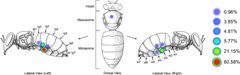
Feeds on the (an organ storing and triglycerides) and of larvae and bees. Feeding occurs primarily on the underside of the 's , particularly the left side beneath the abdominal plates.
Host Associations
- Apis mellifera - primary (western honey bee)Current principal ; susceptible to and mite in both and drone
- Apis cerana - original (Asian )Original ; co-evolved relationship with limited mite primarily in drone and effective host
Life Cycle
Female mites enter just before capping and lay on the cell wall. Eggs (0.2–0.3 mm diameter) hatch into transparent white , which into deuteronymphs, then . Development from egg to adult takes 6–7 days. Males develop and die within the cell after mating with sisters. Only mated female offspring leave the cell. Female life expectancy is approximately 27 days when brood is present. Sibling mating is the norm, contributing to low genetic diversity.
Behavior
females exhibit two behavioral phases: a phoretic stage where they attach to adult bees (preferring nurse bees) to disperse and feed, and a reproductive stage within sealed . Mites show preference for drone cells over cells for . Infested adult bees exhibit increased drifting into other colonies, facilitating mite spread. Mite movement speed and are influenced by viral load, particularly deformed wing virus and sacbrood virus.
Ecological Role
The most significant biotic factor driving colony losses globally. Acts as a biological for at least five viruses (deformed wing virus, virus, Israeli acute paralysis virus, Kashmir bee virus, sacbrood virus) and possibly up to 18. Also serves as a microhabitat for mite-specific viruses that replicate within the mite itself. Invasion of the western honey bee has caused ecological and agricultural disruption through pollination service losses.
Human Relevance
Causes severe economic losses in apiculture worldwide. Unmanaged lead to colony death within 2–3 years in temperate climates. Management relies on integrated pest monitoring, miticides (with growing resistance issues), mechanical controls, and breeding for hygienic . The mite is implicated as a contributing factor to colony collapse disorder. Research into interference treatments and synergist compounds to overcome acaricide resistance is ongoing.
Similar Taxa
- Varroa jacobsoniMorphologically indistinguishable; separated by analysis in 2000. V. jacobsoni does not reproduce on Apis mellifera, making association the practical distinguishing feature.
- Varroa underwoodiDistinguished by slight differences in body size and setae characteristics; occurs on A. mellifera in Papua New Guinea.
- Varroa rindereriDistinguished by slight differences in body size and setae characteristics; less common of honey bees.
Misconceptions
Historically assumed to feed on (blood), but research has shown feeding is primarily on the tissue. Pre-2000 scientific literature referring to V. jacobsoni on western honey bees was actually describing V. destructor due to taxonomic confusion.
More Details
Virus vector capacity
Mites transmit viruses through direct injection during feeding and cause immunosuppression in bees. Deformed wing virus is the most prominent transmitted , causing crumpled wings and shortened . Mites also host their own viral including Varroa destructor virus-2, VDV-3, and VdMLV.
Management challenges
Mite can multiply roughly 12-fold in 12 weeks. Resistance has developed to (tau-fluvalinate, flumethrin), coumaphos, and emerging resistance to amitraz threatens current control options. combining monitoring, cultural controls, mechanical controls, and of chemical treatments is recommended.
Genetic strains
Two distinct haplotypes exist: the Korean strain (global, high frequency, more virulent) and Japanese/Thailand strain (same range, low frequency). Low genetic diversity throughout the is characteristic of an undergoing range and expansion.
Sources and further reading
- BugGuide
- Wikipedia
- GBIF taxonomy match
- iNaturalist taxon
- NCBI Taxonomy
- Catalogue of Life
- UC Davis Scientist Will Discuss Disarming Defenses of the Varroa Mite | Bug Squad
- Mite-Resistant Russian Honey Bees Might Not Prevent Varroa Infestations
- Survey Shines Light on Beekeepers' Efforts to Manage Varroa Mites
- Varroa Mites: New Guide Outlines Integrated Pest Management Options
- How the Varroa Mite Co-Opts Honey Bee Behaviors to Its Own Advantage
- Neonicotinoid Exposure Worsens Varroa Mite Infestations in Honey Bees, Study Shows
- Varroa destructor ve Taşıdığı Virüsler
- Research progress on VARROA DESTRUCTOR
- Varroa Mite, Varroa destructor Anderson and Trueman (Arachnida: Acari:Varroidae)
- Grooming behavior in relation to varroa (Varroa destructor) infestation level of Carniolan honey bee colonies (Apis mellifera carnica)
- Host-parasite interactions between the honey bee, Apis mellifera, and the mite Varroa destructor. Insights into virus spread and Varroa sensitive hygiene
- Reproductive capacity of Varroa destructor in four different honey bee subspecies
- Grooming behaviour and resistance toVarroa destructor
- RNA interference (RNAi) as a next-generation pest control for the honey bee parasite Varroa destructor
- Reduced body size of Varroa destructor associated with varroa-resistant honey bee colonies across Europe
- Viral load alters behavior of the honey bee parasite Varroa destructor v1
- Occurrences and Distributions of Honeybee (Apis mellifera Jemenetica)Varroa Mite (Varroa destructor) in Tigray Region, Ethiopia
- Widespread pyrethroid resistance in Varroa destructor in Türkiye: a molecular warning.