
Varroidae
Delfinado & Baker, 1974
Genus Guides
1- Varroa(Varroa Mites)
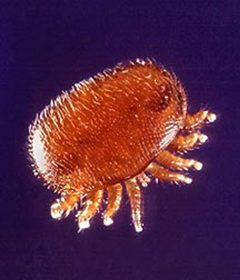
Varroidae is a of parasitic mites in the order Mesostigmata, containing the economically significant Varroa. Members are obligate of honey bees (Apis spp.), with Varroa destructor being the most destructive affecting managed European honey bee (Apis mellifera) colonies worldwide. These mites have a two-stage involving a phoretic traveling phase on bees and a reproductive phase within . The family has become a major focus of apicultural research due to the severe colony losses attributed to Varroa , transmission, and the mites' role in declines.
Pronunciation
How to pronounce Varroidae: /væˈrɔɪdeɪ/
These audio files are automatically generated. While they are not always 100% accurate, they are a good starting point.
Images
Habitat
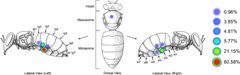
Varroidae mites inhabit colonies, specifically within the nest structure of Apis . They occupy two distinct microhabitats: the exterior of bees (phoretic phase) and the interior of (reproductive phase). In the phoretic phase, adult female mites attach to the or of adult and drone bees. During , female mites enter uncapped brood cells containing developing larvae, remaining hidden until the cell is capped. They then feed and reproduce within the sealed cell alongside the developing pupa. The mites show preference for specific cell types; Varroa jacobsoni has been observed to preferentially invade shallower worker brood cells when available.
Distribution
Varroidae has a distribution in regions where honey bees are present. The originated in Asia, where Varroa mites were first documented in 1904. Varroa destructor spread to Europe in the 1970s and reached North America by 1987. Distribution records from GBIF include Denmark, Norway, and Sweden. The mites now occur wherever Apis mellifera is managed commercially, including temperate and tropical regions globally. Seasonal vary with climate; in temperate Argentina, reproductive rates differ between spring and autumn.
Seasonality
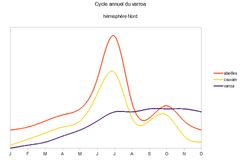
Varroidae exhibits pronounced seasonal tied to availability and climate. In temperate regions, mite peaks in spring when brood rearing increases, with higher proportions of non-reproductive females observed in autumn. Mite within colonies increase during fall, coinciding with reduced brood rearing and the formation of winter clusters. Extended warm fall temperatures, associated with climate change, allow continued foraging activity and mite into colonies later in the season than historically observed.
Diet
female Varroidae mites feed on , not as previously assumed. The fat body tissue, analogous to the mammalian liver, provides nutrients and is involved in detoxification, immune function, and nutrient storage in bees. Feeding occurs during both the phoretic phase on adult bees and intensively during the reproductive phase within , where the female pierces the to access fat body tissue.
Host Associations
- Apis mellifera - primary European honey bee; highly susceptible enabling in both drone and . cause severe colony losses worldwide.
- Apis cerana - native Asian ; original of Varroa mites in their native range. Co-evolved resistance mechanisms including efficient mite removal and restricted to drone only.
Life Cycle
Varroidae has a heteromorphic with two distinct stages. The traveling (phoretic) stage involves female mites dispersing on adult bees. The reproductive stage occurs within sealed : a fertilized female enters an uncapped cell before capping, hides in brood food, and begins feeding when the larva reaches the prepupal stage. She lays an unfertilized male first, followed by fertilized female eggs at approximately 30-hour intervals. Mites undergo two developmental stages before maturity. The male mates with mature sisters within the cell. When the adult emerges, the mother mite and mated daughter mites exit on the new bee.
Behavior
Female Varroidae mites exhibit specific -seeking , preferentially invading cells shortly before capping. They demonstrate photophobic behavior, hiding in brood food until the cell is sealed. The mites are not highly mobile independently and rely on behaviors for between colonies. They exploit bee behaviors including drifting of between hives, robbing of weakened colonies, and reduced swarming in managed settings to spread. Mites can be dislodged by behaviors in host lines.
Ecological Role
Varroidae functions as an obligate of honey bees, with significant impacts on . The mites transmit , most notably deformed wing virus, and their feeding on compromises host immune function and nutrient storage. In natural settings with widely spaced colonies and periodic swarming, mite-host relationships may reach equilibrium. In managed apiculture with high colony densities and suppressed swarming, mite can grow unchecked, contributing to colony collapse. The represents a case study in the ecological consequences of host- co-evolution disrupted by host switching and anthropogenic environmental modification.
Human Relevance
Varroidae, specifically Varroa destructor, is the single greatest threat to managed colonies globally, causing substantial economic losses in apiculture and agricultural pollination services. The mites contribute to colony losses exceeding 20-45% annually in the United States. They necessitate intensive management including chemical treatments (synthetic acaricides and organic acids), cultural practices (drone removal, comb culling), and mechanical controls (screened bottom boards). Acaricide resistance has developed in Varroa . Research explores alternative controls including elevated carbon dioxide during winter storage, mite- breeding, and microbial . The exemplifies how parasitic arthropods can become catastrophic pests following range expansion.
Similar Taxa
- TropilaelapsAnother of parasitic mites affecting honey bees, distinguished by smaller size, faster , and inability to feed on bees—reproduction occurs only in . Tropilaelaps remains primarily in Asia and has not achieved the global distribution of Varroidae.
- Acarapis woodi (tracheal mites)Internal parasitic mites of honey bees that inhabit the tracheal system rather than being external . Different , , and pathological effects distinguish them from Varroidae.
More Details
Taxonomic note
The Varroidae was established by Delfinado and Baker in 1974. It belongs to the superfamily Dermanyssoidea within the order Mesostigmata. The most economically significant is Varroa, with V. destructor being the primary affecting Apis mellifera globally. Varroa jacobsoni, originally described from Apis cerana, was historically confused with V. destructor but is now recognized as a distinct species with different associations and geographic distribution.
Research significance
Varroidae has become one of the most intensively studied groups of parasitic mites due to its agricultural impact. Research spans acaricide resistance mechanisms, - co-evolution, transmission dynamics, and strategies. Recent findings have overturned long-standing assumptions, including the discovery that mites feed on rather than , and that neonicotinoid exposure can increase mite severity through host immunosuppression.
Sources and further reading
- BugGuide
- GBIF taxonomy match
- NCBI Taxonomy
- Catalogue of Life
- How the Varroa Mite Co-Opts Honey Bee Behaviors to Its Own Advantage
- Survey Shines Light on Beekeepers' Efforts to Manage Varroa Mites
- Mite-Resistant Russian Honey Bees Might Not Prevent Varroa Infestations
- Neonicotinoid Exposure Worsens Varroa Mite Infestations in Honey Bees, Study Shows
- Could Carbon Dioxide Be a New Tool Against Varroa Mites?
- Varroa Mites: New Guide Outlines Integrated Pest Management Options
- Reproduction in the Honeybee Brood mite, Varroa jacobsoni (Acarina: Varroidae)
- Reproduction of Varroa jacobsoni (Acari : Mesostigmata: Varroidae) in temperate climates of Argentina
- Distribution of Varroa jacobsoni Female Mites in Honey Bee Worker Brood Cells of Normal and Manipulated Depth (Acarina: Varroidae)
- Assessing the antiparasitic potential of Bifidobacterium sp. Ersapi20 isolated from the cuticle of honeybees against Varroa destructor Oudemans, 1904 (Acari: Varroidae)