
Aphelinus
Dalman, 1820
Species Guides
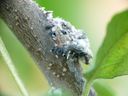
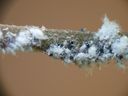
1- Aphelinus mali(woolly aphid parasite)
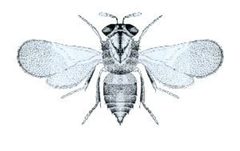
Aphelinus is a of in the Aphelinidae, established by Dalman in 1820. in this genus are specialized parasitoids of aphids (Hemiptera: Aphididae) and are commercially important as agents. Several species, including A. abdominalis, A. asychis, A. varipes, A. certus, and A. mali, are used or studied for management of agricultural pests such as the lettuce aphid, , soybean aphid, and woolly apple aphid.
Pronunciation
How to pronounce Aphelinus: /æfəˈlaɪnəs/
These audio files are automatically generated. While they are not always 100% accurate, they are a good starting point.
Identification
Members of Aphelinus are minute , typically 1-2 mm in length. The can be distinguished from other genera such as Aphidius and Lysiphlebus by morphological features of the and wing venation, though specific identification to level requires examination of microscopic characters. Aphelinus species are often differentiated from the related genus Aphidius by differences in utilization patterns and responses to aphid defensive .
Images
Habitat
in this are found in agricultural, horticultural, and natural wherever their occur. Specific include lettuce crops, sunflowers, cotton, apple orchards, wheat fields, and soybean fields. The genus has been recorded in Australia, Denmark, Mexico, and other regions.
Distribution
Widely distributed globally with records from Australia (AU), Denmark (DK), and Mexico (MX). Individual have more specific distributions: A. abdominalis is commercially available and widely used in programs; A. asychis has been introduced to new regions for pest management; A. mali is associated with apple-growing regions; A. certus is present in soybean-growing areas; A. varipes and A. albipodus are associated with wheat-growing regions.
Diet
All are that develop within living . may feed on honeydew produced by aphids. Specific host associations include: A. abdominalis on Nasonovia ribisnigri (lettuce aphid), Rhopalosiphum padi, Myzus persicae (green peach aphid), and Rhopalosiphum maidis; A. asychis and A. nigritus on Aphis helianthi; A. mali on Eriosoma lanigerum (woolly apple aphid); A. certus on soybean aphid; A. albipodus, A. asychis, and A. varipes on (); A. gossypii on Aphis gossypii (cotton aphid).
Host Associations
- Nasonovia ribisnigri - for A. abdominalis; 51% mortality achieved in 24-hour laboratory exposure
- Rhopalosiphum padi - Preferred for A. abdominalis; greater , larger progeny, shorter developmental time compared to other hosts
- Myzus persicae - for A. abdominalis; A. colemani and L. testaceipes also parasitize this but were ineffective against N. ribisnigri
- Rhopalosiphum maidis - for A. abdominalis; developmental parameters less favorable than for R. padi
- Aphis helianthi - for A. asychis (introduced) and A. nigritus (native) on sunflowers
- Eriosoma lanigerum - for A. mali; key agent for woolly apple aphid
- Aphis gossypii - for A. gossypii on cotton
- Diuraphis noxia - for A. albipodus, A. asychis, and A. varipes ()
Life Cycle
Development is holometabolous with , larval, pupal, and stages, all occurring within the . Developmental time varies by host and temperature. For A. abdominalis, developmental time is shorter in Rhopalosiphum padi than in Myzus persicae or Rhopalosiphum maidis. The kills the host aphid, which becomes a 'mummy' containing the developing .
Behavior
A. abdominalis exhibits instar preference, preferentially parasitizing first instar nymphs of Rhopalosiphum padi. parameters differ depending on and host stage, suggesting behavioral plasticity in host selection. A. mali responds to herbivore-induced plant volatiles (HIPVs) and nectar resources, which can enhance parasitism activity. Field effectiveness may be limited by host accessibility; for example, A. abdominalis may have difficulty reaching lettuce aphids feeding in protected leaves.
Ecological Role
Primary of aphids, functioning as natural enemies that regulate in agricultural and natural . Contribute to of agricultural pests as part of programs. Different within the may exhibit complementarity in biological control due to variation in utilization patterns. Some species, such as A. glycinis and A. atriplicis, respond differently to aphid defensive (Hamiltonella defensa), indicating variation in how congeneric species overcome host defenses.
Human Relevance
Several are commercially available and used as agents in agriculture. A. abdominalis is effective against lettuce (51% mortality in laboratory conditions) and has potential for inoculative biocontrol programs. A. mali is a key of woolly apple aphid in apple orchards. A. certus, A. albipodus, A. asychis, and A. varipes are important for management of soybean aphid and . Effectiveness in field conditions requires further research, particularly regarding plant architecture effects on -finding .
Similar Taxa
- AphidiusAlso in Hymenoptera, but differ in morphological features (, wing venation) and utilization patterns; A. colemani was ineffective against lettuce aphid where A. abdominalis succeeded
- Lysiphlebus ; L. testaceipes was ineffective against lettuce aphid but parasitizes green peach aphid and Aphis helianthi, showing different range from Aphelinus
- Ephedrus studied alongside A. asychis on sunflowers; differs in interactions and effectiveness
- Praon ; P. gallicum was evaluated alongside Aphelinus for control of Aphis helianthi
More Details
Response to Aphid Defensive Symbionts
Different Aphelinus respond differently to Hamiltonella defensa, a defensive bacterial of aphids. A. glycinis and A. atriplicis show differential effects of this symbiont on quality, suggesting that not all species in the are equally affected by defenses.
Temperature Effects
Biological characteristics of A. asychis and A. varipes are affected by temperature, with performance varying on different , indicating that environmental conditions influence effectiveness.
Commercial Availability
A. abdominalis is commercially available for , though field effectiveness depends on accessibility and plant architecture.
Sources and further reading
- BugGuide
- GBIF taxonomy match
- iNaturalist taxon
- NCBI Taxonomy
- Catalogue of Life
- Aphelinus abdominalis Archives - Entomology Today
- Parasitoid Wasps May Be an Effective Tool against Lettuce Aphids
- Host species suitability and instar preference of Aphidius ervi and Aphelinus abdominalis
- The defensive aphid symbiont Hamiltonella defensa affects host quality differently for Aphelinus glycinis versus Aphelinus atriplicis
- Host-Parasitoid Interaction of Aphis helianthi1 on Sunflowers with Introduced Aphelinus asychis2, Ephedrus plagiator3 and Praon gallicum3 and Native Aphelinus nigritus2 and Lysiphlebus testaceipes3,4
- The Effect of Temperatures on the Biological Characteristics of Two Aphid Parasitoids Aphelinus asychis (Walker) and Aphelinus varipes (Förster) (Hymenoptera: Aphelinidae) on Two Aphid Hosts
- The Development of a Colony of Aphelinus mali Hald
- Observations of Aphelinus gossypii (Hymenoptera: Aphelinidae) Reproduction, a Parasitoid of Aphis gossypii (Hemiptera: Aphididae) on Cotton
- Towards an attract-and-reward strategy: evaluating nectar resources and HIPVs under laboratory conditions to enhance Aphelinus mali parasitism activity, a key parasitoid of Eriosoma lanigerum.