
Eriosoma lanigerum
(Hausmann, 1802)
woolly apple aphid, woolly aphid, American blight
Eriosoma lanigerum is a small phloem-feeding native to North America that has become a major worldwide pest of apple . are concealed beneath dense white, cotton-like wax secretions produced from specialized abdominal glands, giving the its . The aphid induces gall formation on both aerial and root tissues of plants, disrupting vascular transport and potentially killing trees. are primarily parthenogenetic in most regions, though occurs where American elm (Ulmus americana) is present.
Pronunciation
How to pronounce Eriosoma lanigerum: /ˌɛriəˈsoʊmə ləˈnɪdʒərəm/
These audio files are automatically generated. While they are not always 100% accurate, they are a good starting point.
Identification
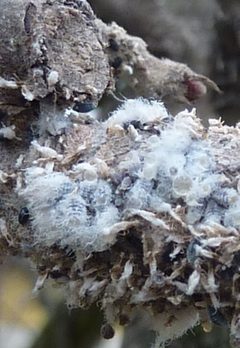
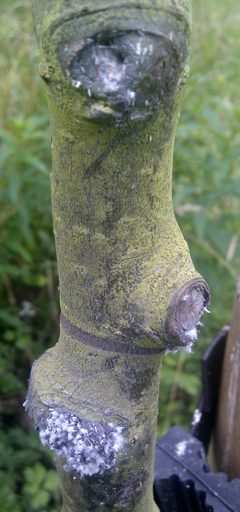
The dense white woolly wax coating distinguishes E. lanigerum from all other aphids on apple trees. Parasitized individuals turn black and cease wax production, sometimes showing a circular exit hole from the Aphelinus mali. The can be confused with Eriosoma herioti (on Ulmus americana), E. crataegi, or E. americanum on elms; taxonomic separation requires plant association and morphological examination.
Images
Appearance
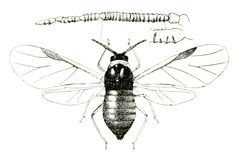
are small to medium-sized aphids, up to 2 mm long, with an elliptical body shape. The body is reddish-brown to purple in color, normally hidden by dense white, filamentous wax secretions. are sooty-brown with six segments; tibias vary from dark brown to yellowish. When crushed, adults leave a blood-red stain. Nymphs are salmon-pink with dark and circular, slightly raised cornicles. Newly moulted individuals lack wax coating; hibernating nymphs are very dark green to almost black, sometimes dingy yellowish-brown, and lack the white waxy covering.
Habitat
Primary is commercial apple orchards and nurseries. Also occurs in urban green areas with ornamental apple plantings, which serve as . Colonizes both aerial portions (twigs, branches, leaf axils on terminal shoots) and root systems of trees. Overwinters as nymphs on roots or in sheltered above-ground locations such as under bark on trunks or main branches; in cooler areas with elms present, overwinters as in bark crevices.
Distribution
Native to North America (northeastern United States). Introduced to all major apple-growing regions worldwide. Documented in Europe (including Britain since 1787, Poland, and across continental Europe), Asia (India, China, Japan, Middle East), Africa, Australasia (Australia, New Zealand), and South America (Brazil, Argentina, Chile, etc.). First confirmed occurrence in Lower Silesia, Poland (Wrocław) documented in urban green areas.
Seasonality
Activity resumes in spring (April in Great Britain). Multiple per year: 8–12 generations depending on summer temperatures. Winged migrate in late summer in native range to overwinter on elms. Peak colony expansion occurs from spring through summer; aerial colonies may be eliminated by severe winter weather.
Diet
Phloem-feeding; pierces outer of plant where thinnest to extract sap. Excretes honeydew containing high sugars.
Host Associations
- Malus domestica - primary Cultivated apple; gall induction on stems and roots
- Malus - Apple generally
- Pyrus - secondary Pear
- Cotoneaster -
- Pyracantha -
- Crataegus - Hawthorn
- Sorbus - Mountain ash
- Prunus spp. -
- Chaenomeles - Japanese quince
- Ulmus americana - primary for American elm; required for production and sexual cycle
Life Cycle
is primarily parthenogenetic in most , with nymphs produced viviparously. Nymphs pass through four instars before becoming . Earliest stages () do not produce waxy filaments until settling to feed. Where occurs: laid in elm bark crevices hatch into wingless stem mothers that produce nymphs parthenogenetically; third produces winged females that migrate to elm, produce single egg each; males are wingless. Each may produce up to 5 live young daily, with over 100 nymphs total per lifetime.
Behavior
Forms dense colonies preferentially at leaf axils on terminal shoots; when abundant, colonizes almost entire tree. migrate continuously up and down the tree between aerial and root colonies. Root colonies serve as persistent source for aerial portions. Feeding induces gall formation that alters vascular cambium, causing abnormal xylem differentiation with over-differentiated parenchyma and redifferentiated abnormal vessel elements. Wax production occurs after each moult; coating may prevent honeydew , provide shelter from weather, , and .
Ecological Role
Pest of apple causing direct damage through phloem removal and indirect damage via gall formation that obstructs water and nutrient transport, potentially killing trees. Galls provide entry sites for fungal including Cryptosporiopsis perennans ( canker) and Gloeosporium . Honeydew production supports growth on fruit and leaves, reducing saleability. Serves as prey for (, ladybirds, hoverfly larvae, lacewings) and for Aphelinus mali.
Human Relevance
Major economic pest of apple production worldwide. Management relies on rootstocks (Er1, Er2, Er3 genes), chemical control (though resistance has developed), and using Aphelinus mali and . Urban apple plantings act as threatening commercial orchards. Monitoring methods being developed to improve and reduce labor. Honeydew creates unpleasant working conditions for orchard .
Similar Taxa
- Eriosoma heriotiPreviously confused with E. lanigerum; now recognized as separate that migrates from Ulmus americana to similar
- Eriosoma crataegiMisidentification possible on elm ; requires morphological and host association verification
- Eriosoma americanumMisidentification possible on elm ; some authorities place in E. lanigerum group
More Details
Gall anatomy
Galls exhibit three anatomical regions (, , ) with decreasing alteration with distance from feeding site. Over-differentiation of parenchyma and redifferentiation of abnormal vessel elements with displaced perforation plates function as compensatory mechanism to maintain water supply to gall, contradicting the 'gall constriction' hypothesis for this system.
Biological control integration
Aphelinus mali effectiveness increases when combined with natural rather than used alone. Optimal strategies require synchronization of predator occurrence timing with .
Resistance genetics
Er1 (Northern Spy) and Er2 (Robusta 5) confer strong resistance through phloem-based factors limiting feeding duration. Er3 (Aotea) resistance has been overcome by some in New Zealand.
Sources and further reading
- BugGuide
- Wikipedia
- iNaturalist taxon
- NCBI Taxonomy
- Catalogue of Life
- European Earwig: Fruit Pest, Potential Ally, or Both?
- Eriosoma lanigerum Archives - Entomology Today
- Attract-and-Kill Strategy Shows Promise for Managing Brown Marmorated Stink Bugs
- These Insect Costume Designers are Dressed to Impress
- Eriosoma lanigerum . [Distribution map].
- Bawełnica korówka [Eriosoma lanigerum (Hausmann, 1802)] – nadal groźnym szkodnikiem
- New tissue organization favors water status in Eriosoma lanigerum galls on Malus domestica
- Evidence of sexual reproduction of woolly apple aphid, Eriosoma lanigerum, in New Zealand
- Natural enemies of wooly apple aphid Eriosoma lanigerum (Hemiptera: Aphididae) in apple production (Malus domestica)
- Evidence of sexual reproduction of woolly apple aphid, Eriosoma lanigerum, in New Zealand
- New insights into Eriosoma lanigerum (Hausm.), the Woolly Apple Aphid (WAA), through adaption of spring migration research methods
- Spatial and Temporal Distribution Patterns of Eriosoma lanigerum (Homoptera: Aphididae) on Apple
- Life history of sexuparae and sexual morphs of woolly apple aphid (Eriosoma lanigerum Hausmann)
- Evaluation of insecticides against woolly apple aphid Eriosoma lanigerum and its parasitoid Aphelinus mali
- Impact of Flavonoids against Woolly Apple Aphid, Eriosoma lanigerum (Hausmann) and Its Sole Parasitoid, Aphelinus mali (Hald.)
- DISTRIBUTION, BIOLOGY, NATURE OF DAMAGE AND MANAGEMENT OF WOOLLY APPLE APHID, ERIOSOMA LANIGERUM (HAUSMANN), (HEMIPTERA: APHIDIDAE) IN APPLE ORCHARD: A REVIEW
- Use of Predators for the Biological control of Eriosoma lanigerum (wooly apple aphids) on apple
- Observation on the Influence of Apple Woolly Aphid (Eriosoma lanigerum Hausm.) on Vegetative Parameters of Grafted Plants in Container Production
- Characteristics associated with Woolly Apple Aphid Eriosoma lanigerum, resistance of three apple rootstocks
- Towards an attract-and-reward strategy: evaluating nectar resources and HIPVs under laboratory conditions to enhance Aphelinus mali parasitism activity, a key parasitoid of Eriosoma lanigerum.