
Aphelinus mali
Haldeman, 1851
woolly aphid parasite
Aphelinus mali is a tiny in the Aphelinidae that specializes in attacking the woolly apple aphid (Eriosoma lanigerum), a major pest of apple orchards worldwide. Native to the northeastern United States, it has been introduced to numerous apple-growing regions as a agent since 1928. The wasp's is tightly coupled with its , with females laying inside living aphids where larvae develop before emerging as . It is considered one of the earliest and most successful examples of in agriculture.
Pronunciation
How to pronounce Aphelinus mali: /æˈfiːlɪnəs ˈmeɪlaɪ/
These audio files are automatically generated. While they are not always 100% accurate, they are a good starting point.
Identification
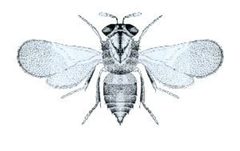
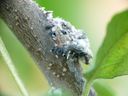
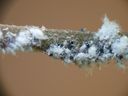
Distinguished from other Aphelinus by its specific association with woolly apple aphid and its black coloration. Wings longer than and folded flat along the back are characteristic. Adults can be observed and jumping on apple foliage rather than flying. Parasitized aphids become black, swollen 'mummies' containing the pupal stage, with a neat round exit hole visible where the adult emerged. Molecular diagnostics may be required for definitive species identification where multiple Aphelinus species occur.
Images
Appearance
are tiny black , slightly smaller than their woolly aphid . The transparent membranous wings are longer than the and fold flat along the back. The body is compact and dark-colored. Larvae are yellow with red ; pupae are black and develop inside the host . Adults have a visible ovipositor used to insert into aphids.
Habitat
Apple orchards and areas where its Eriosoma lanigerum occurs. In laboratory studies, maintained at 22±2°C, 60±10% relative humidity, and 16:8 hour light:dark . often conceal themselves under leaves.
Distribution
Native to northeastern United States. Introduced to Pacific Northwest (Hood River region) in 1928, from where it spread naturally. Subsequently introduced to many other apple-growing regions worldwide including New Zealand, Chile (Maule region), the Netherlands, Turkey, and other countries. Records from Albania, Austria, Australia, and other regions via GBIF.
Seasonality
females emerge from in spring. Multiple per season (six or seven reported). Larvae and pupae enter diapause in fall and overwinter in blackened mummified bodies. Activity in Southern Hemisphere orchards documented in February-March.
Diet
feed on honeydew excreted by Eriosoma lanigerum; water is necessary for honeydew consumption due to viscosity and wax coating. Adults also -feed on haemolymph from puncture wounds made during oviposition. In laboratory conditions, will feed on diluted honey (30% solution) and nectar from Daucus carota.
Host Associations
- Eriosoma lanigerum - primary woolly apple aphid; develops internally
- Lipaphis erysimi - first record from Turkey; turnip aphid
Life Cycle
Females mate within 24 hours of . are laid singly inside living aphids using the ovipositor inserted into the underside of the . Eggs hatch in approximately three days. Larval development takes 10-12 days, feeding on host haemolymph internally. occurs inside the host body. emerge by chewing a neat round hole through the upper surface of the . Total duration is 20-25 days. Multiple occur per season. as diapausing larvae and pupae within mummified host bodies.
Behavior
Prefers to walk and jump rather than fly despite having functional wings. Often conceals itself under leaves. -finding involves responding to honeydew as a contact , which stimulates longer stinging-oviposition events. No olfactory preference for honeydew detected in choice tests. Foraging involves distinct behavioral phases: moving, stationary, stinging-oviposition, attacking, and feeding. Able to consume wax-coated honeydew in both laboratory and field conditions.
Ecological Role
Key agent of woolly apple aphid in apple orchards. can lead to cyclical fluctuations in and densities. enhanced by availability of honeydew, which increases longevity and host searching time. Works best in conjunction with other such as lady beetles, lacewings, hoverfly larvae, and the plant bug Deraeocoris brevis.
Human Relevance
One of the earliest and most successful examples of , with introductions dating to 1928. Reduces economic damage from woolly apple aphid in commercial apple production. Negatively impacted by broad-spectrum chemical , particularly neonicotinoids (imidacloprid, thiacloprid) and carbaryl. Coconut-derived insecticidal soap shows compatibility with activity. Sustainable management of woolly apple aphid in orchards depends on conserving A. mali through selective pesticide use.
Similar Taxa
- Other Aphelinus speciesSame , may co-occur in orchards; require molecular or detailed morphological examination for separation
- Other aphid parasitoids (Aphidius spp., Praon spp., Ephedrus spp.)Different (Aphidiinae vs. Aphelinidae), generally larger, different wing venation and antennal structure
- Encarsia spp.Same Aphelinidae, but typically parasitize whiteflies rather than aphids; different association
More Details
Pesticide Sensitivity
Highly sensitive to neonicotinoid . Imidacloprid shows highest in residual ; thiacloprid also toxic. Spinosad moderately to highly toxic at label rates. Carbaryl shows greatest residual toxicity with 85% mortality at 21 days after application. Diazinon residues become non-toxic after 15 days. Indoxacarb and lime sulphur show no toxicity. Coconut-derived soap (Palizin) shows low toxicity and high compatibility.
Strain Variation
Dutch and Canadian strains have been compared in simulation studies for control efficacy in the Netherlands, suggesting geographic variation in performance characteristics.
Feeding History Inference
Field studies using machine learning classification of sugar profiles have confirmed honeydew consumption by A. mali in apple orchards, validating laboratory findings on the importance of this food source.
Sources and further reading
- BugGuide
- Wikipedia
- GBIF taxonomy match
- iNaturalist taxon
- NCBI Taxonomy
- Catalogue of Life
- Cindy Kron: Adventures of the North Coast Area Extension Entomologist | Bug Squad
- What's It Like to Be Parasitized? | Bug Squad
- Coleoptera | Blog - Part 2
- A non-black background is better… often! | Beetles In The Bush
- Advances in Sterile Insect Technique Driven by Sugarcane Pest Management in South Africa
- Taxon Expeditions | Blog
- The Development of a Colony of Aphelinus mali Hald
- Honeydew Is a Food Source and a Contact Kairomone for Aphelinus mali
- Host finding behaviour of <i>Aphelinus mali</i>, a parasite of the woolly apple aphid
- Aphid Species, Their Natural Enemies in Vegetables from Erzincan, Turkey: First Record of the Parasitoid Wasp Aphelinus mali (Haldeman) parasitizing Lipaphis erysimi (Kaltenbach)*
- Comparison of the toxicity and repellency of two conventional neonicotinoids and a coconut-derived insecticide soap toward the parasitoid wasp Aphelinus mali Haldeman, 1851
- Toxicity of pesticides to <i>Aphelinus mali</i> the parasitoid of woolly apple aphid
- Evaluation of insecticides against woolly apple aphid Eriosoma lanigerum and its parasitoid Aphelinus mali
- Impact of Flavonoids against Woolly Apple Aphid, Eriosoma lanigerum (Hausmann) and Its Sole Parasitoid, Aphelinus mali (Hald.)
- Effect of orchard pesticides on <i>Aphelinus mali</i>, the woolly apple aphid parasitoid
- A SIMULATION STUDY WITH A DUTCH AND A CANADIAN STRAIN OF THE PARASITOID APHELINUS MALI (HALD.) FOR CONTROL OF WOOLLY APPLE APHID ERIOSOMA LANIGERUM (HAUSMANN) IN THE NETHERLANDS
- Towards an attract-and-reward strategy: evaluating nectar resources and HIPVs under laboratory conditions to enhance Aphelinus mali parasitism activity, a key parasitoid of Eriosoma lanigerum.