
Eriosoma americanum
(Riley, 1879)
Woolly Elm Aphid
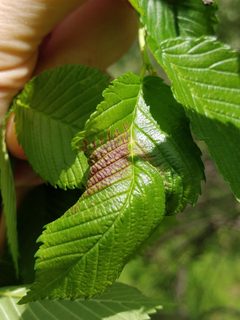
Eriosoma americanum, commonly known as the woolly elm , is a North American aphid that alternates between two plants: American elm (Ulmus americana) and Saskatoon (Amelanchier alnifolia). The species produces distinctive woolly or cottony wax secretions that give it its . Heavy on American elm cause leaf curling and produce visible dark patches and cottony masses. Like other aphids, it excretes honeydew while feeding on plant sap.
Pronunciation
How to pronounce Eriosoma americanum: //ˌɛriˈɒsəmə əˌmɛrɪˈkeɪnəm//
These audio files are automatically generated. While they are not always 100% accurate, they are a good starting point.
Identification
Distinguished from other aphids by its -specific alternation between American elm and Saskatoon, combined with the production of conspicuous woolly wax masses. On American elm, produce curled leaves with dark areas and cottony wax deposits— not typically seen with other elm-feeding aphids. The woolly appearance separates it from non-woolly elm aphids such as Tinocallis .
Images
Habitat
Found in areas where both plants co-occur: American elm (Ulmus americana) and Saskatoon serviceberry (Amelanchier alnifolia). Requires established of both tree to complete its .
Distribution
Native to North America; documented in the United States including Vermont, with records indicating presence where suitable trees are established.
Seasonality
Feeds on Saskatoon from late spring through fall; feeds on American elm during early spring and late fall. This seasonal alternation defines its activity pattern.
Diet
Phloem sap feeder; feeds on American elm (Ulmus americana) and Saskatoon (Amelanchier alnifolia). Specific feeding sites include leaves and possibly young stems.
Host Associations
- Ulmus americana - primary (early spring and late fall)Causes leaf curling, dark patches, and cottony wax masses
- Amelanchier alnifolia - secondary (late spring through fall)
Human Relevance
Considered a pest of American elm and Saskatoon. Heavy cause aesthetic damage through leaf curling and woolly wax deposits. Honeydew may lead to growth on affected plants.
Similar Taxa
- Other Eriosoma speciesShare woolly wax production and gall-forming or woolly habits on Ulmus and related ; distinguished by specific host alternation pattern and geographic range
- Tinocallis spp.Non-woolly elm aphids that lack cottony wax masses and cause different patterns on elm leaves
Sources and further reading
- BugGuide
- Wikipedia
- GBIF taxonomy match
- iNaturalist taxon
- NCBI Taxonomy
- Catalogue of Life
- Get them when they're little - Eastern tent caterpillar, Malacosoma americanum — Bug of the Week
- Hairy wanderers - Eastern tent caterpillars, Malacosoma americanum — Bug of the Week
- Time for tents - Eastern tent caterpillar, Malacosoma americanum — Bug of the Week
- Return of the tent makers - Eastern tent caterpillar, Malacosoma americanum — Bug of the Week
- The silk trail - Eastern tent caterpillar, Malacosoma americanum — Bug of the Week
- Just can't wait: Eastern tent caterpillars, Malacosoma americanum — Bug of the Week