
Eriosomatini
Kirkaldy, 1905
Genus Guides
4- Colopha
- Eriosoma(woolly aphids)
- Kaltenbachiella
- Tetraneura(elm-grass root aphids)
Eriosomatini is a tribe of gall-forming aphids in the Eriosomatinae, comprising approximately 140 across 16 . All members induce galls on plants in the Ulmaceae, primarily on Ulmus (elms) and Zelkova species. The tribe exhibits complex with alternation between primary and secondary hosts, though some species have reduced or lost host alternation. Molecular studies have demonstrated that sequencing can reliably associate morphologically distinct life stages to species, addressing a major identification challenge in the group.
Pronunciation
How to pronounce Eriosomatini: /ˌɛri.oʊˌsɒməˈtaɪni/
These audio files are automatically generated. While they are not always 100% accurate, they are a good starting point.
Identification
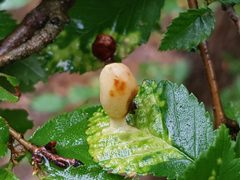
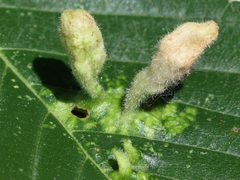
All Eriosomatini are gall-formers on Ulmaceae, distinguishing them from other tribes. Within the tribe, can be distinguished by gall : leaf-roll galls versus completely or incompletely closed pouch galls. -level identification is complicated by extreme morphological divergence between life stages (fundatrices, alienicolae, sexuparae/oviparae); using COI sequences is required to reliably associate these morphs. The genera Eriosoma and Tetraneura are associated with section Ulmus of the genus Ulmus, while other genera show different associations.
Images
Habitat
Galls on primary plants in the Ulmaceae (elms and related trees), specifically on Ulmus and Zelkova . Galls occur on leaves and other plant parts, creating enclosed microhabitats. Secondary host include roots of Gramineae (grasses) for some species.
Distribution
Eurasian distribution strongly correlated with plant ranges; two large (Eriosoma and Tetraneura) are associated with section Ulmus, which is widely distributed across Eurasia including regions. Present distribution patterns have been shaped by host plant diversification and extinction during the late Tertiary and Quaternary.
Diet
Phloem sap from plants in Ulmaceae on primary hosts; phloem feeding on secondary host roots for that maintain host alternation.
Host Associations
- Ulmaceae - primary All induce galls on Ulmaceae; includes Ulmus and Zelkova
- Ulmus - primary Primary for two large Eriosoma and Tetraneura; associated with section Ulmus
- Zelkova - primary Ancestral association; many Zelkova-associated lineages extinct or survived as relict parthenogens on secondary hosts
- Gramineae - secondary Root-feeding secondary for some , e.g., Tetraneura chinensis
Life Cycle
Complex with multiple morphologically distinct stages: fundatrices (founding stem mothers that initiate galls on primary ), alienicolae (migratory parthenogenetic forms that feed on secondary hosts), and sexuparae/oviparae (forms that return to primary hosts to produce sexual ). and egg-laying occur on primary hosts. Some have reduced or lost secondary host alternation, persisting as relict parthenogens.
Behavior
Gall induction on primary plants by fundatrices; manipulation of host plant tissue to create enclosed galls of variable (leaf-roll, completely closed pouch, incompletely closed pouch). Seasonal between primary and secondary hosts for maintaining host alternation.
Ecological Role
Gall-formers that induce structural modifications in Ulmaceae plants, creating specialized microhabitats. Role in plant-herbivore interactions and potentially in of organisms associated with galls. and distribution patterns reflect historical changes in host plant availability.
Similar Taxa
- other Eriosomatinae tribesEriosomatini distinguished by obligate gall-formation on Ulmaceae; other tribes in may have different associations or lack gall-forming
- non-gall-forming aphidsAll Eriosomatini induce galls, whereas other aphids feed openly on plant surfaces or within tissues without forming distinct gall structures