
Praon
Haliday, 1833
Praon is a of braconid wasps in the Aphidiinae containing at least 70 described . Species are solitary of aphids, with females laying inside living . Several species are important agents in agricultural systems. Notable species include P. pequodorum, a native North American parasitoid that outcompeted introduced Aphidius ervi on bacterially-defended pea aphids, and P. volucre, a commercially produced biocontrol agent that exhibits facultative pupal .
Pronunciation
How to pronounce Praon: /ˈpreɪ.ɒn/
These audio files are automatically generated. While they are not always 100% accurate, they are a good starting point.
Identification
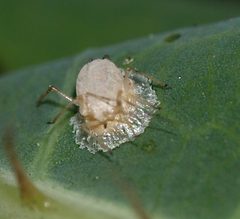
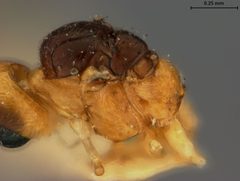
Praon can be distinguished from other Aphidiinae by the presence of a distinct pterostigma on the forewing and characteristic wing venation. Mummies formed by Praon species are typically attached to the substrate by silken threads beneath the , unlike Aphidius species where mummies remain attached to the leaf surface. P. pequodorum and P. volucre exhibit -mediated : diapausing mummies are dark brown, while non-diapausing mummies are clear brown. Identification to species level requires examination of morphological characters including segmentation, ovipositor structure, and male genitalia.
Images
Habitat
Agricultural fields and associated vegetation where occur. P. volucre has been studied in laboratory conditions at 20°C with 60% relative humidity and long-day (16:8 h light:dark); is induced at 2°C with saturated humidity and continuous darkness. P. pequodorum occurs in alfalfa, clover, and native grasslands in North America.
Distribution
Widespread in temperate regions. P. volucre collected in agricultural fields around Louvain-la-Neuve and Fleurus, Belgium; commercially produced and distributed as a biocontrol agent. P. pequodorum native to North America. GBIF records indicate presence in Denmark, Norway, and Sweden. The occurs across the Holarctic region.
Seasonality
Activity synchronized with availability. P. volucre exhibits facultative pupal in response to environmental cues, with approximately 9-10% of entering diapause under laboratory induction conditions. Diapausing individuals overwinter as pupae within mummies and show delayed compared to non-diapausing counterparts.
Diet
All are obligate ; larval development occurs within living . P. aguti has been documented parasitizing Macrosiphum rosae, Macrosiphum pisi, and Myzus circumflexus. P. pequodorum parasitizes Acyrthosiphon pisum and several other aphid species including native North American aphids. P. volucre reared on Myzus persicae. P. palitans parasitizes Therioaphis maculata.
Host Associations
- Acyrthosiphon pisum - primary Pea aphid; major for P. pequodorum
- Myzus persicae - primary Green peach aphid; primary for laboratory rearing of P. volucre
- Macrosiphum rosae - Preferred of P. aguti
- Macrosiphum pisi - of P. aguti; less suitable than M. rosae
- Myzus circumflexus - Common for both P. aguti and Aphidius testaceipes; attacked when preferred hosts absent
- Therioaphis maculata - Spotted alfalfa aphid; of P. palitans
- Aphis gossypii
Life Cycle
Solitary development: females lay inside living . Larvae feed internally, eventually killing the host and forming a mummy (a hardened cocoon within the dead aphid). P. volucre overwinters as pupae inside mummies. P. pequodorum developmental stages include egg, three larval instars, , pupa, and . in superparasitized hosts typically results in older larvae eliminating younger ones. P. volucre exhibits -mediated with distinct morphological and color differences between diapausing and non-diapausing individuals.
Behavior
Females use volatile, individual-specific markers for discrimination. P. pequodorum females attack aphids already parasitized by Aphidius smithi regardless of competitor larva age, but avoid oviposition into hosts containing larvae or embryos. P. pequodorum shows oviposition preference for larger instars (L3 > L2 = L4 > L1). P. volucre virgin females release that elicit wing-fanning and copulation attempts from males. Host examination time considerably exceeds oviposition duration in P. pequodorum, leading to self- when females expect competition for limited hosts. Activity peaks at warm temperatures: P. aguti shows maximum attack rates at 28°C.
Ecological Role
Primary contributing to in agricultural and natural . P. pequodorum serves as a case study for native persistence against introduced competitors through exploitation of defensive . P. volucre functions as a commercial biocontrol agent. Competition with other parasitoid species (including introduced Aphidius ervi and native A. smithi) shapes structure. increases in agricultural fields may spill over into adjacent native grasslands, potentially affecting native aphid-parasitoid dynamics.
Human Relevance
Several are commercially produced and distributed as agents for management in agriculture. P. volucre is used in programs. P. pequodorum demonstrates risks of introduced biocontrol agents: the introduced Aphidius ervi outcompeted most native North American , but P. pequodorum persisted by exploiting pea aphids with bacterial defenses that protected them against A. ervi. This case illustrates how introduced biocontrol agents can disrupt native parasitoid and how unexpected competitive outcomes can cascade through .
Similar Taxa
- AphidiusBoth are Aphidiinae of aphids; distinguished by Praon's silken thread attachment of mummies to substrate versus Aphidius mummies attached directly to leaf surface
- Aphidius erviIntroduced competitor of P. pequodorum in North America; A. ervi is vulnerable to pea aphid bacterial defenses that P. pequodorum circumvents
- Aphidius smithiNative North American competitor; P. pequodorum is intrinsically superior in larval competition regardless of A. smithi larval age
More Details
Diapause physiology
P. volucre involves metabolic depression, reduced Krebs cycle intermediates, galvanized glycolysis favoring polyol biosynthesis, and accumulation of cryoprotective polyols especially sorbitol. Proteomic changes include modulation of proteins involved in cytoskeleton/ remodeling, stress , protein turnover, and lipid metabolism. Diapausing individuals are heavier with larger fat reserves but show reduced longevity, representing a cost.
Competitive superiority mechanism
P. pequodorum outcompetes A. ervi on bacterially-defended pea aphids even when only 10% of the carries defensive bacteria. The bacterial defense (Hamiltonella defensa and associated ) neutralizes A. ervi venom but is ineffective against P. pequodorum, allowing the native to exploit a .
Larval competition outcomes
In with A. smithi, P. pequodorum wins regardless of relative larval ages. In , older larvae usually eliminate younger ones, with outcome depending on relative age difference and developmental stage. The rate of embryonic development is a major factor in contest competition between first-stage larvae.
Sources and further reading
- BugGuide
- Wikipedia
- GBIF taxonomy match
- iNaturalist taxon
- NCBI Taxonomy
- Catalogue of Life
- Praon pequodorum wasp and pea aphid - Entomology Today
- American Underdog Wasp Fights for Foothold on Exotic Hosts
- Research News Archives - Page 83 of 155 - Entomology Today
- Host Instar Preference of the Aphid Parasite Praon pequodorum (Hymenoptera: Aphidiidae)
- Weaving cultural identities on trans-Asiatic networks: Upper Thai-Malay Peninsula – an early socio-political landscape
- Metabolic and Proteomic Profiling of Diapause in the Aphid Parasitoid Praon volucre
- An Experimental Host-Parasite System: Therioaphis maculata (Buckton)-Praon palitans Muesebeck (Homoptera: Aphididae--Hymenoptera: Braconidae)
- Cold‐induced expression of diapause in Praon volucre : fitness cost and morpho‐physiological characterization
- DISCRIMINATION BETWEEN SELF- AND CONSPECIFIC-PARASITIZED HOSTS IN THE APHID PARASITOIDPRAON PEQUODORUMVIERECK (HYMENOPTERA: APHIDIIDAE)
- INTER- AND INTRASPECIFIC LARVAL COMPETITION INAPHIDIUS SMITHIANDPRAON PEQUODORUM(HYMENOPTERA: APHIDIIDAE)
- Mating, Oviposition, and Discrimination of Hosts by Aphidius Testaceipes (Cresson) and Praon Aguti Smith, Primary Parasites of Aphids1
- HOST RELATIONSHIPS OF APHIDIUS TESTACEIPES (CRESSON) AND PRAON AGUTI (SMITH), PRIMARY PARASITES OF APHIDS
- Sex pheromones in the cereal aphid parasitoids Praon volucre and Aphidius rhopalosiphi
- Developmental Stages of Praon pequodorum Viereck (Hymenoptera: Aphidiidae), a Pea Aphid Parasitoid
- Courtship and Mating Behavior of the Aphid Parasitoid Praon volucre: Effects of Host Association and Behavioral Lateralization.