
Therioaphis
Walker, 1870
Species Guides
3- Therioaphis riehmi(Sweetclover Aphid)
- Therioaphis tenera
- Therioaphis trifolii(yellow clover aphid)
Therioaphis is a of aphids in the Aphididae comprising more than 20 described . The genus includes significant agricultural pests, notably the spotted alfalfa (Therioaphis maculata, also treated as T. trifolii forma maculata) and the yellow clover aphid (Therioaphis trifolii), which infest alfalfa, clovers, and related legumes. These species have been extensively studied for , , and their role as of plant including alfalfa mosaic virus.
Pronunciation
How to pronounce Therioaphis: /ˌθɪəriˈoʊəfɪs/
These audio files are automatically generated. While they are not always 100% accurate, they are a good starting point.
Identification
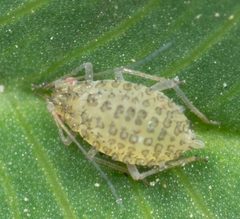
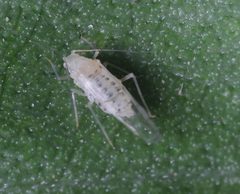
Therioaphis are small aphids with the typical pear-shaped body form of the Aphididae. The spotted alfalfa is distinguished by dark spots on a yellowish to greenish body. Species in this can be separated from other aphid genera by association with Medicago, Trifolium, and related Fabaceae, combined with morphological characters of the Calaphidinae . Accurate species-level identification requires examination of microscopic characters including antennal , cornicles, and cauda structure.
Images
Habitat
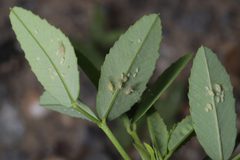
Agricultural and natural supporting plants in the Fabaceae, primarily alfalfa (Medicago sativa), clovers (Trifolium spp.), and related legumes such as Melilotus. In Colorado's Arkansas Valley, alfalfa fields adjacent to chile pepper crops serve as for and associated viruses.
Distribution
distribution with records from North America (USA, Canada, Mexico), Europe, Asia (China, India, Iran, Iraq, Israel, Japan, Lebanon, Pakistan, Saudi Arabia, Turkey), Africa (Egypt, Ethiopia, Libya, Morocco, Sudan), Australasia (Australia, New Zealand), and South America (Chile). Within the USA, documented from most states including major alfalfa-growing regions of California, Colorado, and the Midwest.
Seasonality
vary by and region. In central Greece, Therioaphis trifolii showed peak abundance in July and again from mid-September to mid-October, with absence from December through March. crashes in early August appear driven by natural enemies rather than climatic factors.
Diet
Phloem-feeding herbivores specialized on Fabaceae. Feeding occurs on alfalfa, clovers, and related legumes. Therioaphis trifolii saliva has been demonstrated to manipulate plant defense , activating salicylic acid signaling while suppressing jasmonic acid responses in alfalfa cultivars.
Host Associations
- Medicago sativa - primary Alfalfa; major agricultural
- Trifolium spp. - primary Clovers including subterranean and white clover
- Melilotus spp. - Sweet clovers
Life Cycle
Holocyclic or anholocyclic depending on and climate. is primarily parthenogenetic viviparity, with sexual forms produced under specific conditions. Multiple occur annually with rapid increase under favorable conditions. (winged) forms are produced for between plants and fields.
Ecological Role
Significant agricultural pests causing direct damage through feeding and indirect damage as of non-persistently transmitted plant viruses including alfalfa mosaic virus. Serve as prey for diverse natural enemies including (Trioxys complanatus, Praon palitans, Aphelinus semiflavus), predatory coccinellid beetles (Hippodamia convergens), and fungal (Erynia neoaphidis). Successful programs have established parasitoids for long-term suppression.
Human Relevance
Major economic pests of alfalfa and clover forage crops. The spotted alfalfa caused severe damage in California and elsewhere before successful implementation. of alfalfa mosaic virus, causing $5.6–8.4 million losses in Colorado chile pepper production. Subject of extensive research including breeding, biological control introductions, and cultural control methods.
Similar Taxa
- Acyrthosiphon pisumAlso feeds on alfalfa and other legumes; differs in lacking spotting and having different with spring and fall peaks rather than summer peaks
- Myzus persicaeGreen peach aphid shares virus role but is with broader range and different morphological characters
Sources and further reading
- BugGuide
- Wikipedia
- GBIF taxonomy match
- iNaturalist taxon
- NCBI Taxonomy
- Catalogue of Life
- Management Prospects for Alfalfa Mosaic Virus in Chile Peppers
- The Gifts of Ben Puttler: From Aphids to Answers
- Therioaphis trifolii . [Distribution map].
- Therioaphis maculata . [Distribution map].
- Biology and Evaluation of Certain Predators of Therioaphis maculata (Buckton)1
- An Experimental Host-Parasite System: Therioaphis maculata (Buckton)-Praon palitans Muesebeck (Homoptera: Aphididae--Hymenoptera: Braconidae)
- Seasonal abundance of Acyrthosiphon pisum (Harris) (Homoptera: Aphididae) and Therioaphis trifolii (Monell) (Homoptera: Gal1aphididae) on lucerne in Central Greece
- PRIMARY AND SECONDARY PARASITES OF AN ALFALFA-INFESTING APHID, THERIOAPHIS SP., IN MANITOBA
- Laboratory Studies on Competition Among Three Parasites of the Spotted Alfalfa Aphid Therioaphis Maculata (Buckton)
- The literature of arthropods associated with alfalfa: I. A bibliography of the spotted alfalfa aphid, Therioaphis maculata (Buckton) (Homoptera: Aphidae)
- Deconstructing the control of the spotted alfalfa aphid Therioaphis maculata
- Use of Life Tables To Assess Host Plant Resistance in Alfalfa to Therioaphis trifolii f. muculata (Homoptera: Aphididae): Hypothesis for Maintenance of Resistance
- Fecundity, Reproductive Rates, and Innate Capacity for Increase of Three Parasites of Therioaphis Maculata (Buckton)
- The Influence of Rhythmically Fluctuating Temperatures on the Development and Reproduction of the Spotted Alfalfa Aphid,Therioaphis maculata
- Studies On Succession, Distribution, and Phenology of Imported Parasites of Therioaphis Trifolii (Monell) In Southern California
- Therioaphis trifolii saliva: a key factor in aphid survival and plant-defense
- Suitability of clovers (Trifolium species and cultivars) as hosts of spotted clover aphid, a biotype of Therioaphis trifolii (Monell) (Hemiptera : Aphididae)