
Calaphidinae
Oestlund, 1919
Tribe Guides
2Calaphidinae is the second-largest in the Aphididae, comprising more than 60 and over 360 described . The subfamily includes aphids primarily associated with woody plants, particularly birches (Betula), oaks (Quercus), and related tree species in the families Fagaceae and Betulaceae. Recent molecular phylogenetic studies have substantially revised the classification of Calaphidinae, establishing eight tribal divisions and revealing that the group is with respect to the former 'Saltusaphidinae'. The subfamily shows complex evolutionary patterns involving host plant shifts and geographic expansion from an Eastern Palaearctic origin.
Pronunciation
How to pronounce Calaphidinae: //kælæˈfɪdɪniː//
These audio files are automatically generated. While they are not always 100% accurate, they are a good starting point.
Identification
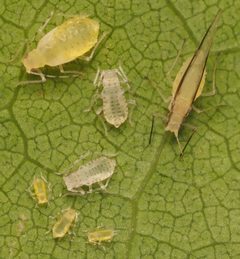
Calaphidinae aphids can be distinguished from other by morphological features of the antennal : they possess placoid sensilla, coeloconic sensilla, and trichoid sensilla on antennal primary rhinaria, with a characteristic pattern of 1 large placoid sensillum on the 4th antennal segment, 2 large placoid sensilla on the 5th segment, and grouped sensilla on the 6th segment. Male reproductive anatomy shows diagnostic features including with 3-4 elongated follicles arranged in rosette patterns, separate vasa deferentia that cling together only at the part, and strongly elongated accessory glands. These traits differ from patterns observed in subfamilies such as Lachninae and Eriosomatinae.
Images
Habitat
within Calaphidinae are primarily associated with forest and woodland , occurring on deciduous and evergreen trees. plant associations center on woody angiosperms, particularly Fagaceae (oaks, beeches, chestnuts) and Betulaceae (birches, alders, hazels). Some species have expanded onto introduced ornamental trees, such as the North American red oak (Quercus rubra) in European regions.
Distribution
The has a broad distribution across the Holarctic region, with ancestral origins in the Eastern Palaearctic according to biogeographic reconstructions. Individual show varying ranges: some are restricted to specific regions, while others have expanded through human-mediated introduction. The expansion of Myzocallis (Lineomyzocallis) walshii onto introduced Quercus rubra in the northeastern Iberian Peninsula demonstrates ongoing range dynamics. Indian records document substantial diversity within the subfamily.
Diet
All are phloem-feeding herbivores, extracting plant sap from trees. Specific feeding guilds vary by host association: species such as Clethrobius comes and Euceraphis betulae feed on birches (Betula spp.), while Myzocallis walshii, Tuberculatus annulatus, and Tuberculatus neglectus are associated with oaks (Quercus spp.).
Ecological Role
Calaphidinae aphids function as primary consumers in forest , forming part of the supporting aphidophagous and . Local parasitoid (particularly Braconidae: Aphidiinae) have demonstrated to expanding on introduced plants, indicating dynamic trophic interactions. The 's association with economically important forest and ornamental trees creates interfaces with managed landscapes.
Human Relevance
Several are of economic concern as pests of forestry and ornamental plantings. The expansion of Myzocallis walshii on introduced oaks illustrates potential for invasiveness on non-native . Host plant associations with valuable timber species (oaks, birches) and widespread ornamental trees create ongoing monitoring needs. The serves as a model system for studying -plant , host shifts, and the phylogenetic basis of ecological diversification.
Similar Taxa
- LachninaeBoth are of Aphididae with woody plant associations, but Lachninae (including Cinara cedri) shows distinct antennal patterns: 1 large placoid sensillum on segment 4, 2 on segment 5, but differing arrangement on segment 6. Olfactory receptor responses also differ, with Lachninae showing highest sensitivity to citronellal rather than terpenes.
- EriosomatinaeAnother Aphididae with differing antennal ; Eriosoma lanigerum shows stronger neuronal responses to linalool and α-terpineol compared to Calaphidinae , and distinct primary rhinaria patterns.
- PhyllaphidinaeFormerly treated as a separate , now recognized as sister group to Calaphidinae s.l. based on molecular ; the two groups share common ancestry but differ in tribal composition and plant associations.
Sources and further reading
- BugGuide
- Wikipedia
- iNaturalist taxon
- NCBI Taxonomy
- Catalogue of Life
- Publications | Entomology Research Museum
- Molecular phylogeny and evolution of Calaphidinae (Hemiptera: Aphididae)
- UPDATED CHECKLIST OF HOST PLANTS OF CALAPHIDINAE (APHIDIDAE : HEMIPTERA) IN INDIA
- Anatomical investigations of the male reproductive system of five species of Calaphidinae (Hemiptera, Aphidoidea)
- Comparative morphology and plant volatile responses of antennal sensilla in Cinara cedri (Hemiptera: Lachninae), Eriosoma lanigerum (Hemiptera: Eriosomatinae), and Therioaphis trifolii (Hemiptera: Calaphidinae)
- Expansion of the aphid Myzocallis (Lineomyzocallis) walshii (Monell) on the red oak Quercus rubra, and adaptation of local parasitoids in the northeastern Iberian Peninsula (Hom., Aphididae, Calaphidinae; Hym., Braconidae, Aphidiinae)