
Lachninae
Herrich-Schaeffer, 1854
Giant Aphids
Tribe Guides
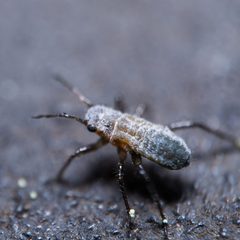
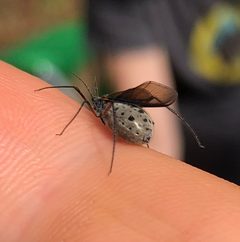
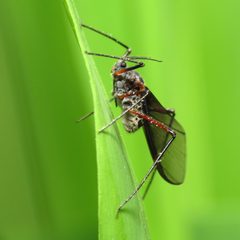
3Lachninae is a of aphids (Aphididae) notable for containing some of the largest-bodied , commonly referred to as 'giant aphids.' Members are distinguished by greatly reduced or cornicles compared to other aphids. The subfamily exhibits a unique dual symbiotic system involving Buchnera and co-obligate secondary endosymbionts, primarily Serratia symbiotica, which compensates for riboflavin biosynthetic deficiencies in the primary . This group has been historically treated as a separate (Lachnidae) by some authors. The subfamily includes economically significant species associated with coniferous and broadleaf trees.
Pronunciation
How to pronounce Lachninae: //læŋˈnaɪniː//
These audio files are automatically generated. While they are not always 100% accurate, they are a good starting point.
Identification
Distinguished from other Aphididae by the combination of large body size and greatly reduced cornicles. The presence of two distinct bacteriocyte types in histological section is a microscopic diagnostic feature reflecting the dual symbiotic system. Molecular identification supported by COI and ITS2 barcoding; some (e.g., Nippolachnus piri) require genetic analysis for delimitation due to cryptic diversity. Reduced ocular in Nippolachnus may be confused with other but SEM reveals triommatidium present beneath despite lack of external tubercle.
Images
Habitat
Primarily arboreal, associated with woody plants. Found on coniferous trees (Pinaceae) including pines, spruces, firs, and cedars, as well as broadleaf trees and shrubs in Rosaceae (Prunus, Cerasus, Pyrus, Sorbus), Fagaceae (Castanea), and other . Some exhibit seasonal host alternation or site-specific feeding (trunk, branches, roots).
Distribution
distribution with strong representation in the Northern Hemisphere. Well-documented from Palaearctic (Europe, Asia), Nearctic (North America), and parts of the Oriental region. Some with restricted distributions: Miyalachnus to Japan; Nippolachnus in Palaearctic-Oriental region. Several introduced outside native ranges (e.g., Cinara shinjii in Europe).
Seasonality
timing varies by and climate. Cinara cedri shows optimal development at 20°C with lower developmental threshold of 4.13°C. Some species exhibit seasonal with distinct morphs in spring/summer (trunk/branches) versus autumn (roots), as observed in Pterochloroides persicae. typically occurs in autumn, with .
Diet
Phloem-feeding on woody plants. Stylet- feeding tracks indicate deep penetration to phloem sieve elements. plant specificity ranges from oligophagous (restricted to single plant ) to relatively within related host .
Host Associations
- Pinus spp. - primary Cinara, Eulachnus
- Picea spp. - primary Cinara ; important honeydew producers
- Cedrus spp. - primary Cinara cedri
- Prunus spp. - primary Pterochloroides persicae, Miyalachnus
- Cerasus spp. - primary Miyalachnus
- Castanea crenata - primary Stomaphis blackmani
- Pyrus spp. - primary Nippolachnus
- Sorbus spp. - primary Nippolachnus micromeli
Life Cycle
Holocyclic (sexual) typical, with seasonal alternation between parthenogenetic females and sexual morphs ( females and males) producing . Some exhibit anholocyclic in mild climates. Development includes four nymphal instars. Cinara cedri requires 263.4 above 4.13°C threshold to complete . common: and viviparous females, fundatrices, oviparae, and males may all occur in life cycle of single species.
Behavior
Colonial, often forming dense on woody stems. Some exhibit seasonal between feeding sites (trunk/branches to roots). Honeydew production significant in some species (e.g., Cinara on conifers), supporting mutualisms with ants and fungi. Defensive not well documented but may include wax secretion and kicking.
Ecological Role
Herbivores of woody plants; some reach pest status in forestry and agriculture. Cinara piceae identified as potential forest pest in nurseries. Important honeydew producers in coniferous forests, supporting including ants, , and other insects. for specialized (e.g., Pauesia antennata on Pterochloroides persicae). Dual symbiotic system with Buchnera and Serratia symbiotica represents model for study of co-obligate mutualism evolution.
Human Relevance
Economic impact varies: some are forest pests (Cinara on spruce, pine); others produce commercially valuable honeydew honey. Pterochloroides persicae is significant pest of stone fruits (peach, almond) in Mediterranean and Middle East. programs target lachnine pests using . Research importance as model system for studying evolution of co-obligate endosymbiosis and replacement.
Similar Taxa
- AphidinaeLarger cornicles, typically smaller body size, lack co-obligate Serratia system
- EriosomatinaeWoolly aphids with waxy flocculent covering, often with complex alternation; Lachninae generally lack dense wax covering
- DrepanosiphinaeMaple and sycamore aphids with characteristic body shape and associations; cornicle structure differs
Misconceptions
Historical classification as separate (Lachnidae) rather than of Aphididae. The reduced cornicles of Lachninae were sometimes interpreted as primitive, but molecular confirms placement within derived Aphididae. The 'giant ' applies to body size relative to other aphids, not giant status in absolute insect terms.
More Details
Symbiont Biology
Lachninae exhibits the most extensively studied dual symbiotic system in aphids. Buchnera, the ancient primary , has undergone riboflavin pseudogenization in the Lachninae ancestor. This loss is compensated by co-obligate Serratia symbiotica or, in some lineages, replacement by other bacterial including Sodalis, Pantoea, or other Serratia strains. Symbiont replacement events and tissue tropism changes have occurred multiple times independently within the .
Taxonomic Complexity
The includes several with cryptic diversity requiring integrative ( + ). Examples include Nippolachnus piri complex and Anagyrus pseudococci species complex (). COI and ITS2 markers are standard for identification, though some closely related species show limited mitochondrial divergence.
Sources and further reading
- BugGuide
- Wikipedia
- GBIF taxonomy match
- iNaturalist taxon
- NCBI Taxonomy
- Catalogue of Life
- Publications | Entomology Research Museum
- The sexuales of giant black bark aphid, Pterochloroides persicae (Hemiptera, Aphidoidea: Lachninae)
- Miyalachnus—A New Lachninae Aphid Genus from Japan (Insecta, Hemiptera, Aphididae)
- Evolution and Diversity of Facultative Symbionts from the Aphid Subfamily Lachninae
- A new chestnut-feeding species of Stomaphis Walker (Hemiptera: Aphididae: Lachninae) from Korea
- Happens in the best of subfamilies: Establishment and repeated replacements of co-obligate secondary endosymbionts within Lachninae aphids
- FIRST RECORD IN EUROPE OF CINARA SHINJII INOUYE (APHIDIDAE LACHNINAE) ON THE JAPANESE WHITE PINE, PINUS PARVIFLORA SIEBOLD & ZUCC.
- The sexuales of Cinara palaestinensis Hille Ris Lambers, the Aleppo pine aphid (Hemiptera: Aphididae Lachninae)
- European species of the aphid genus Eulachnus Del Guercio, 1909 (Hemiptera: Aphididae: Lachninae): revision and molecular phylogeny
- Morphology, Genetics and Biology of Pterochloroides persicae Cholodkovsky (Hemiptera: Lachninae) and Their Effect on Pauesia antennata Mukerji (Hymenoptera: Aphidinae) Behaviour
- DNA barcoding and a precise morphological comparison revealed a cryptic species in the Nippolachnus piri complex (Hemiptera: Aphididae: Lachninae)
- Impact of warm weather events on prolongation of the life cycle ofStomaphis Walker (Hemiptera, Aphididae, Lachninae)
- Influence of temperature on the development and reproduction of Cinara cedri (Hemiptera: Aphidoidea: Lachninae)
- Insect-bacteria parallel evolution in multiple-co-obligate-aphid association: a case in Lachninae (Hemiptera: Aphididae)
- New for Lithuania aphid species of the tribe Eulachnini (Hemiptera: Aphididae, Lachninae): is there any threat to local coniferous forests?
- Two mitochondrial haplotypes in Pterochloroides persicae (Hemiptera: Aphididae: Lachninae) associated with different feeding sites