
Drepanosiphinae
Herrich-Schaeffer, 1857
Genus Guides
2- Drepanaphis(Painted maple aphids)
- Drepanosiphum(sycamore aphids)
Drepanosiphinae is a Holarctic of aphids within Aphididae, comprising approximately 13 (8 extinct) and over 60 described . The six extant genera—Drepanaphis, Drepanosiphoniella, Drepanosiphum, Megalosiphonaphis, Shenahweum, and Yamatocallis—exhibit strict associations primarily with maple trees (Acer spp.). The subfamily is characterized by enlarged fore or mid and rastral spines on hind tibiae. Molecular phylogenetic studies confirm its monophyly and reveal complex endosymbiotic relationships with both Buchnera aphidicola and Sodalis-like bacteria in most species.
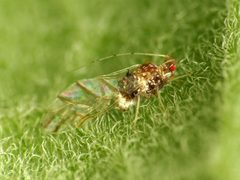
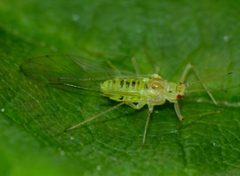
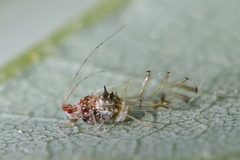
Identification
Distinguished from other by the combination of enlarged fore or mid and rastral spines on hind tibiae. Within the subfamily, are separated by associations and morphological traits: Drepanaphis and Drepanosiphum are sister with Drepanosiphoniella, while Yamatocallis and Megalosiphonaphis form a more distantly related clade. Drepanaphis group by host plant use (rubrum, saccharum, grandidentatum clades) rather than by traditional morphological characters, complicating identification based on alone. Drepanaphis does not form dense colonies and is not attended by ants, unlike many other aphid groups.
Images
Habitat
Associated with trees, primarily maple (Acer spp.) across forested and ornamental landscapes. Drepanaphis species occur on maple and buckeye (Aesculus glabra) in North America. span temperate and Mediterranean regions of the Holarctic, including deciduous forests, urban plantings, and riparian corridors with maple presence. Does not typically form dense colonies.
Distribution
Holarctic distribution. Drepanosiphum is broadly Holarctic and well-represented in Europe. Drepanosiphoniella occurs mainly in the Mediterranean region. Drepanaphis and Shenahweum are primarily Nearctic, though D. acerifoliae has been introduced to Europe and Japan. Yamatocallis occurs in India, China, Korea, and Japan. Megalosiphonaphis is recorded only from Japan.
Seasonality
Activity patterns follow typical seasonal cycles with alternation between parthenogenetic summer and sexual autumn generations producing . Specific timing varies by and latitude.
Diet
Phloem-feeding on plant sap. Strict host specificity to Acer in most ; Drepanaphis species are primarily monophagous on maple, though some are oligophagous, with D. monelli exceptionally feeding on buckeye (Aesculus glabra). Nutritionally dependent on endosymbiotic bacteria for and B-vitamins.
Host Associations
- Acer spp. - primary plantMaple trees; strict association for most
- Aesculus glabra - exceptional Buckeye; for Drepanaphis monelli only
- Buchnera aphidicola - obligate endosymbiontProvides
- Sodalis-like bacteria - co-obligate endosymbiontCompensates for Buchnera metabolic deficiencies in biotin and riboflavin synthesis; absent in most Yamatocallis
- Wolbachia - facultative endosymbiontLimited nutritional role
- Rickettsia - facultative endosymbiontLimited nutritional role
- Fukatsuia - facultative endosymbiontLimited nutritional role
- Serratia - facultative endosymbiontLimited nutritional role
- Arsenophonus - facultative endosymbiontLimited nutritional role
Life Cycle
Involves seasonal alternation between parthenogenetic and . females reproduce by viviparous during the growing season. Sexual morphs— females and winged males—produce that overwinter on plants. Sexual morphs have been documented for 15 Drepanaphis , with first descriptions for many provided in recent taxonomic revisions.
Behavior
Does not form dense colonies. Not attended by ants, distinguishing Drepanaphis from many other groups. Produces honeydew. Exhibits strong specificity, with Drepanaphis grouping by host plant use rather than .
Ecological Role
Phloem-feeding herbivores that contribute to nutrient cycling through honeydew production. Complex mutualistic relationships with bacterial endosymbionts (Buchnera and Sodalis) represent a model system for studying nutritional evolution. Some are significant pests of crop and ornamental plants, causing damage through direct feeding or potential transmission.
Human Relevance
Some are pests of maple trees in forestry and ornamental horticulture. Drepanaphis acerifoliae has been introduced to Europe from North America. Research interest in the focuses on its co-evolutionary relationships with bacterial endosymbionts and plant specialization.
Similar Taxa
- AphidinaeLarger of Aphididae; lacks the enlarged and rastral spines characteristic of Drepanosiphinae; typically exhibits broader ranges and often forms dense, -attended colonies
- EuceraphidinaeAnother maple-associated ; distinguished by different morphological features and associations; molecular places Drepanosiphinae as a distinct lineage
More Details
Taxonomic History
While some authors have suggested elevating Drepanosiphinae to rank, this treatment has not been adopted in recent classifications. The includes 8 extinct known from fossil evidence.
Molecular Systematics
Phylogenetic reconstruction using multiple markers confirms monophyly of Drepanosiphinae. Within Drepanaphis, cluster by plant clade (rubrum, saccharum, grandidentatum) rather than by traditional morphological groupings, indicating host-driven diversification.
Endosymbiont Complexity
Most Drepanosiphinae dual obligate : Buchnera aphidicola and a Sodalis-like bacterium. This dual is rare among aphids and represents an evolutionary compensation for metabolic deficiencies in the primary symbiont. Yamatocallis species mostly lack Sodalis, suggesting alternative nutritional strategies.
Sources and further reading
- BugGuide
- Wikipedia
- iNaturalist taxon
- NCBI Taxonomy
- Catalogue of Life
- Shenahweum minutum (Hemiptera, Aphidoidea: Drepanosiphinae)—taxonomic position and description of sexuales
- Molecular phylogeny of the Acer-feeding aphid subfamily Drepanosiphinae (Insecta: Hemiptera: Aphididae) and the evolution of its endosymbiotic consortia.
- Taxonomic Revision of the Nearctic Genus Drepanaphis Del Guercio (Hemiptera, Aphididae: Drepanosiphinae).