
Anagyrus
Howard, 1896
Species Guides
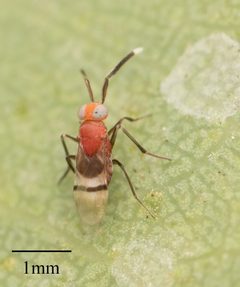
6Anagyrus is a large of parasitic in the Encyrtidae, containing at least 247 described distributed worldwide. These wasps are specialized primarily targeting mealybugs (Hemiptera: Pseudococcidae), with several species commercially important for of agricultural pests. The genus includes notable species such as A. pseudococci, A. lopezi, and A. vladimiri, which have been extensively studied and deployed for managing mealybug in crops including cassava, citrus, and grapes. A subgenus, Nesoanagyrus, was established by Beardsley in 1969.
Pronunciation
How to pronounce Anagyrus: /ˌænəˈdʒaɪrəs/
These audio files are automatically generated. While they are not always 100% accurate, they are a good starting point.
Identification
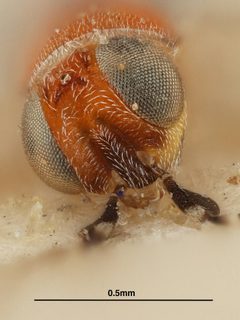
Anagyrus are small chalcidoid wasps typically 1-3 mm in length. They possess the characteristic features of Encyrtidae: reduced wing venation with a distinct linea calva (bare area) on the forewing, geniculate (elbowed) , and often a metallic coloration. Species-level identification requires examination of microscopic characters including antennal segmentation, mandibular , mesoscutal , and ovipositor structure. The can be distinguished from related encyrtid genera by combinations of characters including the number of antennal segments, presence or absence of spurs on the middle tibia, and details of the propodeal structure. Identification keys exist for regional faunas but global keys remain incomplete due to the large number of species.
Images
Distribution
Worldwide distribution, with records from all major biogeographic regions including North America, South America, Europe, Africa, Asia, and Oceania. Specific distribution records include: Bolivia, California (USA), Hawaii (USA), Karnataka and Kerala (India), Indonesia, Argentina, and Puerto Rico. The appears to be most diverse in tropical and subtropical regions where mealybug are abundant.
Host Associations
- Phenacoccus manihoti - for A. lopezi, a specific used in of cassava mealybug
- Planococcus ficus - for A. pseudococci, used in of vine mealybug in vineyards
- Planococcus citri - for A. pseudococci and other Anagyrus in citrus
- Maconellicoccus hirsutus - for A. kamali, used in of
- Pseudococcus viburni - for various Anagyrus in California
- Hypogeococcus spp. - for A. cachamai and A. lapachosus, of Harrisia cactus mealybug
- Phenacoccus aceris - for A. schoenherri, apple mealybug
Ecological Role
Anagyrus function as primary of mealybugs, playing significant roles in natural and programs. Several species have been successfully introduced as agents across multiple continents. The contributes to suppression of mealybug in agricultural , particularly in cassava, citrus, grape, and cactus systems.
Human Relevance
Multiple Anagyrus are commercially important agents. A. lopezi was successfully introduced to Africa and Asia for control of the cassava mealybug, with documented economic benefits exceeding billions of dollars. A. pseudococci is widely used against vine mealybug and citrus mealybug in Mediterranean and Californian agriculture. A. kamali and A. ananatis are used for control. A. vladimiri has been studied for its association with a symbiotic virus (Anagyrus vladimiri ) that enhances success. Mass rearing techniques have been developed for several species to support programs.
Similar Taxa
- LeptomastixAlso encyrtid of mealybugs, but distinguished by different antennal structure and wing venation patterns
- CoccidoxenoidesEncyrtid mealybug with different body proportions and antennal club structure
- PseudaphycusRelated encyrtid parasitizing mealybugs, distinguished by details of mesoscutal and ovipositor structure
- ApoanagyrusSometimes treated as a separate but closely related to Anagyrus, with overlapping ranges and morphological similarity
More Details
Subgenus Nesoanagyrus
Beardsley (1969) established the subgenus Nesoanagyrus within Anagyrus, primarily for with modified antennal structures and specific wing characteristics found in the Pacific region.
Symbiotic Virus Association
Research on A. vladimiri has revealed a novel double-stranded virus (Anagyrus vladimiri , AnvRV) that is vertically transmitted and enhances hatching success by suppressing mealybug immune responses. This represents one of the first documented cases of a beneficial viral in an encyrtid .
Taxonomic Complexity
The A. pseudococci has been resolved using molecular data, revealing cryptic previously misidentified. Similar complexes likely exist within other widespread Anagyrus species, necessitating integrated morphological and molecular approaches for accurate identification.
Mass Production Economics
Studies on A. lopezi mass rearing demonstrate that production depends on plant cutting , with optimal yields at intermediate densities (9 cassava cuttings per 75×50×50 cm cage) due to density-dependent competition effects. Production costs have been estimated at approximately IDR 65 per mummy in Indonesian facilities.
Sources and further reading
- BugGuide
- Wikipedia
- GBIF taxonomy match
- iNaturalist taxon
- NCBI Taxonomy
- Catalogue of Life
- Publications | Entomology Research Museum
- Encyrtid Holdings | Entomology Research Museum
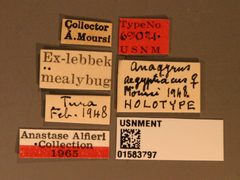
- Primary Type List | Entomology Research Museum
- Could Insect Viruses Open New Doors in Biological Pest Control?
- Yehuda Izraeli, Ph.D. - Entomology Today
- Anagyrus vladimiri wasp - Entomology Today
- Model produksi massal parasitoid Anagyrus lopezi (De Santis) (Hymenoptera: Encyrtidae) menggunakan kutu putih Phenacoccus manihoti Matile-Ferrero di laboratorium