
Phenacoccus aceris
(Signoret, 1875)
apple mealybug, maple mealybug
Phenacoccus aceris, commonly known as the apple mealybug or maple mealybug, is a widespread mealybug in the Pseudococcidae. Native to Europe, it has become established across the Holarctic region including North America and Asia. The species is a significant agricultural and horticultural pest, feeding on phloem sap of numerous plants including apple, maple, grapevine, ash, and prickly ash. Recent molecular and morphological studies have revealed that P. aceris represents a containing multiple cryptic species, with taxonomic confusion arising from co-occurring putative species that cannot be reliably separated by host-plant associations alone. The species is also an important of grapevine viruses, transmitting six ampeloviruses and two vitiviruses.
Pronunciation
How to pronounce Phenacoccus aceris: //fɛnəˈkɒkəs əˈsɛrɪs//
These audio files are automatically generated. While they are not always 100% accurate, they are a good starting point.
Identification
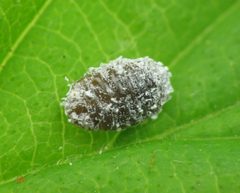
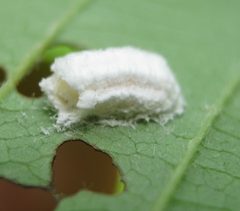
females are covered with white, powdery, meal-like wax typical of mealybugs. Diagnostic morphological characters include the number, location, and relative width of circuli on the body surface, and the distribution pattern of oral-collar tubular ducts on the segments of the . in circuli number alone is unreliable for separation; combined characters are required. Slide-mounting of adult females is mandatory for definitive species-level identification. A color test using 10% potassium hydroxide or 5% sodium hydroxide (pH 14) causes to turn green in some mealybug species, though this reaction is not unique to P. aceris.
Images
Habitat
Found in temperate regions on woody plants in orchards, vineyards, forests, and ornamental landscapes. Occurs on above-ground plant parts including stems, leaves, and fruits.
Distribution
Holarctic distribution including: Europe (France, type locality; Italy, Netherlands, Sweden, Switzerland, United Kingdom, Germany, Austria, Bulgaria, Czech Republic, Denmark, Hungary, Poland, Romania, Russia, Ukraine, Moldova, Latvia, Georgia, Armenia, Turkey), Asia (China, North Korea, Kazakhstan, Iran, Iraq, Afghanistan), and North America (United States, Canada).
Diet
Phloem-feeding sap-sucker; extracts plant sap from phloem tissue using .
Host Associations
- Malus domestica - apple
- Acer spp. - maple
- Vitis vinifera - grapevine; virus
- Fraxinus spp. - ash; co-attacked with P. azaleae in North China
- Zanthoxylum bungeanum - prickly ash; co-attacked with P. azaleae in North China
- Zanthoxylum bungeanum - Sichuan pepper
- Rosa spp. - rose
- Kermes spp. - associatedshared Microterys chalcostomus
Life Cycle
Develops through with , nymph (), and stages. All female stages have been described. First instar nymphs (crawlers) are the most efficient stage for virus transmission. is primarily parthenogenetic; males are rare. Multiple overlapping occur per season in favorable conditions.
Behavior
(first instar nymphs) are the most mobile life stage and most efficient at transmitting plant viruses. and older nymphs are less mobile due to waxy coverings.
Ecological Role
Agricultural and horticultural pest causing direct damage through phloem feeding, resulting in reduced plant vigor, , and defoliation. Indirect damage occurs through honeydew promoting growth. Acts as for grapevine leafroll-associated viruses (GLRaV-1, -3, -4, -5, -6, -9) and vitiviruses (Grapevine virus A and B), contributing to leafroll in vineyards.
Human Relevance
Significant economic pest of apple orchards, vineyards, and ornamental plantings. Management requires approaches including using such as Anagyrus schoenherri and Microterys chalcostomus. Chemical control is complicated by waxy coverings that protect older life stages from contact. Early detection and accurate identification are critical for effective management, particularly at the stage when insecticides are most effective.
Similar Taxa
- Phenacoccus azaleaeCo-occurs on Fraxinus spp. and Zanthoxylum bungeanum in North China; previous -based identifications were misleading; requires morphological and molecular analysis for separation
- Phenacoccus madeirensisMadeira mealybug, another Phenacoccus with similar appearance and habits; distinguished by morphological details of circuli and tubular ducts
- Nipaecoccus viridisHibiscus mealybug with similar waxy appearance; distinguished by green reaction to 10% KOH or 5% NaOH (pH 14)
- Planococcus citriCitrus mealybug, similar pest; distinguished by morphological characters and molecular markers
Misconceptions
-plant identity alone is unreliable for identification in the P. aceris species-group. Previous identifications based on host plants, particularly Fraxinus spp. and Zanthoxylum bungeanum, have been misleading due to co-occurrence of P. aceris and P. azaleae. The number of circuli alone is an unreliable character-state for species separation due to .
More Details
Taxonomic Complexity
Recent molecular studies using COI, EF-1α, and 28S D2D3 genes revealed four well-supported clades within specimens keyed to P. aceris from China, including three putative new genetically and morphologically distinct from P. aceris in France (type locality). This indicates P. aceris as currently defined is a requiring revision.
Virus Transmission Biology
First instar nymphs are most efficient at transmitting GLRaV-1, -3, and Grapevine virus A. This is the first report of GLRaV-6 transmission by a mealybug. Phenacoccus aceris does not transmit GLRaV-7.
Parasitoid Associations
Associated with encyrtid including Anagyrus schoenherri (Nearctic region) and Microterys chalcostomus, which also parasitizes Kermes spp.
Sources and further reading
- BugGuide
- GBIF taxonomy match
- iNaturalist taxon
- NCBI Taxonomy
- Catalogue of Life
- Publications | Entomology Research Museum
- Hans Herren: Why Sustainable Farming That Works With Nature Is Crucial | Bug Squad
- Green Light: New ID Test Ready for Invasive Mealybug Pest
- Hemp Pests Documented in New Guide for Florida Growers
- Celebrating Bugs - Buglife Blog - Buglife
- hemp pests, new records - Entomology Today
- New Host Association and State Record for Apple Mealybug, Phenacoccus aceris (Signoret)
- Transmission of Six Ampeloviruses and Two Vitiviruses to Grapevine by Phenacoccus aceris
- A review of species recognition in the Phenacoccus aceris species-group (Hemiptera: Coccomorpha: Pseudococcidae) using molecular and morphological data
- Descriptions of all female stages of the maple mealybug, Phenacoccus aceris (Hemiptera: Coccoidea: Pseudococcidae), with notes on its biology
- Redescription of Microterys chalcostomus (Dalman) (Hymenoptera: Chalcidoidea: Encyrtidae), a parasitoid associated with Phenacoccus aceris (Signoret) (Hemiptera: Pseudococcidae) and Kermes spp. (Hemiptera: Kermesidae), with comments on its host relationship
- Discovery ofAnagyrus schoenherri(Westwood, 1837) (Hymenoptera: Encyrtidae) in the Nearctic Region, a parasitoid of the apple mealybugPhenacoccus aceris(Signoret, 1875) (Hemiptera: Pseudococcidae) in Washington, U.S.A., with notes on the host