
Planococcus citri
(Risso, 1813)
citrus mealybug
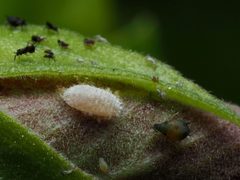
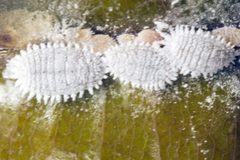
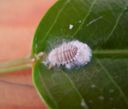
, the , is a highly pest native to Asia that has established worldwide through human-mediated transport. females are approximately 3 mm long, wingless, and covered in white wax with marginal filaments; males are slightly larger with functional wings. The reproduces sexually with multiple per year, producing ovisacs containing up to 20 . It feeds on phloem sap from over 200 plant species across 82 , causing direct damage through sap removal and indirect damage via honeydew secretion and growth. It is also a known of Cacao swollen shoot virus. The species is difficult to distinguish morphologically from the vine mealybug (Planococcus ficus), requiring microscopic examination of pore and duct arrangements or molecular methods for accurate identification.
Pronunciation
How to pronounce Planococcus citri: /plæˈnoʊkəs ˈsiːtraɪ/
These audio files are automatically generated. While they are not always 100% accurate, they are a good starting point.
Identification
From Planococcus ficus (vine mealybug): requires microscopic examination of arrangement of pores and tubular ducts on female body; molecular analysis recommended for confirmation when is planned. From other mealybugs: combination of body coloration, presence of gray line, marginal wax filament arrangement, and association. Slide-mounting of females is standard for definitive identification; field identification unreliable without microscopic examination.
Images
Habitat
Occurs in citrus orchards, vineyards, greenhouses, and ornamental plantings; thrives in warm, humid conditions; established in tropical, subtropical, and temperate regions where it survives under glass at higher latitudes; stable year-round in greenhouse environments with constant conditions.
Distribution
Native to Asia; introduced and established in Europe (including Mediterranean region, UK, Azores, Canary Islands, Madeira), Africa (widespread including Madagascar, Mauritius, South Africa), North America (USA: California, Florida, Hawaii, Texas and others; Mexico), Central America and Caribbean, South America (Argentina, Brazil, Chile, Colombia, Peru, Uruguay, Venezuela, and others), and Oceania (Australia, New Zealand, Pacific Islands including Hawaii, Fiji, Samoa, Tonga). Present in greenhouses in higher latitude temperate regions.
Seasonality
Most abundant in spring and summer with fluctuating according to temperature and availability; peak abundance in early summer in Florida citrus; multiple overlapping per year in favorable climates; continuous in greenhouse environments.
Diet
Phloem sap feeder using ; feeds on over 200 plant in 82 including Citrus, Theobroma cacao, Vitis, Solanum lycopersicum, and numerous ornamental and wild plants; shows preference for grapefruit among citrus varieties.
Host Associations
- Citrus spp. - primary preferred , especially grapefruit
- Theobroma cacao - of Cacao swollen shoot virus
- Vitis spp. - less frequently attacked than by Planococcus ficus
- Solanum lycopersicum - serious pest in glasshouse tomatoes
- Coffea spp. - coffee root mealybug designation in some contexts
Life Cycle
deposited in waxy ovisacs; first instar nymphs () disperse actively; female nymphs progress through multiple instars to wingless ; male nymphs progress through fewer instars with pre-pupal stage, construct cottony cocoon for , and emerge as winged adults; adult males live fewer than three days, do not feed, and seek females for mating; adult females live several weeks, feeding continuously and producing eggs; multiple per year with overlapping cohorts.
Behavior
are active and gregarious, dispersing to find feeding sites; females sedentary after settling, feeding and reproducing in clusters; males exhibit short lifespan focused entirely on mate location and copulation; has been observed engaging in 'triple coitus' where one female copulates with two males simultaneously with a third attempting to join; secretes honeydew continuously while feeding; waxy secretions provide protection from desiccation and some .
Ecological Role
Human Relevance
Major agricultural pest of citrus, glasshouse tomatoes, and ornamentals; causes direct damage through feeding and indirect damage via honeydew and ; reduces crop quality and marketability; increases production costs through management requirements; subject to regulations due to cryptic habits making detection difficult; managed through , cultural practices, and limited chemical options.
Similar Taxa
- Planococcus ficusExtremely similar ; distinguished by microscopic examination of pore and duct arrangement on female body; molecular analysis recommended for confirmation; P. ficus more commonly associated with grapevines and transmits grapevine leafroll and corky-bark
- Planococcus minorCryptic with overlapping range; distinguished by morphological and molecular characters; in Florida since 2010
- Nipaecoccus viridisSimilar mealybug pest of citrus and ornamentals; distinguished by green reaction to 10% KOH or 5% NaOH (unique to N. viridis among Florida mealybugs)
More Details
Endosymbiosis
Possesses nested endosymbiotic bacteria: Tremblaya princeps (betaproteobacterium) resides in bacteriocytes, and contains its own endosymbiont Moranella endobia (gammaproteobacterium); T. princeps has the smallest known bacterial at approximately 139 kilo- with ~120 genes, having lost most metabolic functions and relying entirely on M. endobia for energy and
Insecticide Resistance
Has developed resistance to some including chlorpyrifos; resistance documented in Tunisia and concerns in California due to similar climate; wax coating provides behavioral resistance by limiting contact with chemicals
Biological Control
Key include Leptomastidea abnormis, Leptomastix dactylopii, Anagyrus pseudococci, and Chrysoplatycerus splendens; include Cryptolaemus montrouzieri (mealybug destroyer), green lacewings (Chrysopa lateralis), and brown lacewings (Sympherobius barberi); commercially available for male trapping and monitoring
Sources and further reading
- BugGuide
- Wikipedia
- GBIF taxonomy match
- iNaturalist taxon
- NCBI Taxonomy
- Catalogue of Life
- Publications | Entomology Research Museum
- Molecular Biologist Michelle Heck: Challenges of Citrus Greening Disease | Bug Squad
- Check Your Citrus Trees for Signs of This Pest | Bug Squad
- Sustainable Entomology: How Insect Scientists Can Protect Our Planet
- Green Light: New ID Test Ready for Invasive Mealybug Pest
- Who's been sucking on my coleus? Citrus mealybug — Bug of the Week
- Planococcus citri (citrus mealybug).
- Planococcus citri . [Distribution map].
- Planococcus citri . [Distribution map].
- Coccidoxenoides perminutus parasitizing Planococcus citri on vine in Brazil
- Identification of Planococcus ficus and Planococcus citri (Hemiptera: Pseudococcidae) by PCR-RFLP of COI gene
- Host Plant Diversity of Planococcus citri and Planococcus lilacinus in Horticultural Ecosystem and their Associated Natural Enemies
- Biocontrol Potential of Turkish Entomopathogenic Nematodes Against the Citrus Mealybug, Planococcus citri (Risso, 1813) (Hemiptera: Pseudococcidae) Under Laboratory Conditions Yerel Entomopatojen Nematodların Laboratuvar Koşullarında Turunçgil Unlubiti, Planococcus citri (Risso, 1813) (Hemiptera:Pseudococcidae)'ye Karşı Biyokontrol Potansiyeli
- Host preference and biology of two cryptic species, Planococcus citri (Risso) and Planococcus minor (Maskell) (Hemiptera: Pseudococcidae)