
Sympherobius barberi
(Banks, 1903)
Barber's brown lacewing
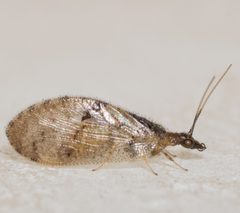
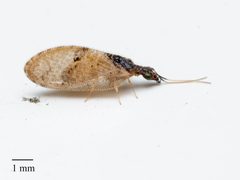
Sympherobius barberi is a of brown lacewing in the Hemerobiidae, commonly known as Barber's brown lacewing. The species has a remarkably broad distribution spanning Europe, Northern Asia (excluding China), Central America, North America, Oceania, and South America. It was first described by Banks in 1903 and has been recorded from the Galápagos Islands, representing both a new species record for the archipelago and the first record of the Sympherobius from the islands. The species was introduced to New Zealand in 1936 as a agent for aphids and but failed to establish.
Pronunciation
How to pronounce Sympherobius barberi: /sɪmˌfɛrəˈbaɪəs ˈbɑr.bɝ.aɪ/
These audio files are automatically generated. While they are not always 100% accurate, they are a good starting point.
Identification
Sympherobius barberi can be distinguished from other Sympherobius by examination of genitalic structures. The Galápagos specimens have been compared with the and specimens from Peru, Mexico, and the southern United States, indicating morphological consistency across its wide geographic range. As a brown lacewing, it possesses the characteristic delicate, lacy wings and elongated body form typical of Hemerobiidae, though specific diagnostic features for field identification are not documented in available sources.
Images
Distribution
Europe and Northern Asia (excluding China), Central America, North America, Oceania (including New Zealand, where introduced), South America, and the Galápagos Islands (Ecuador). The Galápagos record represents a significant range extension for the .
Human Relevance
The was introduced to New Zealand in 1936 as a agent targeting aphids and , but was not able to establish successfully. No other documented human uses or economic impacts are known.
Similar Taxa
- Other Sympherobius speciesRequires examination of genitalic structures for definitive identification; morphological similarity necessitates detailed comparison with .
More Details
Taxonomic history
Originally described as Hemerobius barberi by Banks in 1903, later transferred to Sympherobius. The name 'barberi' honors an individual named Barber, though the specific honoree is not documented in available sources.
Galápagos significance
The 1987 record from the Galápagos Islands represents both the first documentation of S. barberi from the archipelago and the first record of the entire Sympherobius from the islands, expanding known neuropteran diversity in this isolated .
Sources and further reading
- BugGuide
- Wikipedia
- GBIF taxonomy match
- iNaturalist taxon
- NCBI Taxonomy
- Catalogue of Life
- Bugs in orange and black: Three assassins - milkweed assassin bug, Zelus longipes; orange assassin bug, Pselliopus barberi; and wheel bug, Arilus cristatus — Bug of the Week
- Bugs in orange and black – Three spooky assassins: milkweed assassin bug, Zelus longipes; orange assassin bug, Pselliopus barberi; and wheel bug, Arilus cristatus — Bug of the Week
- How One State's Mosquito Data Could Reduce Risk of Malaria Returning to U.S.
- Bug of the Week Academy Awards 2018 — Bug of the Week
- Farmer Feedback: Needs Assessment Reveals Growers' Views on Corn Insect Pests in Iowa
- For Western Corn Rootworm, Combo of Management Methods Critical to Slow Insecticide Resistance
- A review of the Neuroptera of the Galápagos Islands with a new record for Sympherobius barberi (Banks) (Hemerobiidae)