
Leptomastidea abnormis
(Girault, 1915)
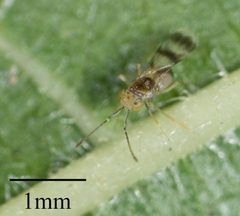
Leptomastidea abnormis is an encyrtid native to the Nearctic and Neotropical regions, with introduced in Europe and elsewhere. It is a primary parasitoid of mealybugs (Pseudococcidae), particularly the citrus mealybug Planococcus citri, and is widely used in programs. Females exhibit size-dependent selection, preferring second-instar mealybugs but also attacking later instars and . The shows temperature-dependent , with maximum progeny production at 24°C maintained up to 34°C. Sex allocation follows host quality models, with female-biased sex ratios on larger hosts.
Pronunciation
How to pronounce Leptomastidea abnormis: /lɛptoʊˈmæstɪdiːə æbˈnɔːrmɪs/
These audio files are automatically generated. While they are not always 100% accurate, they are a good starting point.
Identification
Leptomastidea abnormis can be distinguished from by antennal structure and wing venation patterns typical of the . The lectotype designation by Triapitsyn (2015) clarified the . Males are smaller than females and may be distinguished by genitalia structure. The is most reliably separated from the closely related Leptomastix dactylopii by differences in size class preference—L. abnormis attacks second instar mealybugs while L. dactylopii does not. Molecular identification may be necessary where morphological characters are ambiguous.
Images
Habitat
Agricultural and horticultural systems, particularly citrus groves, where mealybugs occur. Associated with cultivated and ornamental plants supporting Pseudococcus citri and related mealybug .
Distribution
Native to the Americas; recorded from the United States (California), Mexico (Baja California Sur), Brazil (Rio de Janeiro), and Argentina. Introduced to Europe and other regions for . GBIF records indicate presence in Australia, though establishment status unclear.
Diet
females likely feed on honeydew and other sugar sources; larvae develop as endoparasitoids within mealybug . Host feeding by adults on host has been observed in related encyrtids but not explicitly documented for this .
Host Associations
- Planococcus citri - primary citrus mealybug; principal for
Life Cycle
Develops as solitary or gregarious endoparasitoid within mealybug . Females oviposit into host body cavity; larvae feed internally, eventually killing the host. occurs within the host body or in a cocoon formed from host waxy secretions. Development time and survival are temperature-dependent, with optimal conditions around 24°C.
Behavior
Females demonstrate size-dependent selection, preferentially accepting second-instar mealybugs while also attacking third and fourth instars and . Sex allocation is facultative and responsive to host quality: females produce more daughters on larger, higher-quality hosts and more sons on smaller, lower-quality hosts, consistent with local mate competition and host quality models. Females exhibit a Type I survival curve across temperatures from 18°C to 30°C and live longer than males except at high temperatures.
Ecological Role
Human Relevance
Widely used in augmentative and programs against Planococcus citri in citrus and greenhouse systems. Commercially available from suppliers. Competitive interactions with other require consideration in programs.
Similar Taxa
- Leptomastix dactylopiiSimilar range and use in , but differs in host size preference—L. dactylopii does not attack second instar mealybugs while L. abnormis does. L. dactylopii prefers third and fourth instars and .
- Leptomastidea debachiCongeneric from Baja California Sur, Mexico; distinguished by male genitalia structure and geographic distribution.
- Anagyrus pseudococciAnother encyrtid of mealybugs used in ; differs in range and competitive ability.
More Details
Nomenclatural history
Originally described as Paraleptomastix abnormis Girault, 1915; transferred to Leptomastidea by Triapitsyn (2015) who designated a lectotype. The is housed at the University of California, Riverside Entomology Research Museum.
Temperature-dependent performance
Laboratory studies show progeny production increases with temperature from 18°C to 24°C, plateaus through 34°C, then declines. longevity decreases with rising temperature. At 30°C, L. abnormis females live longer than females of competing Anagyrus pseudococci and Leptomastix dactylopii, potentially conferring competitive advantage in warm climates.
Sex ratio manipulation
While females are larger than males as predicted by sex allocation theory, field and laboratory studies show variable sex ratios that do not always differ significantly between size classes, suggesting additional factors influence sex allocation decisions.
Sources and further reading
- BugGuide
- GBIF taxonomy match
- iNaturalist taxon
- NCBI Taxonomy
- Catalogue of Life
- Encyrtid Holdings | Entomology Research Museum
- Publications | Entomology Research Museum
- leptomastidea_hypogeococci_triapitsyn_ht_ucrc_ent_311025_slide.jpg | Entomology Research Museum
- Primary Type List | Entomology Research Museum
- Bug Eric: Scolops Planthoppers
- Host selection and sex allocation in Leptomastidea abnormis, a parasitoid of the citrus mealybug Planococcus citri
- HYMENOPTERA: Description of the male of Leptomastidea debachi Trjapitzin and Ruíz Cancino from Baja California Sur, Mexico, with notes on L. abnormis (Girault) (Hymenoptera: Encyrtidae)
- Progeny production and adult longevity of the mealybug parasitoidsAnagyrus pseudococci, Leptomastix dactylopii, andLeptomastidea abnormis [Hym.: Encyrtidae] in relation to temperature