
Cryptolaemus montrouzieri
Mulsant, 1853
Mealybug Destroyer, Mealybug Ladybird
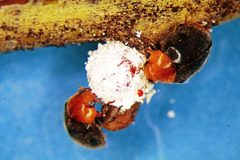
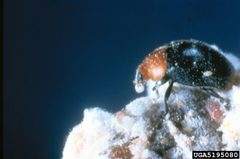
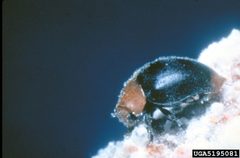
Cryptolaemus montrouzieri is a small ladybird beetle native to eastern Australia, widely used as a agent against mealybugs and scale insects in agricultural and horticultural systems globally. are approximately 6 mm long with dark brown and orange-brown , pronotum, and appendages. Larvae reach 14–15 mm and are covered in white waxy filaments that provide of their mealybug prey, potentially protecting them from aggression. The has been introduced to numerous regions including California (1891), Europe, and New Zealand for of citrus mealybug and related pests.
Pronunciation
How to pronounce Cryptolaemus montrouzieri: //ˌkrɪptoʊˈliːməs mɒntruːˈzjɛriː//
These audio files are automatically generated. While they are not always 100% accurate, they are a good starting point.
Identification
Distinguished from other lady beetles by uniformly dark brown without spots, combined with orange-brown and pronotum. Larvae are particularly distinctive: their white waxy covering makes them appear superficially similar to mealybugs rather than typical alligator-like coccinellid larvae. When disturbed, larvae may be observed actively moving among mealybug colonies, unlike the sedentary sap-feeding mealybugs they resemble.
Images
Habitat
Native to subtropical and tropical forests of eastern Australia (Queensland, New South Wales). In introduced ranges, found in agricultural and horticultural settings including citrus orchards, greenhouses, pomegranate orchards, and interior plantscapes. Requires environments supporting of mealybug or insect prey.
Distribution
to Queensland and New South Wales, Australia. Introduced and established in California (since 1891), New Zealand, Europe (France, Italy, Spain, Greece, Cyprus, northern Germany), North Africa, Afrotropical realm, , and .
Seasonality
In temperate regions, activity coincides with prey availability and warm conditions; in tropical and subtropical climates, and in protected environments such as greenhouses, active year-round. Cold winter temperatures limit outdoor survival in most of the United States, restricting year-round to Florida, California, and indoor environments.
Diet
Specialized of mealybugs (Pseudococcidae) and soft scale insects (Coccidae). and larvae prey on all life stages of mealybugs including , nymphs (), and adults. Documented prey include citrus mealybug (Planococcus citri), (), and longtailed mealybug (Pseudococcus longispinus). Can be reared on alternative prey and artificial diets, though performance is reduced compared to natural prey.
Life Cycle
Females lay among mealybug egg sacs, ensuring immediate prey access for emerging larvae. Development from egg to requires approximately 24 days under favorable conditions, passing through four larval instars and a pupal stage. Total developmental period varies with temperature and prey : 18.1 days on Planococcus citri versus 20.9 days on . Adult longevity averages 47 days on P. citri. Females produce up to 284 eggs under optimal conditions.
Behavior
Females oviposit directly within mealybug masses, a that positions offspring for immediate . Larvae exhibit through their waxy coating, which may reduce detection and aggression by ants that tend mealybugs for honeydew. Both life stages are active , with generally more voracious than larvae. Adults are capable of dispersing among plants to locate prey patches. Searching behavior and attack rates vary with plant characteristics including leaf size and variegation.
Ecological Role
of sap-feeding hemipterans; functions as a agent in programs. By suppressing mealybug , reduces honeydew production and subsequent growth on plants. May compete with other natural enemies including such as Leptomastix dactylopii.
Human Relevance
Primary use is as a agent in agriculture and horticulture. Successfully employed in citrus orchards, pomegranate production, greenhouse operations, and interior plantscapes to manage mealybug without chemical . Commercially available for purchase and release. Onsite rearing programs reduce costs and carbon emissions associated with shipping. Handling is straightforward; beetles tolerate disturbance without dying or becoming inactive, facilitating field application.
Similar Taxa
- Hyperaspis spp.Other waxy lady beetles used for mealybug and control; Hyperaspis larvae also produce waxy secretions but differ in coloration and specific prey associations.
- Rodolia cardinalis (Vedalia beetle)Another Australian coccinellid introduced for of scale insects; distinguished by red and black spotted coloration and preference for cottony cushion scale (Icerya purchasi) rather than mealybugs.
- Harmonia axyridis (Multicolored Asian Lady Beetle) with highly variable spotted or unspotted coloration; distinguished by larger size, more aggressive generalist , and tendency to aggregate in buildings .
Sources and further reading
- BugGuide
- Wikipedia
- GBIF taxonomy match
- iNaturalist taxon
- NCBI Taxonomy
- Who's been sucking on my coleus? Citrus mealybug — Bug of the Week
- Sustainable Entomology: How Insect Scientists Can Protect Our Planet
- Archive — Bug of the Week
- From the mailbag – Mealybugs, Pseudococcidae, in the greenhouse and their destroyer, Cryptolaemus montrouzieri — Bug of the Week
- COMPARATIVE BIOLOGY AND PREDATORY POTENTIAL OF Cryptolaemus montrouzieri ON MEALYBUGS
- Behavioral responses to specific prey and host plant species by a generalist predatory coccinellid (Cryptolaemus montrouzieri Mulsant)
- Banker boxes, a novel release method, improve the biological control of Planococcus citri by Cryptolaemus montrouzieri and Leptomastix dactylopii in pomegranate
- Genomic insight into diet adaptation in the biological control agent Cryptolaemus montrouzieri
- Biology of <I>Cryptolaemus montrouzieri</I> (Mulsant) on <I>Maconellicoccus hirsutus</I> (Green) at different temperature levels
- Effect of Coleus Size and Variegation on Attack Rates, Searching Strategy, and Selected Life History Characteristics of Cryptolaemus montrouzieri (Coleoptera: Coccinellidae)
- Behavioral Analysis ofCryptolaemus montrouzieriMulsant while Preying on the Pink Hibiscus Mealybug under Field Conditions
- Variation in life history traits and transcriptome associated with adaptation to diet shifts in the ladybird Cryptolaemus montrouzieri