
Icerya purchasi
Maskell, 1879
cottony cushion scale, fluted scale, cochinilla australiana
Icerya purchasi is a insect native to Australia that has become a globally distributed pest of citrus and ornamental plants. The is notable for its distinctive : most individuals are capable of self-, with rare males enabling occasional outbreeding. females are and produce large white fluted sacs that can exceed twice the body length. The species achieved historical significance as the target of one of the first successful programs, using the vedalia beetle (Novius cardinalis) in California in 1888–1889.
Identification
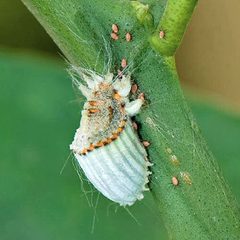
Distinguished from other scale insects by the combination of: (1) large white fluted ovisac with longitudinal grooves, (2) reddish-brown oval body with black marginal setae, (3) retention of legs in all life stages (unlike most Coccoidea), and (4) hermaphroditic . Can be confused with other Icerya , but I. purchasi is distinguished by preference for Citrus and Pittosporum, and by the structure of the sac. In Florida, Fiorinia phantasma and other Fiorinia species may appear similar but belong to a different (Diaspididae) and lack the large fluted ovisac.
Images
Appearance
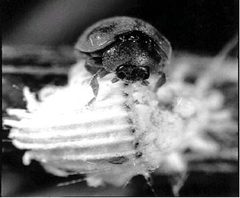
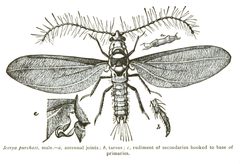
are oval, reddish-brown, approximately 5 mm long, with black marginal setae. The most conspicuous feature is the large white fluted sac (ovisac) extending from the , formed by extruded waxy secretions that create longitudinal grooves. This sac can reach two to three times the body length and contains hundreds of red eggs. The body surface is covered with waxy filaments and secretions that provide protection. Newly hatched nymphs () are bright red with dark and thin brown legs, bearing long setae on the body and antennal segments. Unlike most scale insects, all life stages retain functional legs.
Habitat
Found on woody plants in cultivated and ornamental settings. Infests twigs and branches of plants, with early instars on leaves and small twigs, older nymphs on larger twigs, and on branches and trunk. Thrives in subtropical and Mediterranean climates where citrus is grown. Not restricted to natural ; primarily an agricultural and horticultural pest.
Distribution
Native to Australia. Now in distribution wherever citrus crops are grown. Established in North America (California, Florida, Hawaii), South America (Argentina, Brazil, Chile, Uruguay, Peru, Colombia, Ecuador, Paraguay, Venezuela, Bolivia), Europe (Mediterranean region including Spain, Italy, France, Greece, Portugal), Africa (Egypt, Algeria, South Africa, Kenya, Morocco, Tunisia), Asia (China, India, Japan, Israel, Iran, Turkey, Korea, Taiwan, Indonesia, Malaysia, Philippines), and Australasia/Pacific (New Zealand, Fiji, Hawaii, Pacific islands).
Seasonality
In temperate regions, active year-round with peaks in spring, summer, and fall. In Algeria, three intense periods occur: spring, summer, and fall. In Egypt, abundance extends from April to December with four possible . Generation time is highly temperature-dependent, ranging from 12–14 weeks, with faster development at higher temperatures. Peak occurs in mid-summer (June–July in northern hemisphere).
Diet
Phloem-feeding sap-sucker. Uses long siphon-like mouthparts to extract plant fluids from vascular tissue.
Host Associations
- Citrus - primary most economically important ; includes oranges, lemons, clementines
- Pittosporum - primary ornamental shrub
- Mangifera indica - mango
- Rosmarinus officinalis - rosemary; new record for Greece
- Sterculia diversifolia - recorded in Egypt
- Acacia - original kangaroo acacia in New Zealand where first described
- blueberry - Vaccinium spp.; recorded in Argentina
Life Cycle
are laid within the white fluted ovisac and hatch into first-instar nymphs called '.' These crawlers are the primary stage, moving by crawling and wind dispersal. Early instars feed on leaf midribs and small twigs, causing most damage. At each , nymphs leave behind and waxy secretions. Unlike most scale insects, all stages retain legs and limited mobility. Older nymphs migrate to larger twigs, and become on branches and trunk. duration varies with temperature, with colder temperatures prolonging each stage.
Behavior
are , attaching permanently to plants via waxy secretions. First-instar are highly mobile and dispersive, moving constantly when active. Crawlers disperse by both crawling and wind; long body setae may aid in aerial . Adults and nymphs secrete honeydew, which attracts ants and promotes growth. The exhibits androdioecy: hermaphrodites primarily self-fertilize, but rare outbreeding with males occurs, providing genetic variation while maintaining advantages of selfing.
Ecological Role
Agricultural pest causing direct damage through phloem feeding and indirect damage via honeydew secretion and growth. Heavy cause decreased tree vitality, fruit drop, defoliation, and branch dieback. Ants consume honeydew and may protect from . Subject of programs using natural enemies, particularly the vedalia beetle (Novius cardinalis) and parasitic fly Cryptochetum iceryae.
Human Relevance
Major economic pest of citrus and ornamental industries worldwide. Historically significant as target of first major successful program: vedalia beetle introduction saved California citrus industry in 1888–1889. Control remains primarily biological; are discouraged as they harm natural enemies and can cause resurgence. Imidacloprid is specifically contraindicated—ineffective against I. purchasi but highly toxic to Novius cardinalis. Mechanical control by hand crushing has been shown effective in small- applications.
Similar Taxa
- Icerya aegyptiacacongeneric in same ; distinguished by preference and geographic distribution (primarily Egypt and Middle East)
- Icerya subandinacongeneric found in Argentina; distinguished by subtle morphological differences and
- Fiorinia phantasma (Diaspididae) that may be confused in Florida; lacks large fluted ovisac, has different covering, and infests palms primarily
- Pseudococcidae (mealybugs)also produce waxy secretions but have different body form, lack large structured ovisac, and belong to different superfamily
More Details
Reproductive system
Androdioecy (coexistence of males and ) is extremely rare in insects. Icerya purchasi hermaphrodites possess an ovitestis capable of producing both sperm and , enabling self-. The ovitestis are haploid and derived from excess sperm during matings with males, termed 'parasitic tissue.' This system represents sexual conflict and allows both advantages of selfing and genetic benefits of occasional outbreeding.
Historical significance
The 1888–1889 introduction of Novius cardinalis (then Rodolia cardinalis) by C.V. Riley is considered the birth of modern . The vedalia beetle reduced I. purchasi so dramatically that citrus production recovered within months. This success established biological control as a viable pest management strategy and led to the formation of the USDA's Division of Entomology.
Chemical control issues
and malathion use in the 1950s caused resurgence of I. purchasi by killing vedalia beetles. Drift from airplane spraying was particularly problematic. Modern recommendations emphasize that should only be used when agents are absent, and specific compounds like imidacloprid should be avoided due to differential to natural enemies.
Sources and further reading
- BugGuide
- Wikipedia
- GBIF taxonomy match
- iNaturalist taxon
- NCBI Taxonomy
- Catalogue of Life
- ID Challenge #17 | Beetles In The Bush
- Monophlebidae | Beetles In The Bush
- New Guide Details Management of Invasive Scale Insect in Florida
- quiz | Beetles In The Bush | Page 3
- ID challenge | Beetles In The Bush | Page 2
- Argentina | Beetles In The Bush | Page 5
- Icerya purchasi . [Distribution map].
- Citrus Pest Quick Guide: Cottony Cushion Scale (Icerya purchasi)
- Cottony Cushion Scale, Icerya purchasi Maskell (Insecta: Hemiptera: Margarodidae)
- Sex, males, and hermaphrodites in the scale insect Icerya purchasi
- Adaptation of Rodolia cardinalis (Mulsant) (Col., Coccinellidae) to Icerya aegyptiaca (Douglas) (Hom., Margrodidae) as compared with Icerya purchasi Mask
- Ecology of Icerya purchasi Maskell, 1879 (Homoptera: Margarodidae) on clementine trees at Sidi Moussa (Central Mitidja, Algeria)
- The abundance and mechanical control of Icerya purchasi (Maskell, 1878) (Hemiptera: Monophlebidae) on Mangifera indica in Dhaka, Bangladesh
- Spatial Distribution and Sampling of Icerya purchasi Mask. (Hom.: Margarodidae) on Orange Trees in Southwest Iran
- Icerya purchasi (Homoptera: Margarodidae) on Rosmarinus officinalis (Lamiaceae), a new host plant record for Greece
- Two parasitoid complekes:Hierodoris atychioides(Butler)(Lepidoptera: Oecophoridae) andIcerya purchasiMaskell (Homoptera: Margarodidae)
- Abundance ofIcerya purchasi(Hemiptera: Margarodidae) and Its ParasitoidCryptochaetum iceryae(Diptera: Cryptochaetidae) in Argentina Blueberry Crops
- Distribution and abundance of Icerya purchasi Mask. on Stercholia diversifolia in Egypt