
Fiorinia
Species Guides
2- Fiorinia externa(elongate hemlock scale)
- Fiorinia theae(tea scale)
Fiorinia is a of armored scale insects ( Diaspididae) comprising approximately 70 . The genus is characterized by pupillarial development, where the female remains enclosed within the second-instar . Species are predominantly distributed in tropical and subtropical Asia and the Pacific Islands, though several have become pests globally through trade in ornamental plants. Notable include F. externa (elongate hemlock ), F. fioriniae (palm fiorinia scale), F. phantasma (phantasma scale), and F. theae (tea scale).
Pronunciation
How to pronounce Fiorinia: /fi.oˈriː.ni.a/
These audio files are automatically generated. While they are not always 100% accurate, they are a good starting point.
Identification
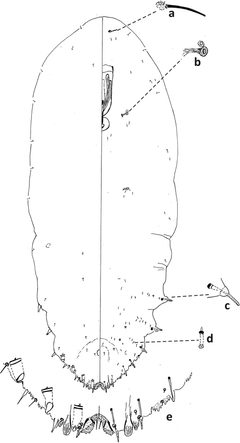
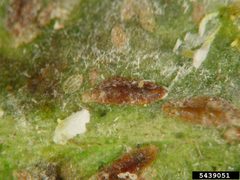
identification requires microscopic examination of slide-mounted specimens; external appearance of covers is insufficient for reliable determination. Female scale covers are elongated, 1.2–2.0 mm in length, and typically brownish; male covers are usually white. Diagnostic characters include female and second-instar : general body shape, end structure, configuration, , and the number and arrangement of macroducts, microducts, and gland spines. Marginal gland spines and macroducts distinguish Fiorinia from the similar Pseudaulacaspis. Field identification is complicated by convergent morphology among species; for example, F. phantasma, F. fioriniae, and F. japonica are indistinguishable in the field on palms. and taxonomic keys to second-instar males and females are available for some regions.
Images
Habitat
infest woody plants including broad-leaved trees and shrubs, conifers, and palm trees. typically occurs on the undersides of leaves. Native species occur in forest and agricultural ; are found in ornamental plantings, nurseries, and managed landscapes.
Distribution
Native range centered in tropical and subtropical Asia and the Pacific Islands. Introduced established in North America, the United Kingdom, Hawaii, Florida, and other regions through human-mediated transport of infested ornamental plants. In the United States, F. phantasma is known from Miami-Dade and Palm Beach counties, Florida, and Hawaii; F. externa occurs in eastern North America; F. theae is present in the southeastern United States.
Host Associations
- Camellia - primary of F. theae
- Ilex - of F. theae
- Tsuga - primary of F. externa
- Abies fraseri - of F. externa
- palm trees - preferred of F. fioriniae and F. phantasma
- avocado - of F. fioriniae
- citrus - of F. theae
- tea - of F. theae
Life Cycle
Females develop through , (first-instar), second-instar, and stages. Males have two additional instars. Only the crawler stage is mobile and capable of . The exhibits pupillarial development: the second-instar female forms the cover, and the adult female remains permanently enclosed within this structure.
Behavior
disperse to new plant parts or longer distances via wind, animal transport, or human activity. Long-distance spread occurs primarily through trade of infested host plants. Post-harvest survival has been documented: F. externa persists on cut Christmas trees for up to 13 weeks, with continued crawler and production.
Ecological Role
Herbivores that extract plant sap, causing foliar yellowing, reduced plant vigor, and potential death at high densities. Serve as prey for natural enemies including lady beetles, lacewings, predatory , predatory mites, and . Subject to natural by fungi including lecanii, bassiana, and Metarhiziopsis microspora.
Human Relevance
Several are significant agricultural, forestry, and ornamental pests. Fiorinia externa threatens eastern North American hemlock forests and the Christmas tree industry; post-harvest survival on Fraser fir creates regulatory challenges. Fiorinia phantasma endangers Florida's $400 million palm industry. Fiorinia fioriniae and F. theae damage ornamentals and tea plantations. Management relies on combining monitoring, targeted application against stages, and . Detection is complicated by cryptic and requires specialized taxonomic expertise.
Similar Taxa
- PseudaulacaspisSimilar ; distinguished by marginal gland spine and macroduct characteristics
- Fiorinia fioriniaeExternally indistinguishable from F. phantasma and F. japonica in the field; requires microscopic or molecular identification
- Fiorinia japonicaField-identical to F. phantasma on palms; distinguished by morphological details of female and second instar
Sources and further reading
- BugGuide
- Wikipedia
- iNaturalist taxon
- NCBI Taxonomy
- Catalogue of Life
- Fiorinia phantasma scale infestation on palm - Entomology Today
- Fiorinia phantasma scale comparison - Entomology Today
- Fiorinia externa Archives - Entomology Today
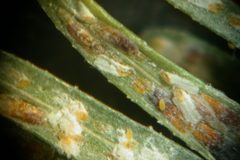
- These small, amber-colored spots on the underside of fir needles are elongate hemlock scale (Fiorinia externa)—an invasive and persistent insect that can persist on trees up to 13 weeks post-harvest. (Photo by Robert Jetton, Ph.D.) - Entomology Today
- New Guide Details Management of Invasive Scale Insect in Florida
- From Hillside to Hearthside: Tracking the Elongate Hemlock Scale's Journey on Christmas Trees
- Seasonal Life Cycle of Fiorinia externa in Maryland1
- Tea Scale, Fiorinia theae Green (Insecta: Hemiptera: Diaspididae)
- Notes on the Biology and Control of Fiorinia externa Ferris1
- Biology and population dynamics of tea scale, Fiorinia theae Green (Diaspididae: Coccoidea: Homoptera) / by Badar Munir.
- Population Dynamics of the Tea Scale, Fiorinia theae (Homoptera: Diaspididae), with Biology and Life Tables
- Foliar Nitrogen: A Basis for Host Suitability for Elongate Hemlock Scale, Fiorinia Externa (Homoptera: Diaspididae)
- Spatial and Seasonal Distribution of Disseminating Stages of Fiorinia externa (Homoptera: Diaspididae) and Natural Enemies in a Hemlock Forest
- FLUCTUACIÓN POBLACIONAL INVIERNO – PRIMAVERA DE Pinnaspis aspidistrae (Signoret), Fiorinia fioriniae (Targioni Tozzetti), Chrysomphalus aonidum (Linnaeus) (HEMIPTERA: DIASPIDIDAE) Y SUS PARASITOIDES, EN PALTO. LA MOLINA, LIMA – PERÚ
- Fungi associated with a natural epizootic in Fiorinia externa Ferris (Hemiptera: Diaspididae) populations
- Seasonal Development of Fiorinia externa, Tsugaspidiotus tsugae (Homoptera: Diaspididae), and Their Parasite, Aspidiotiphagus citrinus (Hymenoptera: Aphelinidae): Importance of Parasite-Host Synchronism to the Population Dynamics of Two Scale Pests of Hemlock
- The identity and distribution of Fiorinia phantasma (Cockerell & Robinson) Hemiptera: Coccomorpha: Diaspididae), with a new synonym