
Fiorinia externa
Ferris, 1942
elongate hemlock scale
Fiorinia externa, the elongate hemlock , is an insect native to Japan and southern China. Accidentally introduced to North America around 1908, it has become established throughout the northeastern United States and threatens hemlock (Tsuga) and related conifers. The is a pupillarial scale, with females remaining within their second-instar . Heavy cause yellowing, premature needle drop, branch dieback, and occasional tree death. It poses particular economic concern for Fraser fir Christmas tree production in the southeastern United States, where it can persist on harvested trees for up to 13 weeks post-harvest.
Pronunciation
How to pronounce Fiorinia externa: //fi.oˈɾi.ni.a ɛkˈstɛr.na//
These audio files are automatically generated. While they are not always 100% accurate, they are a good starting point.
Identification
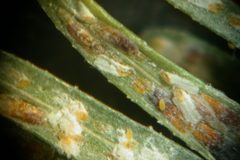
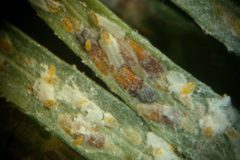
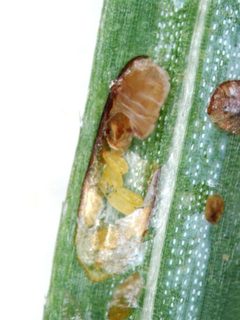
females are approximately 1 mm long. The second-instar female cover is elongated, about 1.5 mm long, and yellowish-brown to reddish-brown in color. male scale covers are white. and are yellowish; when crawlers settle, they excrete white wax filaments that can give infested foliage a whitish appearance. The is distinguished from other Fiorinia species by the elongated shape of the female scale cover and its specific association with conifer .
Images
Habitat
Coniferous forests and plantations, particularly those dominated by hemlock (Tsuga), fir (Abies), and spruce (Picea). In its North American range, it occurs in eastern hemlock stands, Fraser fir Christmas tree farms, and ornamental conifer plantings.
Distribution
Native to Japan and southern China. Introduced and established in the northeastern United States, with records from New York (first reported 1908) south to Georgia, and west to Michigan, Kentucky, and Tennessee. Isolated records exist from California and Florida on imported material, and from England on a single imported fir tree where it did not establish.
Seasonality
occurs as within pupillarial females or as mature females. Eggs hatch in spring, with migrating to new needles. One or two per year occur in North America; where only one generation completes, a partial second generation may begin but with high winter mortality.
Diet
Phloem-feeding sap-sucker; feeds on plant sap from conifer needles using a long siphon tube.
Host Associations
- Tsuga canadensis - primary eastern hemlock, most common in North America
- Tsuga caroliniana - primary Carolina hemlock
- Tsuga diversifolia - primary northern Japanese hemlock
- Abies amabilis - Pacific silver fir
- Abies fargesii - Farges fir
- Abies veitchii - Veitch fir
- Abies fraseri - Fraser fir, economically important Christmas tree
- Picea pungens - Colorado spruce
Life Cycle
Pupillarial : female remains within second-instar . stages are within the pupillarial female or fully mature adult females. Eggs hatch in spring; are the mobile stage. Crawlers settle on new needles and secrete white wax filaments. There may be one or two per year in North America.
Behavior
disperse to new needles on the same plant or are carried longer distances by wind or birds. In post-harvest Christmas trees, crawler increases when trees are moved indoors due to warmer temperatures and water availability. Baling trees for shipping reduces crawler emergence compared to unbaled trees, likely due to restricted airflow.
Ecological Role
Herbivore and forest pest; contributes to decline of eastern hemlock stands in the northeastern United States. Natural caused by fungi (including Conoideocrella luteorostrata, bassiana, lecanii) have been observed in . with Tsugaspidiotus tsugae (hemlock woolly adelgid) has been documented, with F. externa competitively superior.
Human Relevance
Serious pest of ornamental and forest conifers; of particular economic importance to Fraser fir Christmas tree production in North Carolina, Virginia, and Tennessee. Heavy reduce tree quality and marketability. Post-harvest survival on cut trees creates regulatory concerns for interstate transport and risk of introduction to new areas. Chemical control uses or ; efforts have focused on , though poor synchrony between Encarsia citrina and F. externa in North America limits effectiveness compared to Japan.
Similar Taxa
- Tsugaspidiotus tsugaealso feeds on eastern hemlock; distinguished by woolly wax covering and different
- Fiorinia phantasmacongeneric on palms; distinguished by association and geographic range
- Fiorinia fioriniaecongeneric on palms in Florida; requires microscopic or molecular identification for separation
Sources and further reading
- BugGuide
- Wikipedia
- GBIF taxonomy match
- iNaturalist taxon
- NCBI Taxonomy
- Catalogue of Life
- Detailed External Anatomy
- From Hillside to Hearthside: Tracking the Elongate Hemlock Scale's Journey on Christmas Trees
- The Pest Management Methods That Deliver Picture-Perfect Christmas Trees
- New Guide Details Management of Invasive Scale Insect in Florida
- Soil carried on sea freight loaded with dangerous pests and diseases | Blog
- Boric Acid Kills Bed Bugs, But Only When They Eat It
- Seasonal Life Cycle of Fiorinia externa in Maryland1
- Notes on the Biology and Control of Fiorinia externa Ferris1
- Fungi associated with a natural epizootic in Fiorinia externa Ferris (Hemiptera: Diaspididae) populations
- Foliar Nitrogen: A Basis for Host Suitability for Elongate Hemlock Scale, Fiorinia Externa (Homoptera: Diaspididae)
- Spatial and Seasonal Distribution of Disseminating Stages of Fiorinia externa (Homoptera: Diaspididae) and Natural Enemies in a Hemlock Forest
- Fiorinia externa and Tsugaspidiotus tsugae (Homoptera: Diaspididae): Distribution, Abundance, and New Hosts of Two Destructive Scale Insects of Eastern Hemlock in Connecticut
- Seasonal Development of Fiorinia externa, Tsugaspidiotus tsugae (Homoptera: Diaspididae), and Their Parasite, Aspidiotiphagus citrinus (Hymenoptera: Aphelinidae): Importance of Parasite-Host Synchronism to the Population Dynamics of Two Scale Pests of Hemlock
- Morphological and phylogenetic resolution of Conoideocrella luteorostrata (Hypocreales: Clavicipitaceae), a potential biocontrol fungus for Fiorinia externa in United States Christmas tree production areas
- Host Plant Associations of an Entomopathogenic Variety of the Fungus,Colletotrichum acutatum, Recovered from the Elongate Hemlock Scale,Fiorinia externa
- Impact of latitude on synchrony of a scale (Fiorinia externa) (Hemiptera: Diaspididae) and its parasitoid (Encarsia citrina) (Hymenoptera: Aphelinidae) in the Eastern United States
- Effects of voltinism, interspecific competition and parasitism on the population dynamics of the hemlock scales, Fiorinia externa and Tsugaspidiotus tsugae (Homoptera: Diaspididae)