
Fiorinia theae
Green, 1900
tea scale
Fiorinia theae, known as the tea , is an insect native to Asia that has become an established pest in the Americas. It is on woody plants, with primary including tea (Camellia sinensis), ornamental camellias, and hollies (Ilex ). Heavy cause leaf yellowing, premature defoliation, branch dieback, and plant death. The species is multivoltine in warmer climates, with overlapping and year-round activity in southern regions.
Pronunciation
How to pronounce Fiorinia theae: /fi.oːˈriː.ni.a ˈtʰi.aɪ/
These audio files are automatically generated. While they are not always 100% accurate, they are a good starting point.
Identification
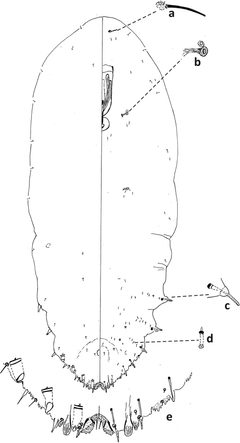
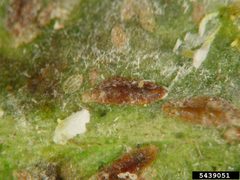
Distinguished from other Fiorinia by the elongated dark brown female cover (1.0–1.5 mm) contrasting with the white male scale cover. Heavy produce conspicuous white wax secretions visible on leaf undersides. males are winged and -like, unlike the females. Microscopic examination of morphological features or may be required for definitive separation from closely related species such as Fiorinia phantasma or Fiorinia fioriniae, which can appear similar in the field.
Images
Habitat
Found on the undersides of leaves of woody plants. Occurs in cultivated settings including tea plantations, ornamental nurseries, and residential landscapes. Thrives in warmer climates with multiple per year; activity diminishes in cooler regions where fewer generations occur.
Distribution
Native to southern Asia, with records from India (type locality), Sri Lanka, Philippines, Taiwan, southern China, Nepal, Malaysia, Indonesia, Brunei, Cambodia, and Japan. Introduced to the Americas in the early 20th century; first recorded in South Carolina in 1908. Now established throughout the eastern and south-central United States from Massachusetts to Texas and Kansas, with additional records from California, the Bahamas, Mexico, Central America, and Argentina in South America.
Seasonality
Year-round activity in southern regions such as Florida, where multiple overlapping occur and all life stages may be present simultaneously. In northern states, fewer generations per year with reduced winter activity. A single generation requires 45–65 days under favorable conditions.
Diet
Phloem sap feeder on woody plants. range includes Camellia sinensis (tea), other Camellia , Ilex species (holly), Citrus, and numerous other ornamental and crop trees and shrubs across more than 20 in 18 plant .
Host Associations
- Camellia sinensis - primary Tea plant; type locality
- Camellia japonica - Highly susceptible ornamental camellia
- Camellia sasanqua - Ornamental camellia
- Ilex cornuta - Highly susceptible non-native holly
- Ilex vomitoria - Native holly; relatively
- Ilex opaca - Native holly; relatively
- Citrus - Crop
Life Cycle
hatch after 1–3 weeks into first instar that disperse by or wind. Crawlers become after approximately one week, begin feeding, and to second instar after 10 days. Females molt once more and remain as within the second-instar . Males undergo three additional molts to reach adulthood. Total development from egg to adult female requires 3–4 weeks; male development is slightly longer. Multiple overlapping occur annually in warm climates.
Behavior
are the stage, moving to new plant parts or spreading via wind. females are permanently beneath their protective cover. Adult males are winged, mobile, and do not feed. Heavy produce copious white wax secretions.
Ecological Role
Economic pest causing direct damage to plants through phloem feeding. Extensive result in leaf , premature defoliation, reduced plant vigor, branch dieback, and host plant mortality. Susceptibility varies among host and cultivars.
Human Relevance
Significant pest of ornamental camellias and hollies in the southeastern United States, where it is considered a key pest of landscape plants. Damage to tea crops in Asia. Management is complicated by the protected feeding position on leaf undersides and hard covers that limit efficacy. using such as Aphytis diaspidis has been attempted, with Aphytis theae introduced from India to Florida in 1976 but failing to establish due to winter mortality.
Similar Taxa
- Fiorinia phantasmaSimilar appearance and ; distinguished by preference (palms) and microscopic morphological features; may be required for definitive identification
- Fiorinia fioriniaeSimilar appearance and ; commonly found on palms; field identification difficult without detailed examination
- Fiorinia externaSimilar ; elongate hemlock scale primarily on conifers such as fir and hemlock; distinct association aids separation
More Details
Management challenges
The protected feeding position on leaf undersides and hard covers make chemical control difficult. are less harmful to natural enemies but may be insufficient for heavy . Pruning before application has been suggested to improve efficacy.
Biological control attempts
Aphytis theae was introduced from India to Florida in 1976 for but failed to survive winter conditions. Native including Aphytis diaspidis occur in southeastern North America.
Sources and further reading
- BugGuide
- Wikipedia
- GBIF taxonomy match
- iNaturalist taxon
- NCBI Taxonomy
- Catalogue of Life
- Aphytis Project Final Report | Entomology Research Museum
- Fiorinia phantasma scale infestation on palm - Entomology Today
- Fiorinia phantasma scale comparison - Entomology Today
- Fiorinia externa Archives - Entomology Today
- New Guide Details Management of Invasive Scale Insect in Florida
- These small, amber-colored spots on the underside of fir needles are elongate hemlock scale (Fiorinia externa)—an invasive and persistent insect that can persist on trees up to 13 weeks post-harvest. (Photo by Robert Jetton, Ph.D.) - Entomology Today
- Tea Scale, Fiorinia theae Green (Insecta: Hemiptera: Diaspididae)
- Population Dynamics of the Tea Scale, Fiorinia theae (Homoptera: Diaspididae), with Biology and Life Tables
- Biology and population dynamics of tea scale, Fiorinia theae Green (Diaspididae: Coccoidea: Homoptera) / by Badar Munir.