
Icerya
Signoret, 1875
Cushion Scale Insects
Species Guides
1- Icerya purchasi(cottony cushion scale)
Icerya is a of scale insects in the Monophlebidae, notable for containing some of the few hermaphroditic insects known to science. The genus includes approximately 50 described distributed worldwide, with several species being significant agricultural pests. The most economically important species is Icerya purchasi (), native to Australia but now in distribution, which has caused severe damage to citrus crops globally. Several Icerya species exhibit androdioecy—a rare mating system where and males coexist—with hermaphrodites possessing ovotestes and reproducing primarily through self-. This reproductive strategy, combined with the nature of females, contributes to their potential. The genus is named after physician-naturalist Dr. Edmond Icery of British Mauritius.
Pronunciation
How to pronounce Icerya: //aɪˈsɪəriə//
These audio files are automatically generated. While they are not always 100% accurate, they are a good starting point.
Identification
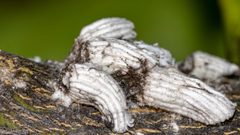
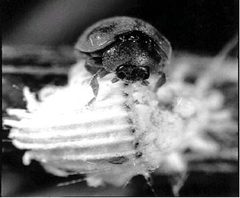
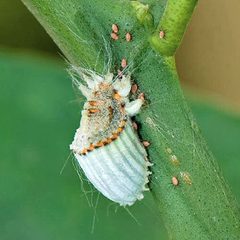
Distinguished from other insect by the combination of: large, fluted, white waxy ovisac; hermaphroditic ; bright red stage with long body setae; and orange-red body coloration. Icerya purchasi specifically identified by the cottony, cushion-like appearance of the sac. Can be confused with other margarodid or monophlebid scales, but the prominent fluted ovisac structure is distinctive. Molecular identification may be required to distinguish among closely related Icerya , as morphological differences can be subtle.
Images
Habitat
Associated with woody plants, particularly in subtropical and tropical regions. Found on branches and twigs of trees, often in concealed areas. established in temperate regions where citrus and other host plants are cultivated. include citrus groves, ornamental plantings, forests, and agricultural landscapes.
Distribution
distribution with native range in Australasia (Australia, Pacific islands). Now present on every continent except Antarctica, including: North America (USA, Mexico), Central and South America (Argentina, Brazil, Chile, etc.), Europe (Mediterranean region), Africa (widespread), Asia (India, China, Southeast Asia, Middle East), and Oceania. Specific distributions vary by —I. purchasi nearly worldwide, I. aegyptiaca in Africa, Asia, and Oceania, I. seychellarum in Africa, Asia, and Oceania.
Diet
Phloem-feeding; specialized plant sap-feeders using long siphon-like mouthparts. , with strong preferences for woody plants.
Host Associations
- Citrus spp. - primary Major economic impact; I. purchasi especially damaging
- Pittosporum spp. - Important for I. purchasi
- Artocarpus spp. (breadfruit, jackfruit) - Primary for I. aegyptiaca
- Mangifera indica (mango) -
- Psidium guajava (guava) -
- Morus alba (mulberry) -
- Annona spp. -
- Manilkara zapota (sapodilla) -
- Coccoloba uvifera (seagrape) - Associated with I. seychellarum in Caribbean
- Ficus nitida - for I. aegyptiaca in Egypt
Life Cycle
Development includes , (first instar nymph), second and third instar nymphs, and stages. First instar nymphs are the primary stage, capable of crawling and wind dispersal via long body setae. Later instars become increasingly and waxy. Adult females are completely sessile, attached to substrate by waxy secretions. Males are rare, winged, and do not feed as adults. primarily through self- in ; males occasionally produced from unfertilized eggs.
Behavior
females are permanently , attached to plant branches. First instar are highly mobile and dispersive, moving to new feeding sites or being wind-dispersed. self-fertilize, with sperm transmitted ovarially to offspring. Rare outbreeding occurs between males and hermaphrodites. mutualism observed, with ants tending for honeydew secretions. Waxy secretions provide protection from desiccation, , and .
Ecological Role
Herbivore and plant pest; phloem-feeding causes direct plant damage including decreased vitality, fruit drop, and defoliation. Honeydew secretion promotes growth, further impacting plant health. Serves as prey for numerous natural enemies including lady beetles (especially Rodolia cardinalis), , lacewings, and predatory mites. Important model organism for studying rare androdioecious mating systems and self- in insects.
Human Relevance
Major agricultural pest of citrus, causing significant economic damage globally. Icerya purchasi was the target of one of history's first successful programs—introduction of the vedalia beetle (Rodolia cardinalis) from Australia to California in 1888, which became a landmark achievement in pest management. Continues to require management in citrus and ornamental industries. concern for international plant trade due to potential. Subject of ongoing research on climate change impacts on distribution.
Similar Taxa
- Fiorinia spp.Armored scale insects also damaging to palms and ornamentals; distinguished by protective covering rather than waxy ovisac, and by separate sexes rather than hermaphroditism
- Pseudococcidae (mealybugs)Also produce waxy secretions and are soft-bodied; distinguished by segmented body, absence of large fluted ovisac, and typical without hermaphroditism
- Diaspididae (armored scales)Have hard protective covering formed from and wax; lack the prominent cottony ovisac characteristic of Icerya
- Coccidae (soft scales)Lack the large, fluted ovisac structure; typically have more convex, unsegmented body form and different reproductive strategies
More Details
Etymology
The name honors Dr. Edmond Icery, a physician-naturalist from British Mauritius who contributed to early natural history studies in the region.
Reproductive biology
Hermaphroditism in Icerya represents one of the few known cases in insects. The ovotestis produces both sperm and , with self- occurring internally. Sperm is transmitted through the ovarian tissue to developing embryos, a mechanism termed 'ovarial transmission.' This reproductive self-sufficiency allows single individuals to colonize new territories, contributing to spread.
Historical biological control
The 1888 introduction of Rodolia cardinalis to California against I. purchasi is considered the first major success in and established the vedalia beetle as a model agent. The control program saved the California citrus industry and demonstrated the potential for natural enemy introductions in pest management.
Sources and further reading
- BugGuide
- Wikipedia
- GBIF taxonomy match
- iNaturalist taxon
- NCBI Taxonomy
- Catalogue of Life
- Encyrtid Holdings | Entomology Research Museum
- ID Challenge #17 | Beetles In The Bush
- Monophlebidae | Beetles In The Bush
- New Guide Details Management of Invasive Scale Insect in Florida
- quiz | Beetles In The Bush | Page 3
- ID challenge | Beetles In The Bush | Page 2
- Icerya seychellarum . [Distribution map].
- Icerya samaraia (steatococcus scale).
- Adaptation of Rodolia cardinalis (Mulsant) (Col., Coccinellidae) to Icerya aegyptiaca (Douglas) (Hom., Margrodidae) as compared with Icerya purchasi Mask
- Establishment and host records of Icerya aegyptiaca (Douglas) (Hemiptera: Coccoidea: Monophlebidae) in the Sakishima Islands of the Ryukyu Archipelago, Japan, with notes on its worldwide distribution
- Icerya aegyptiaca . [Distribution map].
- Icerya aegyptiaca . [Distribution map].
- Icerya purchasi . [Distribution map].
- Cottony Cushion Scale, Icerya purchasi Maskell (Insecta: Hemiptera: Margarodidae)
- Icerya seychellarum . [Distribution map].
- Citrus Pest Quick Guide: Cottony Cushion Scale (Icerya purchasi)
- Sex, males, and hermaphrodites in the scale insect Icerya purchasi
- Predicting the Potential Global Geographical Distribution of Two Icerya Species under Climate Change