
Hyperaspis
Chevrolat in Dejean, 1836
Sigil Lady Beetles
Species Guides
64- Hyperaspis aemulator
- Hyperaspis annexa
- Hyperaspis bensonica
- Hyperaspis bigeminata(bigeminy lady beetle)
- Hyperaspis binotata
- Hyperaspis bolteri
- Hyperaspis brunnescens
- Hyperaspis caseyi
- Hyperaspis cincta(Corona Sigil Lady Beetle)
Hyperaspis is a of lady beetles ( Coccinellidae) comprising more than 100 described . Members are known as Sigil Lady Beetles. Species in this genus are predatory, with documented associations with scale insects and . The genus has a wide distribution including North America and northern Europe, though individual species vary in range.
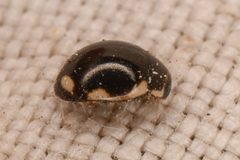
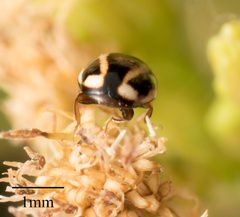
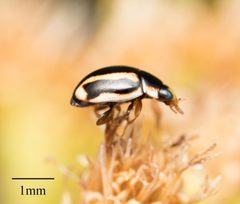
Pronunciation
How to pronounce Hyperaspis: /ˌhaɪ.pəˈræspɪs/
These audio files are automatically generated. While they are not always 100% accurate, they are a good starting point.
Identification
Hyperaspis are distinguished from other coccinellid by tribal assignment to Hyperaspidini. Specific identification to species level often requires examination of genitalia and detailed morphological features. The genus name is masculine in gender.
Images
Distribution
Documented from eastern North America, Fenno-Scandian countries (northern Europe), and other regions. Specific distributional records include: H. pseudopustulata and H. inexpectata in northern Europe; H. concolor in Sweden; H. paludicola with reviewed distribution in association with Miscanthus mealybug.
Diet
Predatory on scale insects and . H. binotata complex has been observed feeding on Toumeyella numismaticum, Pulvinaria spp., and other scale insects. H. paludicola is associated with Miscanthicoccus miscanthi (Miscanthus Mealybug).
Host Associations
- Toumeyella numismaticum - prey insect
- Pulvinaria spp. - preyscale insects
- Miscanthicoccus miscanthi - preyMiscanthus Mealybug
Ecological Role
Predatory coccinellid functioning as a agent of scale insects and . H. trifurcata has been studied for integrated management of Dactylopius opuntiae (cochineal insect on Opuntia cacti).
Human Relevance
Used in biological pest management. H. trifurcata has been investigated for optimizing integrated management of Dactylopius opuntiae, a pest of Opuntia cacti. Research has examined effects of temperature, release rate, prey , and on effectiveness.
Similar Taxa
- Other Coccinellidae generaHyperaspis belongs to tribe Hyperaspidini, distinguishing it from other coccinellid tribes; -level identification requires detailed examination
More Details
Taxonomic note
H. reppensis was historically reported from northern Europe based on misidentifications; the does not actually occur in Fenno-Scandian countries.
Research focus
Multiple have been subjects of research, with particular attention to optimizing release protocols and understanding impacts.
Sources and further reading
- BugGuide
- Wikipedia
- iNaturalist taxon
- NCBI Taxonomy
- Catalogue of Life
- Two New Species of the Genus Hyperaspis (Coleoptera: Coccinellidae)
- On the occurrence of the genus <i>Hyperaspis</i> (Col. Coccinellidae) in Fenno-Scandian countries.
- Hyperaspis paludicolaSchwarz (Coleoptera: Coccinellidae): Association with Miscanthus Mealybug,Miscanthicoccus miscanthi(Takahashi) (Hemiptera: Pseudococcidae), with a Review of its Distribution
- Differential Impact of Temperature, Release Rate, Prey Density, and Pesticides on Hyperaspis trifurcata (Coleoptera: Coccinellidae) to Optimize Integrated Management of Dactylopius opuntiae (Hemiptera: Dactylopiidae).