
Toumeyella
Cockerell, 1895
tortoise scales, pine tortoise scales
Species Guides
4- Toumeyella liriodendri(tuliptree scale)
- Toumeyella mirabilis
- Toumeyella parvicornis(pine tortoise scale)
- Toumeyella pini(Striped Pine Scale)
Toumeyella is a of soft scale insects ( Coccidae) commonly known as tortoise scales. These sedentary, sap-feeding insects infest conifers and broadleaf trees, with females protected by a waxy, shell-like covering. Several are significant forest and ornamental pests, including T. liriodendri (tuliptree ) and T. pini (striped pine scale). The genus is characterized by phloem-feeding habits, honeydew production, and frequent mutualistic associations with ants.
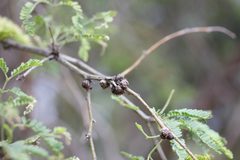
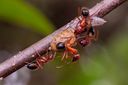
Pronunciation
How to pronounce Toumeyella: //taʊˌmeɪˈɛlə//
These audio files are automatically generated. While they are not always 100% accurate, they are a good starting point.
Identification
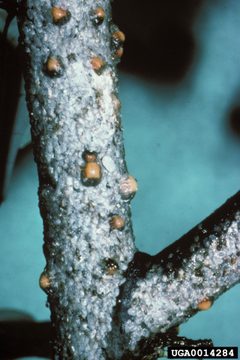
Toumeyella are distinguished from other soft scales by their highly convex, tortoise-like female coverings and association with conifers or magnoliaceous . Specific identification requires examination of microscopic features including duct distribution, setae arrangement, and body shape. T. liriodendri females reach peppercorn size (approximately 6 mm); T. pini females are similarly convex with striped patterning. Males are smaller, elongate, and develop on needles rather than twigs.
Images
Habitat
Forests, seed orchards, and ornamental landscapes; primarily associated with trees including pines (Pinus spp.), tuliptree (Liriodendron tulipifera), and magnolias. initially settle on leaf undersides or new growth before migrating to twigs.
Distribution
Native to North America; various have been introduced or spread to Europe (T. parvicornis in Italy, France), Colombia (T. coffeae), and other regions. Individual species show distinct ranges: T. liriodendri occurs where tuliptree grows; T. pini ranges east of the Rocky Mountains with recent expansion to Colorado; T. parvicornis is in Mediterranean Europe.
Seasonality
Varies by and latitude. T. pini has 1–3 annually: emerge late May–early June, mid-July–early August, and late October–early November in Georgia. T. liriodendri has one generation per year with fertilized females, spring ovisac production, and crawler June–July.
Diet
Phloem sap extracted from plants using . Excess fluid excreted as honeydew.
Host Associations
- Liriodendron tulipifera - primary tuliptree (T. liriodendri)
- Pinus taeda - loblolly pine for T. pini
- Pinus spp. - multiple pine for T. pini, T. parvicornis, T. numismaticum
- Magnoliaceae - tuliptree and relatives
- Myrtillocactus geometrizans - arborescent cactus for T. martinezae in Mexico
Life Cycle
Sexual and parthenogenetic occurs; T. liriodendri reproduces primarily by with rare males. Females are (T. liriodendri) or /larviparous (T. pini produces directly). Development includes , crawler (mobile first instar), nymphal instars, and stages. Females remain sedentary after initial settlement; males develop wings and fly to mate. stage varies: fertilized females (T. liriodendri), females (T. pini).
Behavior
Ecological Role
Phloem-feeding herbivores that reduce tree vigor through nutrient extraction; heavy cause branch dieback or tree death. Honeydew production supports mutualisms and broader insect . Serve as prey for specialized (lady beetles, larvae, pyralid larvae) and . (T. parvicornis) alter fire in Mediterranean pine forests.
Human Relevance
Several are economically significant pests: T. liriodendri damages ornamental tuliptrees and magnolias; T. pini affects pine seed orchards and Christmas tree plantations; T. parvicornis threatens stone pine (Pinus pinea) forests and urban parks in Europe. Management includes pruning, applications, and using (Exochomus quadripustulatus) and (Coccophagus lycimnia, Metaphycus spp.).
Similar Taxa
- ParthenolecaniumBoth are soft with convex female coverings; Toumeyella distinguished by association with conifers/Magnoliaceae and specific duct patterns
- CoccusLarger soft scales with different ranges and body ; Toumeyella females more tortoise-shaped
- Chionaspis (pine needle scale) (Diaspididae) with separable waxy cover; often co-occurs with Toumeyella on pines but belongs to different with distinct
Sources and further reading
- BugGuide
- Wikipedia
- GBIF taxonomy match
- iNaturalist taxon
- NCBI Taxonomy
- Catalogue of Life
- Encyrtid Holdings | Entomology Research Museum
- There's a sucker born everday - Tuliptree scale, Toumeyella Iiriodendri — Bug of the Week
- Bug Eric: Striped Pine Scale
- Green Tree Ant Sister Act: Oecophylla smaragdina — Bug of the Week
- Archive — Bug of the Week
- Toumeyella parvicornis . [Distribution map].
- Tuliptree Scale Toumeyella liriodendri (Gmelin) (Insecta: Hemiptera: Coccoidea: Coccidae)
- Biology of the Tuliptree Scale, Toumeyella liriodendri (Homoptera: Coccidae)
- Genome report: Genome sequence of the tuliptree scale insect, Toumeyella liriodendri (Gmelin)
- Genome report: Genome sequence of tuliptree scale, Toumeyella liriodendri (Gmelin), an ornamental pest insect
- The Amino Acids and Sugars in Honeydew of the Tuliptree Scale, Toumeyella liriodendri, and in the Sap of Its Host, Yellow-Poplar
- Outbreaks of invasive phloem feeding Toumeyella parvicornis modified fire behaviour and canopy surface reflectance in Mediterranean Pinus pinea forests
- Some Aspects of the Biology and Dispersal of the Pine Tortoise Scale, Toumeyella numismaticum (Pettit and McDaniel) (Homoptera: Coccidae)
- THE LIFE HISTORY OF TOUMEYELLA PINI (KING) (HOMOPTERA: COCCIDAE) IN LOBLOLLY PINE SEED ORCHARDS IN GEORGIA
- “Alien versus predator”: predatory effect of coccinellid Exochomus quadripustulatus on the scale insect Toumeyella parvicornis . An open‐field experimentation on the Pinus pinea of Rome
- Host Plants of Toumeyella Coffeae And Puto Barberi (Hemiptera) In Coffee Agroecosystems Of Norte de Santander, Colombia
- Effects of Parasitism on the Population Growth of Toumeyella martinezae (Coccidae) in the Presence of Its Mutualistic Ant Liometopum apiculatum (Formicidae) in an Arid Region of Central Mexico
- Using Species Distribution Models (SDMs) to Estimate the Suitability of European Mediterranean Non-Native Area for the Establishment of Toumeyella Parvicornis (Hemiptera: Coccidae)
- Development of an LNA-Based qPCR Assay for Detecting Toumeyella parvicornis (Cockerell, 1897) (Hemiptera: Coccidae) from Insect and Honeydew DNA.
- "The Last of Them": Entomopathogenic Effect of Akanthomyces muscarius on the Scale Insect Pest Toumeyella parvicornis Under Laboratory Conditions, a Potential Biological Control Candidate.
- Fisher-Shannon Analysis of Sentinel 1 Time Series from 2015 to 2023: Revealing the Impact of Toumeyella Parvicornis Infection in a Pilot Site of Central Italy.