
Hyperaspis bigeminata
(Randall, 1838)
bigeminy lady beetle, Bigeminate Sigil Lady Beetle
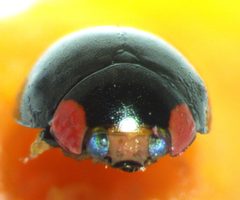
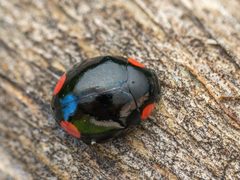
Hyperaspis bigeminata is a small lady beetle native to North America, ranging from Maine to Florida and west to Michigan and east Texas. measure 2.40–3.35 mm and display distinct in pronotum coloration. The is a specialized of scale insects, with larvae that produce a protective white waxy coating often mistaken for mealybugs.
Pronunciation
How to pronounce Hyperaspis bigeminata: /ˌhaɪpəˈræspɪs bɪˌdʒɛmɪˈneɪtə/
These audio files are automatically generated. While they are not always 100% accurate, they are a good starting point.
Identification
Distinguished from other Hyperaspis by the single yellow or red spot on each . Males identified by yellow margin and lateral pronotum; females by black anterior margin with yellow lateral pronotum. Larvae covered in white wax, resembling mealybugs but distinguished by rapid movement when disturbed (mealybugs remain stationary).
Images
Habitat
Associated with trees and shrubs infested with scale insects, particularly crapemyrtle and magnolia. Occupies bark surfaces, leaf litter, and protected locations beneath bark during winter.
Distribution
North America: recorded from Maine to Florida, west to Michigan and east Texas. Also present in New Brunswick, Nova Scotia, and Ontario, Canada.
Seasonality
active spring through autumn. Larvae present during growing season. Adults overwinter in protected locations beneath bark or in leaf litter, departing -infested trees by early December. Return to trees in spring to lay .
Diet
Specialized of scale insects (Coccoidea). Larvae consume and within waxy egg sacs; feed on scale insects. Documented on crapemyrtle bark scale (Acanthococcus lagerstroemiae) and tuliptree scale (Toumeyella liriodendri).
Host Associations
- Crapemyrtle (Lagerstroemia spp.) - Associated with crapemyrtle bark scale
- Magnolia (Magnolia spp.) - Associated with tuliptree scale
Life Cycle
Complete . laid on -infested trees in spring. Larvae develop through instars covered in protective white wax produced from lateral glands. occurs on plants. emerge in autumn, overwinter in protected locations, and return to host trees the following spring. Multiple per year possible in southern range.
Behavior
Larvae produce white waxy coating from glands lining their sides; this wax reduces effectiveness of attacks and other . When feeding, larvae chew holes in sacs and consume contents. Both larvae and are active hunters of scale insects. Adults and larvae move quickly when disturbed, unlike the sedentary mealybugs they resemble.
Ecological Role
Important agent of insect pests. Larvae may consume several thousand scale insects during development. continue on scales. Helps suppress of economically significant pests including crapemyrtle bark scale.
Human Relevance
Beneficial insect for biological pest control in horticulture and urban landscapes. Frequently misidentified as a pest (mealybug) due to waxy larval appearance, leading to unnecessary applications that harm . Conservation encouraged by avoiding insecticide use on infested plants when larvae or are present.
Similar Taxa
- Mealybugs (Pseudococcidae)Larvae covered in white wax and resemble mealybugs; distinguished by rapid movement when disturbed versus sedentary of mealybugs
- Other Hyperaspis speciesSimilar size and general appearance; H. bigeminata distinguished by single spot on each and specific pronotum dimorphism
Misconceptions
Larvae are commonly mistaken for mealybugs or other insect pests due to their white waxy covering, leading to inappropriate applications that kill beneficial .
More Details
Wax production
Larval wax glands produce protective coating that chemically and physically deters aggression, facilitating feeding on ant-tended scale insects
Conservation status
Not formally assessed; may be impacted by broad-spectrum use in urban horticulture