
Toumeyella liriodendri
(Gmelin, 1790)
tuliptree scale
Toumeyella liriodendri, the tuliptree , is a soft scale insect (Coccidae) native to North America and specialized on Liriodendron tulipifera (tuliptree or yellow-poplar). This overwinters as second-instar nymphs on twigs, matures to in spring, and produces that hatch into in early summer. First-instar nymphs feed on leaf undersides before migrating back to twigs in autumn. Males are unknown; is presumed parthenogenetic. Heavy cause branch dieback, reduced growth, and honeydew production that supports growth. The species has been the subject of recent genomic research, with a 536Mb assembly revealing it as an early-diverging soft scale with 17 .
Pronunciation
How to pronounce Toumeyella liriodendri: //ˌtuː.maɪˈɛl.lə ˌlɪr.i.oʊˈdɛn.dri//
These audio files are automatically generated. While they are not always 100% accurate, they are a good starting point.
Identification
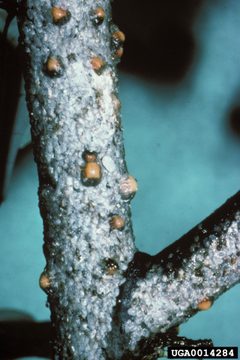
females are immobile, oval to hemispherical approximately 5-6 mm in diameter at maturity—about the size of a peppercorn. The body is covered by a soft, flexible rather than a hard armor. Coloration ranges from brown to reddish-brown. Second-instar nymphs are smaller and darker. First-instar are tiny (approximately 0.5 mm), black, and mobile, dispersing to leaf undersides. The is distinguished from other scale insects by its exclusive association with Liriodendron tulipifera, its with seasonal between twigs and leaves, and the absence of males. Unlike armored scales (Diaspididae), the body covering is soft and non-separable from the insect. Heavy produce conspicuous blackening of bark from growing on accumulated honeydew.
Images
Habitat
Deciduous forests and urban landscapes where the tree Liriodendron tulipifera (tuliptree or yellow-poplar) occurs. Within host trees, occupies two distinct microhabitats seasonally: twigs and branches for second-instar nymphs and females, and leaf undersides for first-instar during summer feeding.
Distribution
Native to eastern North America, following the range of its tree Liriodendron tulipifera. Documented from the United States and Canada. Specific study have been characterized in Maryland, USA.
Seasonality
(one per year). : second-instar nymphs on twigs (October–March). Spring activity resumption: April–May, with maturation to females by late May. Oviposition and hatch: late June to early July. First-instar feeding on leaves: July–September. Autumn : second-instar nymphs return to twigs (September–October) to overwinter.
Diet
Phloem sap of Liriodendron tulipifera (tuliptree or yellow-poplar). Feeding involves insertion of into the vascular tissue to withdraw nutrient-rich fluids.
Host Associations
- Liriodendron tulipifera - primary Tuliptree or yellow-poplar; exclusive for feeding and . All life stages complete development on this .
Life Cycle
Hemimetabolous development with three instars in females. hatch into first-instar that disperse to leaf undersides. After summer feeding, crawlers to second instars and migrate to twigs for . In spring, second-instar nymphs resume feeding and molt to females. No male stage has been observed; is presumed to be .
Behavior
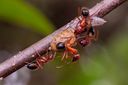
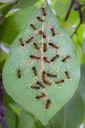
Sedentary as and most nymphal stages; only first-instar are mobile. Seasonal shifting: crawlers move from maternal location on twigs to leaf undersides, then second-instar nymphs migrate back to twigs for . Aggregated feeding: multiple individuals often occupy contiguous bark areas, producing localized heavy . Honeydew is continuous during feeding, with droplets falling to surfaces below. attendance has been observed, with ants collecting honeydew and potentially providing protection from .
Ecological Role
Herbivore and phloem feeder. Heavy reduce tree vigor through nutrient extraction, causing branch dieback and growth reduction. Honeydew production supports fungi (Capnodium spp. and others), which blacken bark and leaves and may impair . Honeydew serves as a resource for ants, , and other insects. The functions as a model system for studying insect reproductive and evolution.
Human Relevance
Ornamental and forest pest. Economic damage includes tree decline in landscapes and reduced aesthetic value from blackening. Management options include pruning infested branches, crushing manually, or applications for severe . Subject of research; natural enemies include (Encyrtidae) and such as lady beetles (Hyperaspis spp.). Recent genomic sequencing (2024) has established T. liriodendri as a reference for understanding soft scale evolution and dynamics.
Similar Taxa
- Coccus hesperidum (brown soft scale)Both are soft scales (Coccidae) with similar hemispherical female and honeydew production, but C. hesperidum is on many woody plants and lacks the strict specificity to Liriodendron.
- Parthenolecanium spp. (oak lecanium scales)Similar soft and , but oak lecanium scales occur on Quercus and have different seasonal and .
- Ericerus pela (Chinese white wax scale)Both are soft scales with recent genomic resources, but E. pela has only 9 versus 17 in T. liriodendri, and is commercially cultivated for wax production rather than being a pest.
Sources and further reading
- BugGuide
- GBIF taxonomy match
- iNaturalist taxon
- NCBI Taxonomy
- Catalogue of Life
- Encyrtid Holdings | Entomology Research Museum
- Green Tree Ant Sister Act: Oecophylla smaragdina — Bug of the Week
- Archive — Bug of the Week
- There's a sucker born everday - Tuliptree scale, Toumeyella Iiriodendri — Bug of the Week
- Green Tree Ants: Oecophylla smaragdina — Bug of the Week
- The next invader: Spotted lanternfly, Lycorma delicatula — Bug of the Week
- Tuliptree Scale Toumeyella liriodendri (Gmelin) (Insecta: Hemiptera: Coccoidea: Coccidae)
- Biology of the Tuliptree Scale, Toumeyella liriodendri (Homoptera: Coccidae)
- Genome report: Genome sequence of the tuliptree scale insect, Toumeyella liriodendri (Gmelin)
- Genome report: Genome sequence of tuliptree scale, Toumeyella liriodendri (Gmelin), an ornamental pest insect
- The Amino Acids and Sugars in Honeydew of the Tuliptree Scale, Toumeyella liriodendri, and in the Sap of Its Host, Yellow-Poplar