
Coccus hesperidum
Linnaeus, 1758
brown soft scale
Coccus hesperidum, commonly known as the brown soft , is a soft scale insect with a distribution. It is a significant agricultural pest of citrus and greenhouse crops, feeding on plant phloem sap and excreting honeydew that promotes growth. The reproduces primarily through , with females producing live young. It serves as to numerous , which are important agents.
Pronunciation
How to pronounce Coccus hesperidum: //ˈkɒk.kəs hɛsˈpɛr.ɪ.dəm//
These audio files are automatically generated. While they are not always 100% accurate, they are a good starting point.
Identification
Distinguished from armored scales (Diaspididae) by the absence of a hard, separable waxy covering and retention of legs and in females. Differs from Coccus praetermissus, a morphologically similar , by having setae with sharply pointed rather than bluntly rounded tips. Separation from other Coccus requires microscopic examination of morphological details.
Images
Appearance
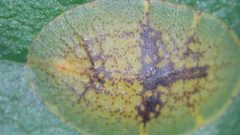
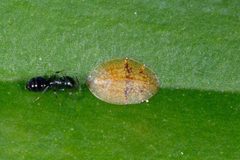
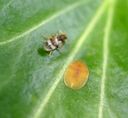
females are oval and dome-shaped, 3–5 mm long, with a pale yellowish-brown to greenish-brown marked by irregular brown speckles. The cuticle darkens with age. Unlike armored scales, it does not produce copious wax coverings. Females retain legs and throughout life. Males are rarely encountered; when present, they develop into winged adults.
Habitat
Occurs on woody and herbaceous plants in agricultural, ornamental, and greenhouse settings. Found on leaves, stems, and branches of host plants. Thrives in warm environments; laboratory studies indicate development at 25°C with 65% relative humidity.
Distribution
distribution spanning Europe (Mediterranean regions, Azores, Balearic Islands, Corsica, Crete, France, Greece, Italy, Malta, Portugal, Sardinia, Sicily, Spain, former Yugoslavia), Asia (Bangladesh, China, India, Indonesia, Iran, Iraq, Israel, Japan, Lebanon, Malaysia, Nepal, Philippines, Saudi Arabia, Sri Lanka, Syria, Taiwan, Thailand, Turkey), Africa (widespread including Algeria, Egypt, Ethiopia, Kenya, Morocco, Nigeria, South Africa, and Indian Ocean islands), Australasia and Pacific Islands (Australia, Fiji, Hawaii, New Caledonia, New Zealand, Papua New Guinea, Solomon Islands, Western Samoa), North America (Canada, Mexico, USA), Central America and West Indies, and South America (Argentina, Brazil, Chile, Colombia, Ecuador, Guyana, Paraguay, Peru, Surinam, Uruguay, Venezuela).
Seasonality
In Algeria, exhibits three to four peaks annually on citrus, with abundance correlated to temperature. time approximately two months under favorable conditions, with three to seven generations per year depending on temperature. In laboratory conditions at 25°C, mean generation time is 110.985 days.
Diet
Phloem-feeding; ingests nutrient-rich plant sap using . Excess fluid is excreted as honeydew. , feeding on numerous plant across diverse .
Host Associations
- Citrus spp. - primary Major agricultural pest; includes orange (Citrus sinensis), lemon (C. limon), mandarin (C. reticulata)
- Solanum nigrum - Suitable for laboratory rearing
- Gossypium barbadense - Suitable for laboratory rearing
- Loquat - Recorded in Hawaii
- Carica papaya - Recorded in Hawaii
- Hevea brasiliensis - Rubber trees; recorded in Hawaii
- Orchidaceae - Recorded in Hawaii
- Camellia sinensis - Tea
- Nerium oleander - Oleander
Life Cycle
; females retain internally and give birth to live young (). Females may produce up to 250 eggs over their lifetime, with a few laid each day. First-stage nymphs (crawlers) emerge, are brooded briefly, then disperse short distances before settling to feed. They pass through two additional nymphal stages before becoming females. Males, when produced, undergo four nymphal stages before becoming winged adults. Laboratory parameters: net production rate (R0) 185.295 female/female/offspring; gross rate (GRR) 579.047 eggs/female; (rm) 0.047 female/female/day; doubling time 14.732 days; finite rate of increase (λ) 1.048 eggs/female/day.
Behavior
First-instar nymphs () are the stage, moving short distances from the mother before becoming sedentary. are largely immobile, remaining fixed on plant tissues. attendance is common; ants collect honeydew and defend from . Wind may aid crawler dispersal, with field studies showing positive correlation between scale abundance and wind speed.
Ecological Role
Herbivore that reduces plant vigor through sap extraction, though typically does not kill plants directly. Honeydew production supports growth, reducing photosynthetic capacity and aesthetic value. Serves as host for multiple including Coccophagus lycimnia, Metaphycus stanleyi, Metaphycus helvolus, and various Encyrtidae, forming important links in agricultural and natural . - mutualism modifies local structure.
Human Relevance
Significant agricultural pest causing economic damage to citrus orchards and commercial greenhouse crops. Reduced plant growth and yield result from sap loss; degrades fruit quality and ornamental value. Subject to programs emphasizing through conservation and exclusion rather than broad-spectrum . Growth regulators such as hydroprene have been investigated for disrupting nymphal development. Type of the Coccus, Coccidae, and superfamily Coccoidea, making it taxonomically significant.
Similar Taxa
- Coccus praetermissusMorphologically very similar distinguished only by bluntly rounded vs. sharply pointed setae tips; historically confused in museum collections and field identification
- Chrysomphalus aonidum pest of citrus with different (separable waxy cover, different parameters); laboratory studies have compared their demographic parameters
- Icerya purchasiCottony cushion scale with similar honeydew-producing habit and citrus pest status, but produces conspicuous cottony ovisac and has different reproductive
More Details
Taxonomic significance
As the type of Coccus, Coccidae, and Coccoidea, C. hesperidum is central to insect . Recent molecular and morphological studies revealed cryptic diversity within species previously identified as C. hesperidum, with C. praetermissus described as a distinct species in 2017.
Parasitoid host size preference
Coccophagus lycimnia, a primary , most frequently attacks 1100–1500 μm long, with 71% success from hosts 1400–1700 μm. The filter chamber is the preferred oviposition site, typically receiving one per host.
Sugar composition variation
Honeydew sugar composition varies with plant , reflecting the feeding habit and potentially affecting attendance and development.
Sources and further reading
- BugGuide
- Wikipedia
- GBIF taxonomy match
- iNaturalist taxon
- NCBI Taxonomy
- Dye in the desert - Cochineal insects, Dactylopius coccus — Bug of the Week
- Crapemyrtles are not dreaming of a white Christmas: Crapemyrtle bark scale, Acanthococcus (=Eriococcus) lagerstroemiae — Bug of the Week
- Coccus hesperidum . [Distribution map].
- The life tables of Chrysomphalus aonidum and Coccus hesperidum under laboratory conditions
- Survey of brown soft scale Coccus hesperidum L. parasitoids in southern California citrus
- OPTIMAL LENGTH OF COCCUS HESPERIDUM L. (HOMOPTERA: COCCIDAE) FOR PARASITISM BY COCCOPHAGUS LYCIMNIA (WALKER) (HYMENOPTERA: APHELINIDAE)
- Determination of suitable host plant for rearing of <i>Coccus hesperidum</i> (Homoptera: Coccidae)
- Sex ratios in field populations of two parasitoids (Hymenoptera: Chalcidoidea) of Coccus hesperidum L. (Homoptera: Coccidae)
- A newly recognised species that has been confused with the global polyphagous pest scale insect, Coccus hesperidum Linnaeus (Hemiptera: Coccomorpha: Coccidae)
- Effects of temperature and host age upon the encapsulation of Metaphycus stanleyi and Metaphycus helvolus eggs by brown soft scale Coccus hesperidum
- Differences in the sugar composition of the honeydew of polyphagous brown soft scale Coccus hesperidum (Hemiptera: Sternorrhyncha: Coccoidea) feeding on various host plants
- Precise sex ratios manifested by several encyrtid parasitoids (Hymenoptera: Encyrtidae) of brown soft scale, Coccus hesperidum L. (Hemiptera: Coccidae)
- Responses of Metaphycussp. nr. flavus to semiochemicals released from a scale host, Coccus hesperidum
- Phenology of two scale insects, Coccus hesperidum and Icerya purchasi (Hemiptera: Coccomorpha) on Citrus in Mostaganem, Algeria
- Ribosomal RNA-Specific Antisense DNA and Double-Stranded DNA Trigger rRNA Biogenesis and Insecticidal Effects on the Insect Pest Coccus hesperidum.