
Chrysomphalus aonidum
(Linnaeus, 1758)
Florida red scale, Egyptian black scale, circular black scale, citrus black scale
is an insect (Diaspididae) and a significant pest of citrus and other fruit trees. It is native to tropical and subtropical regions but has established across six continents. The forms a hard, protective cover over its body while feeding on plant phloem. Population densities can reach economically damaging levels in citrus orchards, with recorded on leaves and fruit. The species is subject to by and predatory beetles.

Pronunciation
How to pronounce Chrysomphalus aonidum: /krɪˈsɒmfələs eɪˈoʊnɪdəm/
These audio files are automatically generated. While they are not always 100% accurate, they are a good starting point.
Identification
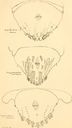
females form a circular to subcircular, convex cover approximately 1.5–2.0 mm in diameter. The cover is dark brown to black with a reddish tinge, often with a central (shed skin) that appears as a lighter spot. The scale is firmly attached to the plant surface. Male scale covers are smaller, oval, and lighter in color. Under microscopic examination, the adult female body is pear-shaped with reduced appendages typical of armored scales. Distinguished from Aonidiella aurantii (California red scale) by the circular rather than elongated cover shape and darker coloration.
Images
Habitat
Citrus orchards and groves; avocado orchards; other fruit tree plantations. Found in tropical, subtropical, and warm temperate climates. Thrives in enclosed or protected growing environments such as Citrus Under Protective Screen structures, where higher temperatures and humidity promote increase.
Distribution
Widespread across six continents. Native to tropical Asia; established in North America (USA: California, Florida, Texas, Hawaii; Mexico), Central America and Caribbean, South America (Argentina, Brazil, Chile, Colombia, Peru, Venezuela), Europe (France, Greece, Italy, Spain, Portugal, Cyprus, Turkey), Africa (Egypt, Morocco, South Africa, Kenya, Madagascar, Mauritius, Réunion), Asia (China, India, Israel, Japan, Philippines, Taiwan, Indonesia), and Oceania (Australia, Fiji, Hawaii, New Caledonia).
Seasonality
densities increase during warmer periods. In Florida Citrus Under Protective Screen systems, persisted year-round with increases observed from 2020–2021 to 2021–2022 sampling cycles. time averages 82 days under laboratory conditions at 25°C, suggesting multiple generations per year in favorable climates.
Diet
Phloem-feeding on plants. Primary hosts are Citrus (Citrus paradisi, C. sinensis, and other citrus). Also recorded on avocado (Persea americana), coconut and other palms, Yucca decipiens, and numerous other mono- and dicotyledonous plants. Laboratory rearing successful on pumpkin (Cucurbita sp.).
Host Associations
- Citrus spp. - primary Major economic ; on leaves and fruit
- Persea americana - Avocado; first record in Morocco 2023–2024
- Cocos nucifera and other palms - Recorded from distribution sources
- Yucca decipiens - New record from India
- Cucurbita sp. - laboratory Used for studies
Life Cycle
with separate sexes. Under laboratory conditions at 25°C: mean time (T0) of 82.030 days; doubling time (T2) of 13.320 days. Net production rate (R0) of 74.001 female offspring per female. Gross rate (GRR) of 142.555 per female. (rm) of 0.052 female per female per day. stages develop under the protective cover; females are while males are winged and mobile.
Behavior
Sedentary as females; forms a hard, protective cover that shields the body from and some . Scale cover may absorb insecticides, reducing efficacy—specimens with armor removed showed approximately six times greater sensitivity to malathion than intact individuals. Males emerge from under their scale covers and are capable of .
Ecological Role
Herbivorous pest causing direct damage to citrus and other crops through phloem feeding. Serves as for including Aphytis melinus, Aphytis holoxanthus, Aphytis sp., and Pteroptrix smithi. Preyed upon by lady beetles including Curinus coeruleus, Rhyzobius lophanthae, Chilocorus bipustulatus, and Clitostethus arcuatus. can disrupt systems in citrus orchards.
Human Relevance
Major economic pest of citrus production worldwide. reduce fruit quality and yield; high densities cause leaf yellowing and premature drop. Subject to using agents. Malathion- sprays applied for Mediterranean fruit fly (Ceratitis capitata) control have adverse effects on , contributing to biological control failures. Citrus Under Protective Screen systems show elevated risk of C. aonidum establishment due to favorable microclimate conditions.
Similar Taxa
- Aonidiella aurantiiCalifornia red scale; distinguished by elongated rather than circular cover and lighter coloration
- Chrysomphalus ficusHistorically confused with C. aonidum; now recognized as distinct with different preferences and distribution
- Coccus hesperidumSoft brown ; Coccidae rather than Diaspididae, with soft waxy covering rather than hard armor
Sources and further reading
- BugGuide
- Wikipedia
- GBIF taxonomy match
- iNaturalist taxon
- NCBI Taxonomy
- Catalogue of Life
- Chrysomphalus aonidum . [Distribution map].
- Chrysomphalus aonidum . [Distribution map].
- The life tables of Chrysomphalus aonidum and Coccus hesperidum under laboratory conditions
- Notes on the Biology of the Florida Red Scale (Chrysomphalus aonidum (L.))
- Effect of malathion-bait mixture on two parasitoids of the Florida red scale, Chrysomphalus aonidum (L.)
- <I>Yucca decipiens</I> Trel., a New Host of Florida Red Scale <I>Chrysomphalus aonidum L.</I> in India
- FLUCTUACIÓN POBLACIONAL INVIERNO – PRIMAVERA DE Pinnaspis aspidistrae (Signoret), Fiorinia fioriniae (Targioni Tozzetti), Chrysomphalus aonidum (Linnaeus) (HEMIPTERA: DIASPIDIDAE) Y SUS PARASITOIDES, EN PALTO. LA MOLINA, LIMA – PERÚ
- Predation of Florida red scale Chrysomphalus aonidum (L.) by the metallic blue ladybeetle Curinus coeruleus (Mulsant)
- EFFECT OF SOME CHEMICAL CONSTITUENTS OF CERTAIN CITRUS TREE HOSTS ON THE POPULATION DENSITY OF Aonidiella aurantii (Maskell) AND Chrysomphalus aonidum (L.) AND THEIR POPULATION FLUCTUATIONS
- Florida red scale, Chrysomphalus aonidum (Linnaeus, 1758) (Hemiptera: Diaspididae) in Morocco, infesting citrus orchards and an avocado tree
- Effects of the malathion-bait mixture used on citrus to control Ceratitis capitata (Wiedemann) (Diptera: Tephritidae) on the Florida red scale, Chrysomphalus aonidum (L.) (Hemiptera: Diaspididae), and its parasitoid Aphytis holoxanthus DeBach (Hymenoptera: Aphelinidae)
- Florida red scale Chrysomphalus aonidum (Hemiptera: Diaspididae) and parasitoid Aphytis melinus (Hymenoptera: Aphelinidae) colonization of Citrus Under Protective Screen
- Chrysomphalus ficus . [Distribution map].
- Reciprocal host-parasite relations as exemplified byChrysomphalus aonidum [Homoptera: Diaspididae] andPteroptrix smithi [Hymenoptera: Aphelinidae]