
Aonidiella aurantii
(Maskell, 1879)
California red scale, red scale
, commonly known as or red , is an insect and major agricultural pest of citrus and other crops. Native to South China, it has spread globally through human-mediated transport of infected plant material, first appearing in California between 1868 and 1875. The is now established across six continents and infests over 77 plant , with citrus remaining its primary economic . Heavy cause fruit pitting, shoot distortion, leaf drop, and tree death.
Pronunciation
How to pronounce Aonidiella aurantii: /ˌaʊ̯.nɪˈdiː.ɛl.lə aʊ̯ˈræn.ti.aɪ̯/
These audio files are automatically generated. While they are not always 100% accurate, they are a good starting point.
Identification
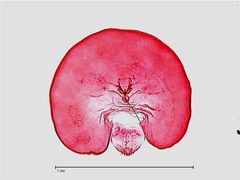
The female cover's circular shape, brownish-red coloration, and concentric ring pattern distinguish A. aurantii from other armored scales. The 1.8 mm diameter and presence of the whitish coating are diagnostic. Males are identified by their smaller size, darker coloration, and elongated cover. The can be separated from Aonidiella citrina (yellow ) by cover coloration and from other Diaspididae by the combination of circular female cover, concentric ring structure, and specific associations.
Images
Appearance
Female scale insects possess a circular, brownish-red cover approximately 1.8 mm in diameter, firmly attached to surfaces during molting and . The cover forms from exuded material during two , developing a characteristic concentric ring in the center with each molt. The insect body beneath is oval, becoming kidney-shaped at the final instar, with a distinctive whitish coating on the underside separating it from the host plant. Male scale insects develop similarly through two molts, then become oval and darker, measuring about 1 mm in diameter with an eccentric cover. males are small, yellowish, two-winged insects that emerge after four molts.
Habitat
Found on all aerial parts of plants including fruit, leaves, twigs, and branches. In citrus groves, concentrate on fruit surfaces where they are most visible. On guava trees, the pest favors the upper leaf surface in the basal layer. Establishment requires suitable host plant tissue for feeding; settle in depressions on twigs, leaves, or fruits.
Distribution
Native to South China. Established across Europe (Crete, Cyprus, France, Greece, Italy, Malta, Spain, Turkey), Africa (Algeria, Angola, Egypt, Ethiopia, Kenya, Madagascar, Morocco, Mozambique, South Africa, Tunisia, Uganda), Asia (Afghanistan, Bangladesh, China, India, Indonesia, Iran, Iraq, Israel, Japan, Jordan, Lebanon, Malaysia, Nepal, Pakistan, Philippines, Saudi Arabia, Sri Lanka, Syria, Taiwan, Thailand, Vietnam, Yemen), Australasia and Pacific Islands (Australia, Fiji, New Caledonia, New Zealand, Papua New Guinea, Solomon Islands, Tonga, Vanuatu), North America (USA: Arizona, California, Florida, Texas; Mexico), Central America and Caribbean (Antigua, Bahamas, Barbados, Bermuda, Dominica, Guadeloupe, Honduras, Jamaica, Martinique, Montserrat, Puerto Rico, St. Lucia, St. Vincent, Trinidad), and South America (Argentina, Brazil, Chile, Colombia, French Guiana, Guyana, Paraguay, Uruguay).
Seasonality
Activity patterns vary by climate and region. In temperate zones, development rates increase with temperature from 15-30°C. and settling occur primarily in late morning when wind velocities favor . Multiple per year occur in favorable climates, with continuous possible in tropical and subtropical regions.
Diet
Phloem-feeding sap-sucker. Insert mouthparts deep into plant tissue to extract sap from parenchyma . Saliva is toxic to tissue, causing direct damage. Successfully reared in laboratory on potato tubers and pumpkin; field hosts span at least 77 plant .
Host Associations
- Citrus - primary economic Major pest of citrus including oranges, mandarins, lemons, and grapefruit. Infests all aerial parts of tree.
- Psidium guajava - Major pest of guava in India; favors upper leaf surface in basal layer.
- Carica papaya - Economic damage reported in Taiwan.
- Olea europaea - Serious damage to olives in California, Mediterranean countries, and Morocco.
Life Cycle
Females undergo two , remaining beneath their protective cover. They are , with hatching internally; each female produces 100-150 young over her lifetime. Live nymphs () emerge from under the maternal cover at 2-3 per day. First-instar crawlers are the only mobile stage, dispersing to find settlement sites. Upon settling, they insert mouthparts and begin forming their own round, waxy covers. Males undergo four molts, developing through similar stages before emerging as winged with a lifespan of approximately 6 hours dedicated solely to mating.
Behavior
First-instar exhibit wandering before settling, with times ranging from 98-243 minutes in laboratory conditions and 174-206 minutes in field estimates. Wandering time varies by plant , surface color, crawler , and temperature. Crawlers disperse by crawling (limited to about 1 meter), wind transport (documented up to 312 meters), and on flying insects and birds. males locate unmated females by detecting .
Ecological Role
Herbivore and agricultural pest. influenced by temperature-dependent development rates and plant quality. Serves as host for numerous and predatory insects. presence indirectly increases by deterring natural enemies.
Human Relevance
Major economic pest of citrus production globally, causing fruit pitting, discoloration, shoot distortion, leaf drop, branch dieback, and tree death. Fruit damage renders produce unmarketable for fresh consumption. Control is complicated by protective waxy covers that shield insects from ; are developing resistance to multiple chemical classes. Subject to intensive programs using (Aphytis melinus, Aphytis lingnanensis, Comperiella bifasciata) and . control is necessary to protect biological control agents. Monitoring protocols established for in citrus, though specific guidelines for mandarin varieties require further development.
Similar Taxa
- Aonidiella citrinaYellow , distinguished by yellowish cover coloration rather than brownish-red; similar concentric ring structure and range.
- Other DiaspididaeA. aurantii separated by combination of circular female cover, specific diameter (~1.8 mm), concentric ring pattern, brownish-red coloration, and whitish coating.
Sources and further reading
- BugGuide
- Wikipedia
- GBIF taxonomy match
- iNaturalist taxon
- NCBI Taxonomy
- Catalogue of Life
- Encyrtid Holdings | Entomology Research Museum
- Mandarin Boom Means Citrus Pest Management Must Evolve
- red scale infestation - Entomology Today
- Aonidiella aurantii Archives - Entomology Today
- Aonidiella aurantii . [Distribution map].
- Aonidiella aurantii . [Distribution map].
- The Biology of the California Red Scale, Aonidiella aurantii (Maskell) (Diaspididae: Homoptera)
- BIOLOGY OF RED SCALE Aonidiella aurantii AND ITS BIOLOGICAL CONTROL USING Beauveria bassiana AND Metarhizium anisopliae
- Biological control of California red scale, Aonidiella aurantii (Hemiptera: Diaspididae): spatial and temporal distribution of natural enemies, parasitism levels and climate effects
- Factors affecting the biological control of California red scale Aonidiella aurantii (Hemiptera: Diaspididae) by Aphytis (Hymenoptera: Aphelinidae) in eastern Spain citrus: host size, ant activity, and adult parasitoid food sources
- Toxicity of malathion to California red scale, Aonidiella aurantii (Mask.) (Hemiptera: Diaspididae)
- Population dynamic for Aonidiella aurantii (Mask.) (Homoptera, Diaspididae) and its parasitoids on lemon trees in Sicily*
- Wandering Time of the Crawlers of California Red Scale, Aonidiella Aurantii (Mask.) (Homoptera: Diaspididae), on Citrus.
- Horizontal and Vertical Dispersal of California Red Scale, Aonidiella Aurantii (Mask.), (Homoptera: Diaspididae) in the Field.
- Studies on rates of development and reproduction of California red scale, Aonidiella aurantii (Mask.) (Homoptera : Diaspididae) on citrus
- Morphometric comparison between two populations of Aonidiella aurantii (Maskell) (Homoptera: Diaspididae) from Algeria and Turkey
- Monitoring and spatial distribution of the red scale insect Aonidiella aurantii (Hemiptera: Diaspididae) infesting guava trees
- PARASITOIDS ATTACKING AONIDIELLA AURANTII (MASKELL) (HOMOPTERA: DIASPIDIDAE) WITH EMPHASIS ON PARASITOID FAUNA OF THIS SPECIES IN BAHARIA OASIS
- A Lightweight Instance Segmentation Model for Simultaneous Detection of Citrus Fruit Ripeness and Red Scale (Aonidiella aurantii) Pest Damage