
Ceratitis capitata
Wiedemann, 1824
Mediterranean fruit fly, medfly
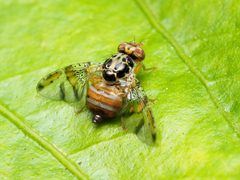
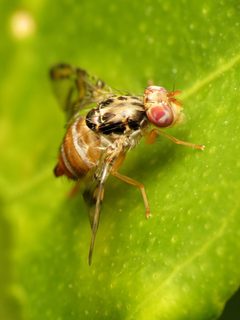
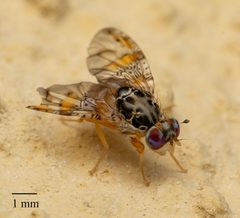
, the or medfly, is a highly destructive agricultural pest native to sub-Saharan Africa. It has established across tropical and subtropical regions worldwide, with frequent incursions into temperate areas including California, Florida, and Texas. The is considered one of the most economically important fruit flies due to its exceptionally broad range—over 200 fruit and vegetable species—and its ability to tolerate cooler climates better than most tropical fruit fly species. are small yellow-brown flies with distinctive black thoracic markings.
Pronunciation
How to pronounce Ceratitis capitata: /sɛrəˈtaɪtɪs kæpɪˈteɪtə/
These audio files are automatically generated. While they are not always 100% accurate, they are a good starting point.
Identification
Distinguished from other fruit flies by the combination of: yellow-brown coloration with black thoracic blotches; wing pattern with dark transverse band and spotted ; and male-specific flattened black interocular setae. in wing shape (males wider and shorter) provides additional diagnostic characters. Distinguished from other Ceratitis and from Drosophila species by larger size, distinct thoracic patterning, and wing markings. Molecular identification via COI barcoding is used for confirmation in surveillance programs.
Images
Habitat
Occupies diverse environments from natural vegetation to intensive agriculture. In natural settings, associated with wild and cultivated fruit-bearing plants. In agricultural systems, found in orchards, vineyards, and backyard fruit trees. Climate is unusually broad for a tropical fruit fly; development ceases below 10°C and oviposition stops below 16°C, but can survive cooler conditions than most tropical tephritids. mating sites are typically sunlit leaf undersurfaces.
Distribution
Native to sub-Saharan Africa. Established throughout Africa, Mediterranean Europe, Middle East, Central and South America, and parts of Oceania including Australia (Western Australia, South Australia, New South Wales, Queensland, Victoria) and New Zealand (historically, eradicated). In North America: established in Hawaii; recurrent incursions in California, Florida, and Texas with successful eradications to date. Absent from most of North America, Indian subcontinent, and most of Australia. Climate change may expand suitable range.
Seasonality
Activity and time strongly temperature-dependent. completes in 21 days under optimal warm conditions; extends to 100 days in cooler temperatures. In temperate regions with seasonal climates, activity peaks in warmer months; in tropical regions, continuous breeding occurs year-round where fruit is available. lifespan averages under 60 days in field conditions, with some individuals surviving 6 months to 1 year under cool, well-fed conditions.
Diet
Highly . Larvae feed on fleshy pulp of developing and ripe fruits, preferring portions with higher nutritional value. obtain from ripe fruit and protein from decomposing fruit or bird . Documented include citrus, peach, nectarine, apricot, avocado, grapefruit, orange, cherry, mango, guava, plum, pear, and over 200 additional fruit and vegetable .
Host Associations
- Citrus spp. - larval major economic ; bitter oranges show highest larval survival
- Prunus persica (peach) - larval preferred thin-skinned
- Prunus armeniaca (apricot) - larval preferred thin-skinned
- Prunus avium (sweet cherry) - larval preferred thin-skinned
- Mangifera indica (mango) - larval tropical
- Psidium guajava (guava) - larval tropical
- Persea americana (avocado) - larval preferred
- Malus domestica (apple) - larval economic in some regions
- Pyrus communis (pear) - larval economic
- Coffea spp. - larval coffee berries attacked
Life Cycle
Holometabolous with four stages: , larva, pupa, . Females deposit 1–10 eggs per fruit in groups of 10–14, just under the skin surface; total lifetime averages ~300 eggs, maximum ~800. Eggs hatch in a few days. Three larval instars; larvae feed within fruit, then exit to pupate in soil or within fallen fruit. Adults emerge from pupae. time 21–100 days depending on temperature.
Behavior
Males exhibit : establish territories on sunlit leaf undersurfaces, release , and produce wing-buzzing sounds to attract females. Courtship involves abdominal tucking, movements, and rhythmic wing fanning initiated when female approaches within 3–5 mm, followed by rapid copulation initiation. Males also attempt forced copulation with already-mated females on fruit. Aggressive interactions between males include head-butting, physical pushing, and acoustic threat displays (1–3 kHz sounds); non-aggressive courtship sounds are lower frequency (0.16–0.35 kHz). capacity: up to 12 miles when fruit scarce; 300–700 feet when hosts abundant. Females switch olfactory preference from male (virgin state) to host fruit odor (after mating), mediated by protein CcapObp22.
Ecological Role
Primary ecological role in invaded regions is as a destructive fruit pest causing direct damage through larval feeding and indirect damage via premature fruit drop and oviposition wound entry for secondary . In native African range, ecological role less documented; likely regulator of wild fruit resources. Serves as for pupal including Spalangia simplex, S. leiopleura, S. impunctata, and Pachycrepoideus vindemmiae. Gut includes nitrogen-fixing Enterobacteriaceae that may benefit host nutrition.
Human Relevance
One of the most economically damaging agricultural pests globally, causing billions of dollars in losses through direct crop damage, yield reduction, control costs, and trade restrictions. pest with zero in many importing countries. Subject to extensive programs using sterile insect technique (SIT), chemical controls, and quarantine measures. California alone has conducted nearly 300 state-sponsored eradication programs. Historical eradication successes include Mexico, Guatemala, Chile, New Zealand, and Western Australia. Research by James R. Carey and colleagues demonstrated that medfly is permanently established in California and cannot be eradicated, prompting policy debates on long-term management strategies. Potential : can harbor GFP-tagged E. coli for up to 7 days, suggesting capacity to transmit human to fruit surfaces.
Similar Taxa
- Bactrocera dorsalis (Oriental fruit fly)Similar size and economic importance; distinguished by different wing pattern and lack of medfly's characteristic thoracic blotches
- Anastrepha ludens (Mexican fruit fly)Overlapping range and use; distinguished by wing pattern with characteristic S-band and different body coloration
- Drosophila melanogaster (vinegar fly)Commonly misidentified by laypersons; much smaller, lacks patterned wings and thoracic markings, feeds on decaying rather than intact fruit
- Ceratitis rosa (Natal fruit fly) with similar ; distinguished by different wing pattern and thoracic markings
Misconceptions
Despite ',' the is native to sub-Saharan Africa, not the Mediterranean region. Frequently confused with Drosophila species (vinegar flies), which are smaller, lack economic importance, and feed on decaying rather than intact fruit; this distinction was emphasized by geneticist Mel Green, who advocated for 'vinegar fly' as the common name for Drosophila melanogaster. The term 'fruit fly' properly applies to tephritid pests like C. capitata, not to Drosophila.
More Details
Symbiotic bacteria
diazotrophic Enterobacteriaceae in the gut that fix nitrogen via nitrogenase, potentially alleviating nitrogen limitation. Klebsiella and Providencia dominate gut ; Chroococcidiopsis and Propionibacterium identified as stable components. Asaia bacteria detected in reproductive organs can colonize guts when introduced via feeding, suggesting potential for -based control methods.
Genetic characteristics
Sex determination by XY system. Unusual among Diptera and frugivores in lacking an opsin gene for blue light perception. Mitochondrial sequenced at 15,980 ; used for analysis and tracing introduction sources. Whole genome sequenced 2016.
Irradiation and SIT effects
Sterile insect technique involves mass-rearing, irradiation, and release of sterile males. Irradiation reduces male mating competitiveness; supplementation with Klebsiella oxytoca improves mating latency in irradiated males. Male age at irradiation affects subsequent sexual performance and remating frequency of their female offspring.
Starvation resistance
Plastic trait varying with age, sex, and diet history. Decreases with age. Females show higher starvation resistance than males. Greatest influences: age and diet, followed by sex and larval diet. Important factor in invasion success.
Sources and further reading
- BugGuide
- Wikipedia
- GBIF taxonomy match
- iNaturalist taxon
- NCBI Taxonomy
- Of Medflies and Light Brown Apple Moths | Bug Squad
- A Glimpse of George Compere, a Pioneer in Biological Control | Bug Squad
- CDFA to Host Fruit Fly Workshop, Free to Participants | Bug Squad
- Medflies: Permanent Residents | Bug Squad
- Green Hall: Fitting Tribute to Two Scientists | Bug Squad
- The Big 43: The California Native Plants, Plus One, Studied in UC Davis Research | Bug Squad
- Bacterial Symbionts in Ceratitis capitata
- Ceratitis capitata . [Distribution map].
- Ceratitis capitata (Mediterranean fruit fly).
- Spatio-temporal distribution of Ceratitis capitata population in a heterogeneous landscape in Central Italy
- Figure 2: Distribution of COI haplotypes across the study area for Ceratitis capitata .
- Parasitoides pupais de Ceratitis capitata (Wiedemann) (Diptera: Tephritidae) no município de Mossoró/RN
- Akdeniz Meyvesineği (Ceratitis capitata Wiedemann) (Diptera: Tephritidae)’nin Tanımı, Dağılımı, Biyolojisi, Zararı ve Mücadele Yöntemleri Damage, Biology, Distribution, Definition and Management Methods of Mediterranean Fruit Fly (Ceratitis capitata Wiedemann) (Diptera: Tephritidae)
- Effect of male age at the time of irradiation on the sexual performance of sterile Ceratitis capitata males: insights from remating female offspring.