
Spalangia
Latreille, 1805
Species Guides
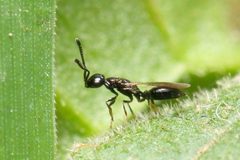
2Spalangia is a of chalcidoid wasps in the Spalangiidae (sometimes placed in Pteromalidae), comprising pupal of filth flies. such as S. endius, S. cameroni, and S. nigroaenea are widely used as agents against house flies (Musca domestica) and stable flies (Stomoxys calcitrans) in livestock and poultry operations. Females locate buried pupae by burrowing through manure and decaying organic matter, while males remain near the surface to mate with emerging females.
Pronunciation
How to pronounce Spalangia: //spəˈlæn.dʒi.ə//
These audio files are automatically generated. While they are not always 100% accurate, they are a good starting point.
Identification
Distinguished from other pupal by combination of: burrowing in females; range focused on filth fly pupae; compact body form with reduced wing venation; and specific antennal segmentation. Differs from Muscidifurax in host substrate preferences—Spalangia prefer equine manure and deeper substrates, while Muscidifurax species prefer bovine manure and shallower substrates. Species-level identification requires examination of antennal structure, punctation patterns, and male genitalia.
Images
Habitat
Associated with decaying organic matter, particularly manure accumulations in livestock and poultry facilities. Females burrow through substrate up to 10 cm deep to locate buried pupae. Found in dairy farms, feedlots, poultry houses, horse stables, and other settings where filth flies breed. Requires moist to moderately dry manure; excessive moisture promotes fly breeding but inhibits activity.
Distribution
distribution with records from North America (California, Florida, Georgia, Hawaii, Mississippi), Europe, Asia, South America (Brazil), and other regions. Widely distributed through human-mediated transport as agents.
Seasonality
Activity patterns vary by climate; in temperate regions, peak during warmer months when flies are abundant. Under simulated Florida conditions, occurs year-round with seasonal peaks. In managed systems, releases typically made weekly or biweekly during fly season.
Host Associations
- Musca domestica - house fly pupae, primary for
- Stomoxys calcitrans - stable fly pupae
- Hippelates collusor - eye gnat pupae
- Peckia chrysostoma - flesh fly pupae, reported from Brazil
- Drosophila melanogaster - laboratory for S. drosophilae
Life Cycle
Develops as solitary endoparasitoid within . Female drills through puparium with ovipositor to deposit ; drilling takes approximately 17 minutes in S. endius. Single offspring typically develops per host, though occurs at high densities. Development from egg to occurs entirely within host puparium. Males emerge 1-2 days before females and remain near natal hosts to mate with emerging females. Total development time varies with temperature; multiple per year possible under favorable conditions.
Behavior
Females actively burrow through decaying organic matter to locate buried pupae, demonstrating substrate-specific host-finding . Upon locating a , females examine it before drilling and ovipositing. Females exhibit discrimination between parasitized and unparasitized hosts, rejecting previously attacked hosts after shorter examination times. Males remain above ground, wing-fan while pursuing females, and engage in postcopulatory courtship. Females signal dismounting after copulation by brushing hind legs across ; males respond to this signal with delayed dismounting. Neither sex exhibits physical aggression. Both sexes use hind legs for .
Ecological Role
Important agent of filth fly in agricultural systems. Reduces house fly and stable fly populations in livestock and poultry operations through of pupal stage. Part of natural enemy complex including predatory mites (Macrocheles muscaedomesticae), hister beetles (Carcinops pumilio), and other (Muscidifurax spp.). Contributes to programs, reducing reliance on chemical .
Human Relevance
Widely used in programs for filth flies in livestock, poultry, and equine facilities. Commercially available from suppliers, typically sold in mixed releases with Muscidifurax. Recommended release rate of approximately 2,000 per animal every two weeks during fly season. Effectiveness enhanced by proper manure management to maintain dry conditions and preserve . Reduces fly populations that and cause nuisance to livestock and humans.
Similar Taxa
- MuscidifuraxAlso pupal of filth flies, but prefer bovine manure over equine manure; morphologically similar but differ in antennal structure and substrate preferences
- NasoniaPteromalid of flies, but typically associated with blow flies and carrion rather than filth flies in manure systems
More Details
Biological control implementation
Successful use requires understanding of -specific preferences. S. endius and S. nigroaenea perform better in equine manure, while Muscidifurax species prefer bovine manure. Mixed releases recommended for diverse fly control. applications must be minimized to avoid killing beneficial ; cyromazine (Larvadex) is the only insecticide safe to use with parasitoid releases.
Sex allocation and host size
Females adjust offspring sex ratios based on size, with larger hosts receiving more female . This facultative sex ratio manipulation optimizes under local mate competition conditions.
Sources and further reading
- BugGuide
- Wikipedia
- GBIF taxonomy match
- iNaturalist taxon
- NCBI Taxonomy
- Catalogue of Life
- spalangia_xanthoscapa_gibson_holotype_ucrc_ent_146423_lateral.jpg | Entomology Research Museum
- Primary Type List | Entomology Research Museum
- Poultry Pest Management - AgriLife Extension Entomology
- Managing External Parasites of Texas Cattle - AgriLife Extension Entomology
- Spalangia Archives - Entomology Today
- Open-access Article Offers Horse Owners Advice on How to Control Flies with Parasitoid Wasps
- Sexual Size and Shape Dimorphism in Three Species of Parasitoid Wasps with Burrowing Females: Spalangia endius, Spalangia nigroaenea, and Spalangia nigra (Hymenoptera: Pteromalidae)
- Biological Study of the House Fly Pupal Parasitoid, Spalangia endius (Walker) (Hymenoptera: Pteromalidae)
- Brood sex ratios of Spalangia Cameroni (Hymenoptera : Pteromalidae) in relation to mating behaviour
- NOVO HOSPEDEIRO E HABITAT PARA O PARASITÓIDE SPALANGIA DROSOPHILAE ASHMEAD (HYMENOPTERA: PTEROMALIDAE) NO BRASIL
- Sex-Ratio Manipulation in Response to Host Size by the Parasitoid Wasp Spalangia cameroni: A Laboratory Study
- A Test of Local Mate Competition Theory with a Solitary Species of Parasitoid Wasp, Spalangia Cameroni
- Puparial Factors in Host Location by Spalangia endius (Walker) (Hymenoptera: Pteromalidae)
- Behaviour of Spalangia Cameroni Males and Sex Ratio Theory
- Superparasitism bySpalangia drosophilaeAshm
- A Field Study of Host Size Effects on Sex Ratio of the Parasitoid Wasp Spalangia cameroni
- DISTRIBUTION PATTERN OF HOSTS AND PARASITIZATION BY SPALANGIA DROSOPHILAE (HYMENOPTERA: PTEROMALIDAE)
- Effects of host size experience on sex ratios in the parasitoid wasp Spalangia cameroni
- Seasonal Reproduction of Muscidifurax raptor1 and Spalangia endius2 under Simulated Florida Conditions
- Which sex controls the duration of postcopulatory courtship and to what effect in the parasitoid wasp Spalangia endius
- Parasitism of the house fly parasitoid Spalangia cameroni on Norwegian pig farms: local effect of release method